Antiderivatives: Reverse Power Rule, +C and Initial Value Problems
Learn how to find antiderivatives: the reverse power rule, a table of basic integrals, why you add +C, and how to solve initial value problems step by step.
By the PracticeCalculus team Published 7 min read
On this page
- What is an antiderivative?
- Why do we add +C?
- The reverse power rule
- Table of basic antiderivatives
- Worked example 1: a polynomial
- Worked example 2: roots and fractions
- Worked example 3: simplify first
- Worked example 4: trig and exponentials
- How to check any antiderivative
- Initial value problems: finding the exact C
- Common antiderivative mistakes
- Practice until it is automatic
You can differentiate x^3 in your sleep. Now the question runs backwards: what function has derivative 3x^2? That reverse question is the start of integral calculus, and the answers, called antiderivatives, come from running the derivative rules you already know in reverse.
What is an antiderivative?
A function F is an antiderivative of f if
For example, F(x) = x^3 is an antiderivative of f(x) = 3x^2, because \frac{d}{dx}x^3 = 3x^2.
But x^3 + 1 and x^3 - 8 work too. Any constant disappears when you differentiate. So we write the indefinite integral, which collects every antiderivative at once:
The \int sign and the dx go together like brackets: dx says the variable is x, and everything between them is the function you are antidifferentiating (the integrand).
Why do we add +C?
If F'(x) = f(x), then (F(x) + C)' = F'(x) + 0 = f(x) for every constant C. So one antiderivative gives infinitely many, all vertical shifts of each other. (The mean value theorem proves that on an interval there are no others: two functions with the same derivative differ by a constant.)
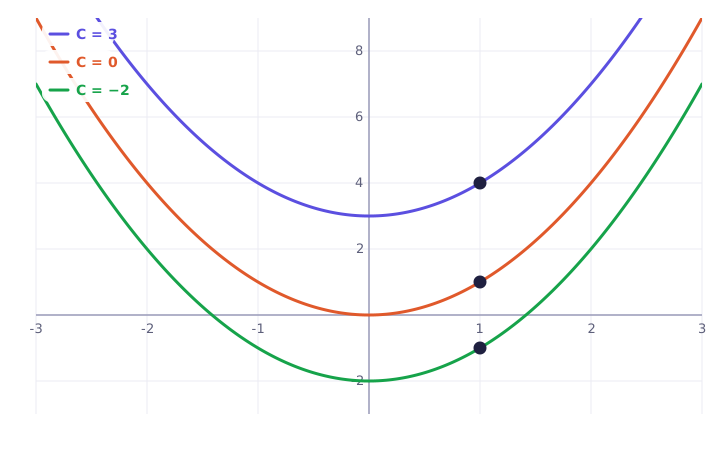
Leaving off +C is not a small style issue. It means you only found one member of the family, and in an initial value problem it makes the answer impossible to get right.
The reverse power rule
The power rule says \frac{d}{dx}x^{n+1} = (n+1)x^n. Divide both sides by n + 1 and read it backwards:
In words: add one to the exponent, then divide by the new exponent.
The rule breaks at n = -1 because you would divide by zero. That case has its own answer:
The absolute value lets it work for negative x as well.
Two more rules make most problems routine. Constants factor out, and sums split:
Table of basic antiderivatives
Each line is a derivative rule read backwards. Check any row by differentiating the right side.
| Function f(x) | Antiderivative \int f(x)\,dx |
|---|---|
| k (a constant) | kx + C |
| x^n, n \ne -1 | \frac{x^{n+1}}{n+1} + C |
| \frac{1}{x} | \ln\lvert x\rvert + C |
| e^x | e^x + C |
| a^x | \frac{a^x}{\ln a} + C |
| \cos x | \sin x + C |
| \sin x | -\cos x + C |
| \sec^2 x | \tan x + C |
| \sec x \tan x | \sec x + C |
| \frac{1}{1 + x^2} | \arctan x + C |
| \frac{1}{\sqrt{1-x^2}} | \arcsin x + C |
Watch the signs on the trig rows. The derivative of \cos x is -\sin x, so the antiderivative of \sin x is -\cos x.
Worked example 1: a polynomial
Find \int (3x^2 - 4x + 5)\,dx.
Step 1. Split into terms. Integrate 3x^2, -4x and 5 separately.
Step 2. Reverse power rule on each.
- \int 3x^2\,dx = 3 \cdot \frac{x^3}{3} = x^3
- \int -4x\,dx = -4 \cdot \frac{x^2}{2} = -2x^2
- \int 5\,dx = 5x
Step 3. Add one constant.
Check: \frac{d}{dx}(x^3 - 2x^2 + 5x + C) = 3x^2 - 4x + 5. One +C at the end is enough, since several constants add up to one constant.
Worked example 2: roots and fractions
Find \int \left(\sqrt{x} + \frac{1}{x^2}\right) dx.
Step 1. Rewrite as powers. \sqrt{x} = x^{1/2} and \frac{1}{x^2} = x^{-2}.
Step 2. Reverse power rule.
- \int x^{1/2}\,dx = \frac{x^{3/2}}{3/2} = \frac{2}{3}x^{3/2}
- \int x^{-2}\,dx = \frac{x^{-1}}{-1} = -\frac{1}{x}
Step 3. Combine.
Dividing by a fraction like \frac{3}{2} is the same as multiplying by \frac{2}{3}. That step trips up a lot of people.
Worked example 3: simplify first
Find \int \frac{x^2 + 1}{x}\,dx.
There is no quotient rule for integrals, so simplify before integrating. Divide each term by x:
Now integrate term by term:
Worked example 4: trig and exponentials
Find \int (2\cos x - 3e^x)\,dx.
Using the table, \int \cos x\,dx = \sin x and \int e^x\,dx = e^x:
Check: \frac{d}{dx}(2\sin x - 3e^x) = 2\cos x - 3e^x.
Two more table entries in action: find \int \left(\frac{4}{1 + x^2} + \sec^2 x\right) dx. Each term is a row of the table with a constant in front:
How to check any antiderivative
Integration is hard; differentiation is easy. So every antiderivative comes with a free check: differentiate your answer and see whether you get the integrand back. If \frac{d}{dx}F(x) = f(x), you are right, no matter what method you used.
This catches almost every slip. Suppose you wrote \int x^{-1/2}\,dx = \frac{x^{1/2}}{1/2} and then simplified it to \frac{1}{2}\sqrt{x}. Differentiating gives \frac{1}{4}x^{-1/2}, which is not x^{-1/2}, so you know something went wrong (the correct answer is 2\sqrt{x} + C). Make the check a habit on every problem until the rules feel automatic.
Initial value problems: finding the exact C
An initial value problem gives you a derivative and one point on the original function. The point picks out exactly one curve from the family F(x) + C.
Worked example 5: find f from f' and one point
Find f(x) if f'(x) = 6x^2 - 2x and f(1) = 4.
Step 1. Antidifferentiate.
Step 2. Use the point. Substitute x = 1 and f(1) = 4:
Step 3. Write the answer.
Worked example 6: motion from acceleration
A ball is thrown straight up from the ground at 48 ft/s. Its acceleration is a(t) = -32 ft/s². Find its height s(t) and its maximum height.
Step 1. Velocity. v(t) = \int -32\,dt = -32t + C_1. At launch v(0) = 48, so C_1 = 48 and v(t) = -32t + 48.
Step 2. Position. s(t) = \int (-32t + 48)\,dt = -16t^2 + 48t + C_2. It starts on the ground, s(0) = 0, so C_2 = 0:
Step 3. Maximum height. The ball peaks when v(t) = 0, at t = 1.5 s. Then s(1.5) = -16(2.25) + 72 = 36 ft.
Each antiderivative needed its own constant, and each was fixed by its own initial condition.
Worked example 7: starting from the second derivative
Find f(x) if f''(x) = 12x, f'(0) = 1 and f(0) = 2.
Step 1. f'(x) = 6x^2 + C_1. Since f'(0) = 1, C_1 = 1, so f'(x) = 6x^2 + 1.
Step 2. f(x) = 2x^3 + x + C_2. Since f(0) = 2, C_2 = 2.
Check: f'(x) = 6x^2 + 1 and f''(x) = 12x, with f'(0) = 1 and f(0) = 2. Two integrations always need two conditions.
Common antiderivative mistakes
- Forgetting +C. It costs marks on indefinite integrals and ruins initial value problems.
- Using the reverse power rule on \frac{1}{x}. \frac{x^0}{0} is undefined. The answer is \ln|x| + C.
- Integrating products or quotients piece by piece. \int x \cdot x^2\,dx is not \frac{x^2}{2}\cdot\frac{x^3}{3}. Multiply out first to get \int x^3\,dx = \frac{x^4}{4} + C.
- Sign slips with trig. \int \sin x\,dx = -\cos x + C, not \cos x + C.
- Not rewriting roots and fractions. \int \frac{1}{\sqrt{x}}\,dx looks hard until you write it as \int x^{-1/2}\,dx = 2\sqrt{x} + C.
When the integrand is a composite function, such as (3x + 1)^5, the basic table is not enough. That is the job of u-substitution. And antiderivatives are exactly what you need to compute areas with the fundamental theorem of calculus.
Practice until it is automatic
Antiderivatives are the foundation of every integral you will ever compute, so speed here pays off for the rest of the course. Work through the interactive lesson below: each answer is checked instantly, missing constants are flagged, and every solution is shown step by step.
Practice it now
The reverse power rule
Solve real problems on this topic with instant feedback, hints and a step-by-step walkthrough for every answer. Free, no sign-up needed to start.
Practice this lesson