Mean Value Theorem: Statement, Rolle's Theorem and Finding c
Understand the mean value theorem with graphs: what it says, Rolle's theorem, how to find the value of c step by step, and when the theorem does not apply.
By the PracticeCalculus team Published 7 min read
On this page
- What the mean value theorem says
- The mean value theorem on a graph
- How to find c in the mean value theorem
- Worked example 1: a parabola
- Worked example 2: a cubic (the graph above)
- Worked example 3: a square root
- Rolle's theorem: the special case
- When the mean value theorem does not apply
- Why the mean value theorem matters
- Quick reference
- Common mistakes with the mean value theorem
- Practice finding c
Your teacher writes "verify that the mean value theorem applies and find all values of c" and the theorem looks like an abstract existence statement with no obvious use. In fact the mean value theorem says something you already believe about driving, and finding c takes about four lines of algebra once you see the pattern.
What the mean value theorem says
The mean value theorem (MVT) says that over any smooth stretch of a function, the instantaneous rate of change equals the average rate of change at least once.
Formally: if f is continuous on [a, b] and differentiable on (a, b), then there is at least one number c with a < c < b such that
The right side is the slope of the secant line through (a, f(a)) and (b, f(b)), the average rate of change. The left side is the slope of the tangent line at c, the instantaneous rate of change. So the theorem says: somewhere between a and b, the tangent line is parallel to the secant line.
A real-life version: you drive 120 miles in exactly 2 hours. Your average speed is 60 mph. You cannot have been below 60 the whole time (you would not have made it) or above 60 the whole time (you would have gone further). So at some instant your speed was exactly 60 mph.
The mean value theorem on a graph
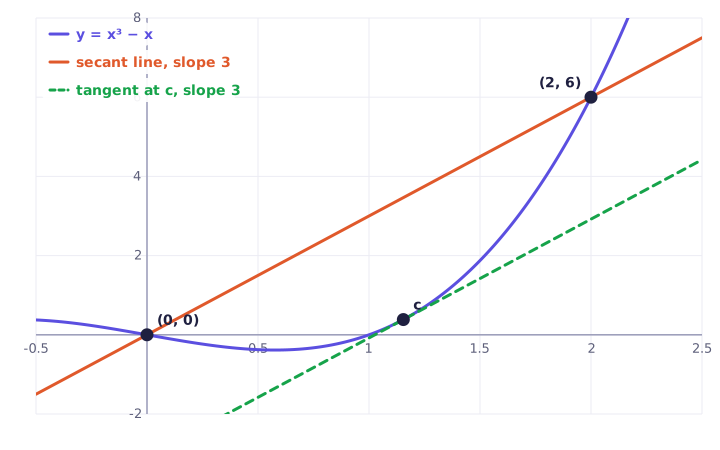
Slide the secant line sideways without turning it. Before it leaves the curve completely, it touches the curve at a single point. That point of tangency is c.
How to find c in the mean value theorem
- Check the hypotheses. Is f continuous on [a, b] and differentiable on (a, b)? Polynomials, \sin, \cos and e^x always are. Watch for denominators that hit zero, roots of negative numbers, and absolute values.
- Compute the average slope \frac{f(b) - f(a)}{b - a}.
- Set f'(c) equal to that slope and solve for c.
- Keep only solutions with a < c < b. Throw away anything outside or on the endpoints.
Worked example 1: a parabola
Find c for f(x) = x^2 on [1, 3].
Step 1. f is a polynomial, so the hypotheses hold.
Step 2. f(1) = 1 and f(3) = 9, so the average slope is
Step 3. f'(x) = 2x, so 2c = 4 and c = 2.
Step 4. 2 is in (1, 3). So c = 2.
For any parabola, c is always the midpoint of the interval. That makes a nice check.
Worked example 2: a cubic (the graph above)
Find all c for f(x) = x^3 - x on [0, 2].
Step 1. Polynomial, so the hypotheses hold.
Step 2. f(0) = 0 and f(2) = 8 - 2 = 6, so the average slope is \frac{6 - 0}{2 - 0} = 3.
Step 3. f'(x) = 3x^2 - 1. Set it equal to 3:
Step 4. -\frac{2}{\sqrt{3}} is outside (0, 2), so discard it. The answer is c = \frac{2}{\sqrt{3}} \approx 1.155.
Worked example 3: a square root
Find c for f(x) = \sqrt{x} on [0, 4].
Step 1. \sqrt{x} is continuous on [0, 4]. It is not differentiable at 0 (the tangent is vertical there), but the theorem only requires differentiability on the open interval (0, 4), and that holds.
Step 2. Average slope: \frac{\sqrt{4} - \sqrt{0}}{4 - 0} = \frac{2}{4} = \frac{1}{2}.
Step 3. f'(x) = \frac{1}{2\sqrt{x}}, so
Step 4. 1 is in (0, 4). So c = 1.
Rolle's theorem: the special case
Rolle's theorem is the mean value theorem when the endpoints are at the same height. If f is continuous on [a, b], differentiable on (a, b), and f(a) = f(b), then there is a c in (a, b) with
The secant line is horizontal, so the parallel tangent is horizontal too. Picture throwing a ball straight up and catching it at the same height: at the top, its velocity is zero.
Worked example 4: Rolle's theorem
Verify Rolle's theorem for f(x) = x^2 - 4x + 3 on [1, 3] and find c.
Step 1. Polynomial, so continuous and differentiable everywhere.
Step 2. Check the endpoints: f(1) = 1 - 4 + 3 = 0 and f(3) = 9 - 12 + 3 = 0. They match.
Step 3. f'(x) = 2x - 4 = 0 gives c = 2, which is in (1, 3).
Another classic: f(x) = \sin x on [0, \pi] has f(0) = f(\pi) = 0, and f'(c) = \cos c = 0 at c = \frac{\pi}{2}, the top of the arch.
When the mean value theorem does not apply
Both hypotheses matter. Here are two functions where the conclusion fails because a hypothesis fails.
A sharp corner. f(x) = |x| on [-1, 1]. The endpoints are both 1, so the average slope is 0. But f'(x) is -1 or 1 everywhere except x = 0, where it does not exist. No c works, because |x| is not differentiable at 0.
A break. f(x) = \frac{1}{x} on [-1, 1]. The average slope is \frac{1 - (-1)}{2} = 1, but f'(x) = -\frac{1}{x^2} is always negative. No c works, because f is not even defined (let alone continuous) at 0.
Tip: when a question asks whether the MVT applies, name the specific point and the specific hypothesis that fails. "Not differentiable at x = 0" earns the marks; "it doesn't work" does not.
Why the mean value theorem matters
The MVT is the bridge between a derivative and actual change, and it proves results you use constantly:
- Zero derivative means constant. If f'(x) = 0 on an interval, then f(b) - f(a) = f'(c)(b - a) = 0 for any a, b, so f never changes. This is why two antiderivatives of the same function differ by a constant C.
- Positive derivative means increasing. If f' > 0, then f(b) - f(a) = f'(c)(b - a) > 0 whenever b > a. This underpins curve sketching.
- Bounds. Suppose f(0) = 2 and f'(x) \le 5 for all x. How large can f(3) be? By the MVT, f(3) - f(0) = 3f'(c) \le 15, so f(3) \le 17.
Quick reference
| Theorem | Hypotheses | Conclusion |
|---|---|---|
| Mean value theorem | Continuous on [a, b], differentiable on (a, b) | f'(c) = \frac{f(b) - f(a)}{b - a} |
| Rolle's theorem | Same, plus f(a) = f(b) | f'(c) = 0 |
| Consequence | f'(x) = 0 on an interval | f is constant there |
| Consequence | \lvert f'(x) \rvert \le M on (a, b) | \lvert f(b) - f(a) \rvert \le M(b - a) |
Common mistakes with the mean value theorem
- Skipping the hypothesis check. Many questions are designed so that the theorem does not apply. Always check for corners, asymptotes and domain problems first.
- Keeping the wrong solutions. In example 2, c = -\frac{2}{\sqrt{3}} solves the equation but is not in (0, 2). The interval is part of the answer.
- Mixing up f and f'. You set the derivative at c equal to the average slope, not f(c).
- Thinking the theorem tells you where c is. It only guarantees existence. You find c by solving.
- Requiring differentiability at the endpoints. Only the open interval matters, which is why \sqrt{x} on [0, 4] is fine.
Practice finding c
The MVT becomes routine quickly: check, compute the slope, solve, filter. The interactive lesson below gives you functions to test, catches the solutions that fall outside the interval, and explains the fix whenever a step goes wrong. A few rounds and you will spot a failing hypothesis at a glance.
Practice it now
Tangent lines at work
Solve real problems on this topic with instant feedback, hints and a step-by-step walkthrough for every answer. Free, no sign-up needed to start.
Practice this lesson