How to Evaluate Limits: 5 Methods With Worked Examples
Evaluate limits step by step: direct substitution, factor and cancel, rationalizing, special trig limits, and a flowchart for picking a method.
By the PracticeCalculus team Published 7 min read
On this page
- The first rule: always try direct substitution
- Method 2: factor and cancel
- Method 3: rationalize with the conjugate
- Method 4: special trig limits
- Method 5: nonzero over zero means an asymptote
- A decision flowchart for any limit
- Common mistakes when evaluating limits
- Quick reference
- Make these methods automatic
You know what a limit means, but when a homework problem says "evaluate \lim_{x \to 3} \frac{x^2 - 9}{x - 3}," what do you actually do? The good news is that almost every limit in a first calculus course yields to one of a handful of techniques, and there is a reliable way to pick the right one.
This guide gives you each method, a fully worked example for each, and a decision flowchart (in words) you can follow on any exam.
The first rule: always try direct substitution
Most functions you meet (polynomials, rational functions, roots, trig, exponentials and logarithms) are continuous wherever they are defined. For a continuous function, the limit is simply the function value:
So the first move is always the same: plug in a and see what happens. There are only three possible outcomes:
| Substitution gives | What it means | What to do |
|---|---|---|
| A real number, like 7 | The limit is that number | Stop. You are done. |
| \frac{0}{0} | Indeterminate form | Simplify, then substitute again |
| \frac{k}{0} with k \neq 0 | Vertical asymptote | Check signs from each side |
Worked example 1: direct substitution
Evaluate \lim_{x \to 2} (x^2 + 3x - 1).
Step 1. Substitute. 2^2 + 3(2) - 1 = 4 + 6 - 1 = 9.
Step 2. Check the result. It is a real number, so
The same works for \lim_{x \to \pi} \cos x = \cos \pi = -1 and \lim_{x \to 1} \frac{x + 4}{x + 1} = \frac{5}{2}. If substitution works, no other technique is needed.
Method 2: factor and cancel
When substitution produces \frac{0}{0}, the numerator and denominator both vanish at x = a. For polynomials, that means both contain the factor (x - a). Factor it out, cancel it, and substitute again.
Canceling is legal because a limit as x \to a never uses x = a itself, so x - a \neq 0 throughout the calculation.
Worked example 2: a difference of squares
Evaluate \lim_{x \to 3} \frac{x^2 - 9}{x - 3}.
Step 1. Substitute. \frac{9 - 9}{3 - 3} = \frac{0}{0}. Indeterminate, so simplify.
Step 2. Factor. x^2 - 9 = (x - 3)(x + 3).
Step 3. Cancel the common factor.
Step 4. Substitute again.
Worked example 3: factoring a trinomial
Evaluate \lim_{x \to -2} \frac{x^2 + 5x + 6}{x^2 - 4}.
Step 1. Substitute. Top: 4 - 10 + 6 = 0. Bottom: 4 - 4 = 0. Indeterminate.
Step 2. Factor both. x^2 + 5x + 6 = (x + 2)(x + 3) and x^2 - 4 = (x + 2)(x - 2).
Step 3. Cancel and substitute.
Tip: if substitution gives \frac{0}{0} at x = a for a polynomial ratio, you know (x - a) is a factor of both top and bottom. Use that to guide your factoring (or polynomial division).
Method 3: rationalize with the conjugate
When the \frac{0}{0} comes from a square root in a sum or difference, factoring will not help. Instead multiply the numerator and denominator by the conjugate. The conjugate of \sqrt{A} - B is \sqrt{A} + B, and their product is A - B^2, which has no root.
Worked example 4: rationalizing the numerator
Evaluate \lim_{x \to 0} \frac{\sqrt{x + 4} - 2}{x}.
Step 1. Substitute. \frac{\sqrt{4} - 2}{0} = \frac{0}{0}. Indeterminate.
Step 2. Multiply by the conjugate over itself.
Step 3. Simplify the top. (x+4) - 4 = x, so the expression becomes
Step 4. Substitute again.
Notice that we deliberately did not multiply out the bottom. Leaving x(\sqrt{x+4}+2) factored is what made the cancellation visible.
Method 4: special trig limits
Trig expressions often give \frac{0}{0} in a way no algebra can untangle. For these you rely on two standard limits, both with x in radians:
The first is usually proved with the squeeze theorem and a picture of the unit circle. The graph shows what it says: \frac{\sin x}{x} is undefined at 0, but it heads straight to 1.
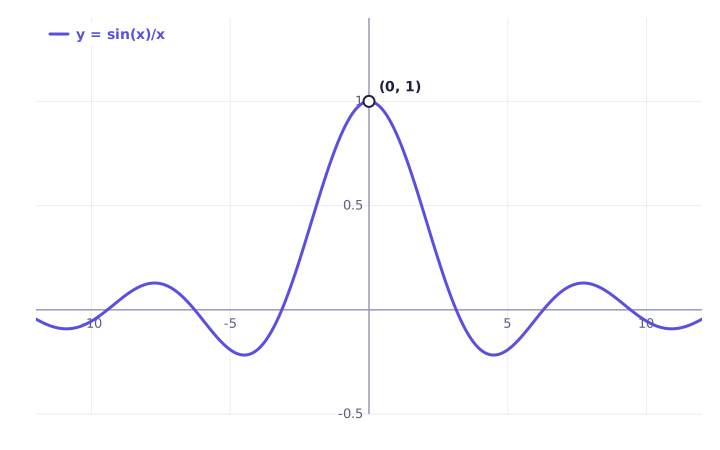
The trick with these limits is to make the argument of the sine match the denominator exactly.
Worked example 5: adjusting the argument
Evaluate \lim_{x \to 0} \frac{\sin(5x)}{x}.
Step 1. Substitute. \frac{\sin 0}{0} = \frac{0}{0}.
Step 2. Make the denominator match the argument. Multiply top and bottom by 5:
Step 3. Use the special limit. As x \to 0, u = 5x \to 0 too, so \frac{\sin(5x)}{5x} \to 1:
The same idea gives \lim_{x \to 0} \frac{\sin(3x)}{\sin(7x)} = \frac{3}{7} (write it as \frac{3}{7} \cdot \frac{\sin 3x}{3x} \cdot \frac{7x}{\sin 7x}) and \lim_{x \to 0} \frac{\tan x}{x} = 1 (write \frac{\tan x}{x} = \frac{\sin x}{x} \cdot \frac{1}{\cos x}, which approaches 1 \cdot 1).
Method 5: nonzero over zero means an asymptote
If substitution gives a nonzero number over 0, no amount of algebra will produce a finite limit. The function blows up. Your job is to find the direction on each side.
Worked example 6: checking signs
Evaluate \lim_{x \to 2} \frac{x + 1}{x - 2}.
Step 1. Substitute. \frac{3}{0}. Nonzero over zero, so there is a vertical asymptote at x = 2.
Step 2. Right side. For x slightly more than 2 (say 2.01), the top is about 3 and the bottom is a tiny positive number, so the fraction is a huge positive number: \lim_{x \to 2^+} = +\infty.
Step 3. Left side. For x slightly less than 2, the bottom is a tiny negative number, so \lim_{x \to 2^-} = -\infty.
Step 4. Conclude. The sides disagree, so \lim_{x \to 2} \frac{x + 1}{x - 2} does not exist. (If both sides had gone to +\infty, as with \frac{1}{(x-2)^2}, you would write +\infty.)
A decision flowchart for any limit
Here is the whole process as a sequence of questions. Run through it in order.
- Is x heading to \pm\infty? If yes, this is a limit at infinity: compare the highest powers (see limits at infinity).
- Is the function piecewise, or does it contain an absolute value? If yes, compute the left and right limits separately and compare.
- Substitute. If you get a real number, that is the answer. Stop.
- Got \frac{k}{0} with k \neq 0? Vertical asymptote. Check the sign from each side.
- Got \frac{0}{0}? Look at what the expression contains:
- Polynomials: factor and cancel.
- A square root in a sum or difference: multiply by the conjugate.
- Fractions inside fractions: combine over a common denominator, then cancel.
- \sin, \cos or \tan of something going to 0: use the special trig limits.
- Still stuck, and you know derivatives? Use L'Hôpital's rule.
- After simplifying, go back to step 3 and substitute again.
Common mistakes when evaluating limits
- Writing "= \frac{0}{0}" as the answer. \frac{0}{0} means "keep going," never "the limit is undefined."
- Dropping the \lim symbol too early. Write \lim_{x \to a} on every line until you actually substitute. Many teachers deduct points for \frac{x^2-9}{x-3} = x + 3 = 6, which is false as written.
- Canceling terms instead of factors. In \frac{x^2 - 9}{x - 3} you cannot cancel the x's or the 9 with the 3. Only whole factors cancel.
- Using degrees. \lim_{x \to 0} \frac{\sin x}{x} = 1 is true only in radians.
- Forgetting to check both sides at an asymptote. \frac{k}{0} alone does not tell you the sign of the infinity.
Quick reference
| Situation | Technique | Example | Limit |
|---|---|---|---|
| Substitution works | Direct substitution | \lim_{x \to 2} (x^2 + 3x - 1) | 9 |
| \frac{0}{0}, polynomials | Factor and cancel | \lim_{x \to 3} \frac{x^2-9}{x-3} | 6 |
| \frac{0}{0}, square root | Conjugate | \lim_{x \to 0} \frac{\sqrt{x+4}-2}{x} | \frac{1}{4} |
| \frac{0}{0}, trig | Special limits | \lim_{x \to 0} \frac{\sin 5x}{x} | 5 |
| \frac{k}{0} | Sign check | \lim_{x \to 2} \frac{x+1}{x-2} | does not exist |
Make these methods automatic
Recognizing which technique a limit needs is a pattern-matching skill, and patterns come from repetition. The interactive lesson below throws a steady mix of factor-and-cancel problems at you, checks every step instantly, and shows the full solution whenever you get stuck. Ten minutes of practice will make the flowchart above second nature.
Practice it now
Factor and cancel
Solve real problems on this topic with instant feedback, hints and a step-by-step walkthrough for every answer. Free, no sign-up needed to start.
Practice this lesson