Derivative of x ln x: Formula, Steps and Examples
The derivative of x ln x is ln x + 1. See the product rule steps, the minimum at x = 1/e, the second derivative, a graph and similar examples.
Exponential and log derivatives Updated 2 min read
At a glance
- Derivative
- \ln x + 1 for x > 0
- Second derivative
- \dfrac{1}{x}
- Minimum
- x = \frac{1}{e}, value -\frac{1}{e} \approx -0.368
- Limit at 0
- \lim_{x \to 0^+} x\ln x = 0
- Integral
- \int x\ln x\,dx = \frac{x^2}{2}\ln x - \frac{x^2}{4} + C
On this page
The derivative of x\ln x is \ln x + 1. It is a product, so the product rule does all the work.
Step by step with the product rule
The product rule says (fg)' = f'g + fg'. Take f = x and g = \ln x:
- f' = 1.
- g' = \frac{1}{x}, from the derivative of ln x.
- Combine: 1\cdot\ln x + x\cdot\frac{1}{x} = \ln x + 1.
The x in front cancels the \frac{1}{x} from the log, leaving a clean answer.
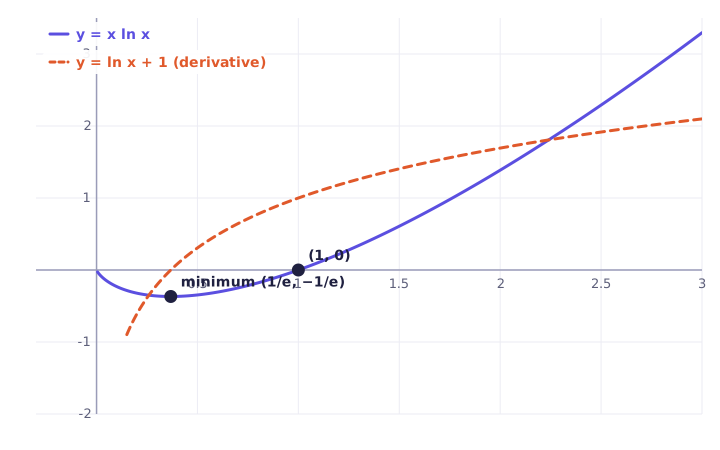
Graph of x ln x and its derivative
Finding the minimum
Set the derivative to zero:
For x < \frac{1}{e} the derivative is negative, and for x > \frac{1}{e} it is positive, so this is a minimum. Its value is
The second derivative confirms it: \frac{d^2}{dx^2}x\ln x = \frac{1}{x}, which is positive for every x > 0, so the curve is concave up everywhere.
What happens near x = 0
The graph seems to start at the origin, even though x\ln x is not defined at 0. That is because \lim_{x \to 0^+} x\ln x = 0. Write it as \frac{\ln x}{1/x} and apply L'Hôpital's rule:
Meanwhile the slope \ln x + 1 goes to -\infty, so the curve leaves the origin almost vertically.
Related examples
Example 1. \frac{d}{dx}(x\ln x - x) = \ln x + 1 - 1 = \ln x. This shows x\ln x - x is an antiderivative of \ln x; see the integral of ln x.
Example 2. \frac{d}{dx}x^2\ln x = 2x\ln x + x^2\cdot\frac{1}{x} = 2x\ln x + x = x(2\ln x + 1).
Example 3. \frac{d}{dx}\frac{\ln x}{x} = \frac{\frac{1}{x}\cdot x - \ln x}{x^2} = \frac{1 - \ln x}{x^2}, by the quotient rule. Its maximum is at x = e.
Example 4. \frac{d}{dx}x\ln(3x) = \ln(3x) + 1, since \frac{d}{dx}\ln(3x) = \frac{1}{x} too.
Common mistakes
- Multiplying the derivatives. 1\cdot\frac{1}{x} = \frac{1}{x} is not the product rule. You need both terms.
- Forgetting the domain. x\ln x only exists for x > 0, so the minimum search only happens there.
- Mixing it up with x^x. \frac{d}{dx}x^x = x^x(\ln x + 1). The factor \ln x + 1 appears because x^x = e^{x\ln x}; see the derivative of xˣ.
To go the other way, the integral of x ln x uses integration by parts. Practise more product rule problems on product and quotient rules.
Practice it now
The product rule
Solve real problems on this topic with instant feedback, hints and a step-by-step walkthrough for every answer. Free, no sign-up needed to start.
Practice this lesson