Derivative of xeˣ: Formula, Steps and Examples
The derivative of xeˣ is eˣ(x + 1). See the product rule steps, the minimum at x = −1, the nth derivative pattern, a graph and worked examples.
Exponential and log derivatives Updated 2 min read
At a glance
- Derivative
- e^x(x + 1)
- Second derivative
- e^x(x + 2)
- nth derivative
- e^x(x + n)
- Minimum
- x = -1, value -\frac{1}{e} \approx -0.368
- Integral
- \int xe^x\,dx = e^x(x - 1) + C
On this page
The derivative of xe^x is e^x(x + 1). It is a product of x and e^x, so the product rule is the tool to use.
Step by step with the product rule
With f = x and g = e^x, the product rule (fg)' = f'g + fg' gives:
- f' = 1.
- g' = e^x, since the derivative of eˣ is itself.
- Combine: 1\cdot e^x + x\cdot e^x = e^x + xe^x.
- Factor out e^x: e^x(x + 1).
The factored form is more useful. Because e^x is never zero, the derivative is zero only where x + 1 = 0.
Graph of xeˣ and its derivative
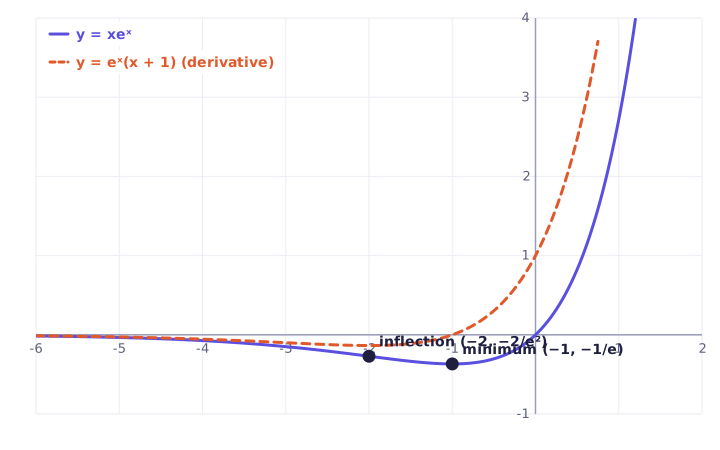
Minimum and inflection point
Minimum. The derivative e^x(x + 1) is negative for x < -1 and positive for x > -1. So x = -1 is a minimum, with value
Inflection point. The second derivative is
It changes sign at x = -2, so the graph switches from concave down to concave up there. The point is \left(-2, -\frac{2}{e^2}\right) \approx (-2, -0.271).
The nth derivative pattern
Every time you differentiate e^x(x + k), you get e^x(x + k) + e^x = e^x(x + k + 1). So:
| Derivative | Result |
|---|---|
| f'(x) | e^x(x + 1) |
| f''(x) | e^x(x + 2) |
| f'''(x) | e^x(x + 3) |
| f^{(n)}(x) | e^x(x + n) |
Worked examples
Example 1: decaying version. For f(x) = xe^{-x}, use the chain rule on e^{-x} (see e^(−x)):
Now the critical point is a maximum at x = 1.
Example 2: a bigger power. For g(x) = x^2e^x,
Critical points are at x = 0 and x = -2.
Example 3: a scaled exponent. For h(x) = xe^{3x},
Example 4: a tangent line. At x = 0, xe^x = 0 and the slope is e^0(0 + 1) = 1. The tangent line is y = x.
Common mistakes
- Multiplying the two derivatives. 1\cdot e^x = e^x is not the product rule; it drops the xe^x term.
- Writing xe^x as the answer. The derivative of e^x is e^x, but the product with x still needs the product rule.
- Not factoring. Leaving e^x + xe^x is correct, but factoring makes it far easier to find critical points.
Going backwards, \int xe^x\,dx = e^x(x - 1) + C by integration by parts; see the integral of xeˣ. Check it: \frac{d}{dx}e^x(x - 1) = e^x(x - 1) + e^x = xe^x. Practise with product and quotient rule problems.
Practice it now
The product rule
Solve real problems on this topic with instant feedback, hints and a step-by-step walkthrough for every answer. Free, no sign-up needed to start.
Practice this lesson