Area Between Curves: Top Minus Bottom, Step by Step
Find the area between two curves step by step: top minus bottom, finding intersection points, curves that cross, and when to integrate with respect to y.
By the PracticeCalculus team Published 6 min read
On this page
- The formula for the area between two curves
- How to find the area between curves in 5 steps
- Worked example 1: a line and a parabola
- Worked example 2: a downward parabola and a line
- Worked example 3: curves that cross
- Integrating with respect to y
- Quick reference: dx or dy?
- Common mistakes with area between curves
- Practice finding areas between curves
You know how to find the area under one curve. But what about the area trapped between a parabola and a line, or between \sin x and \cos x? The idea is simple (subtract the bottom from the top), and the real work is in finding where the curves meet and keeping track of which one is on top.
The formula for the area between two curves
If f(x) \ge g(x) on [a, b], the area of the region between them is
In words: top minus bottom, integrated from left to right.
Why does it work? Slice the region into thin vertical strips. Each strip has width dx and height equal to the gap between the curves, f(x) - g(x). Adding up all the strips is exactly what the integral does. It does not matter whether the curves are above or below the x-axis: the gap is the gap.
How to find the area between curves in 5 steps
- Sketch the curves, even roughly.
- Find the intersections by setting the two functions equal and solving. These are usually your limits.
- Decide which curve is on top using a test point between the intersections.
- Set up \int_a^b (\text{top} - \text{bottom})\,dx.
- Integrate and evaluate with the fundamental theorem of calculus.
Worked example 1: a line and a parabola
Find the area between y = x and y = x^2.
Step 1. Intersections. Set x = x^2, so x^2 - x = 0, x(x - 1) = 0, giving x = 0 and x = 1.
Step 2. Which is on top? Test x = \frac{1}{2}: the line gives 0.5, the parabola gives 0.25. The line is on top.
Step 3. Set up and integrate.
Worked example 2: a downward parabola and a line
Find the area of the region bounded by y = 4 - x^2 and y = x + 2.
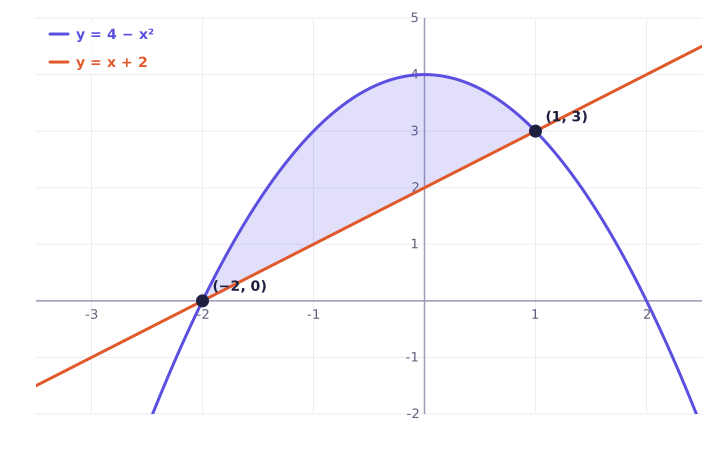
Step 1. Intersections. Set 4 - x^2 = x + 2:
Step 2. Which is on top? Test x = 0: the parabola gives 4, the line gives 2. The parabola is on top.
Step 3. Set up. Top minus bottom simplifies first:
Step 4. Integrate.
At x = 1: 2 - \frac{1}{2} - \frac{1}{3} = \frac{7}{6}.
At x = -2: -4 - 2 + \frac{8}{3} = -\frac{10}{3}.
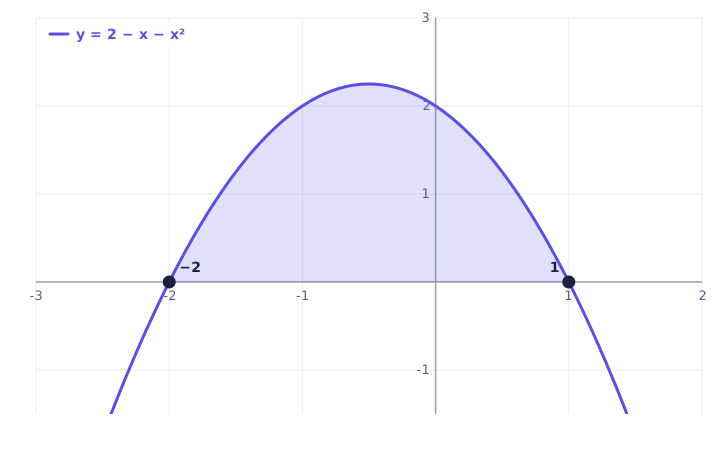
The graph below shows the same idea in a different way. The area between two curves equals the area under their difference f(x) - g(x), which here is the parabola y = 2 - x - x^2.
Worked example 3: curves that cross
Find the area between y = \sin x and y = \cos x from x = 0 to x = \frac{\pi}{2}.
Step 1. Intersections. \sin x = \cos x when \tan x = 1, so x = \frac{\pi}{4} in this interval. The curves cross inside the interval.
Step 2. Which is on top, piece by piece?
- On [0, \frac{\pi}{4}]: at x = 0, \cos 0 = 1 > \sin 0 = 0. Cosine is on top.
- On [\frac{\pi}{4}, \frac{\pi}{2}]: at x = \frac{\pi}{2}, \sin = 1 > \cos = 0. Sine is on top.
Step 3. Split and integrate.
Step 4. Add.
If you had integrated \cos x - \sin x over the whole interval without splitting, the two pieces would cancel and you would get 0, which is clearly not the area.
Tip: a compact way to write this is A = \int_a^b |f(x) - g(x)|\,dx. The absolute value is a reminder to split wherever the curves cross.
Integrating with respect to y
Some regions are awkward to slice vertically. If the region is bounded on the left and right by curves of the form x = h(y), slice it horizontally instead:
where c and d are y-values.
Worked example 4: a sideways parabola and a line
Find the area between x = y^2 and y = x - 2.
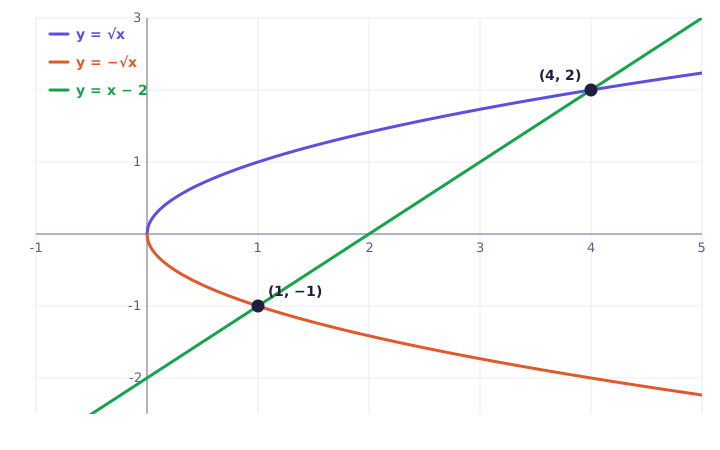
Step 1. Rewrite both as x in terms of y. The parabola is x = y^2 and the line is x = y + 2.
Step 2. Intersections. y^2 = y + 2 gives y^2 - y - 2 = 0, so (y - 2)(y + 1) = 0 and y = -1 or y = 2.
Step 3. Which is on the right? Test y = 0: the line gives x = 2, the parabola gives x = 0. The line is on the right.
Step 4. Integrate.
At y = 2: 2 + 4 - \frac{8}{3} = \frac{10}{3}. At y = -1: \frac{1}{2} - 2 + \frac{1}{3} = -\frac{7}{6}.
In x, the bottom boundary changes at x = 1 (from -\sqrt{x} to the line), so you would need two integrals: \int_0^1 2\sqrt{x}\,dx + \int_1^4 (\sqrt{x} - x + 2)\,dx = \frac{4}{3} + \frac{19}{6} = \frac{9}{2}. Same answer, twice the work.
Quick reference: dx or dy?
| Situation | Slice | Formula |
|---|---|---|
| One curve on top, one on the bottom | Vertical | \int_a^b (\text{top} - \text{bottom})\,dx |
| One curve on the right, one on the left | Horizontal | \int_c^d (\text{right} - \text{left})\,dy |
| Top or bottom changes partway across | Try dy, or split the dx integral | |
| Curves cross inside the interval | Either | Split at each crossing |
Common mistakes with area between curves
- Bottom minus top. You get the right size with the wrong sign. If an area comes out negative, this is the first thing to check.
- Not splitting at crossings. Pieces cancel and the answer is too small, sometimes zero.
- Using x-limits in a dy integral. When integrating in y, the limits must be y-values of the intersection points.
- Losing a sign when simplifying. (4 - x^2) - (x + 2) is 2 - x - x^2. Distribute the minus sign over every term of the bottom curve.
- Guessing the limits. The limits come from solving f(x) = g(x), not from where the curves hit the axis, unless the problem says so.
Practice finding areas between curves
These problems follow the same five steps every time, and the hard part is usually the algebra of finding intersections. Practice builds the habit of sketching first. The interactive lesson below checks each setup and each answer instantly, so you learn to catch a flipped top and bottom before it costs you. Next, the same slicing idea gives you volumes of revolution.
Practice it now
Area between curves
Solve real problems on this topic with instant feedback, hints and a step-by-step walkthrough for every answer. Free, no sign-up needed to start.
Practice this lesson