Continuity in Calculus: Definition, Discontinuities and the IVT
Learn the three conditions for continuity, how to classify removable, jump and infinite discontinuities, and how to use the Intermediate Value Theorem.
By the PracticeCalculus team Published 7 min read
On this page
Informally, a continuous function is one you can draw without lifting your pencil. That picture is a great start, but exam questions ask you to prove continuity, find the value of k that makes a function continuous, or classify a discontinuity by type. For that you need the precise definition, and it turns out to be just three short checks.
The definition of continuity: three conditions
A function f is continuous at x = a when all three of these hold:
- f(a) is defined.
- \lim_{x \to a} f(x) exists (the left and right limits agree).
- The limit equals the function value:
In plain language: the graph heads to a certain height as you approach a, and the point at a is sitting exactly at that height.
A function is continuous on an interval if it is continuous at every point of the interval (with one-sided limits at closed endpoints). A function is simply called continuous when it is continuous at every point of its domain.
Which functions are continuous?
The good news is that almost every function you know is continuous wherever it is defined:
- polynomials, everywhere
- rational functions, everywhere except where the denominator is 0
- \sqrt{x} for x \ge 0, and other roots on their domains
- \sin x and \cos x everywhere; \tan x except at odd multiples of \frac{\pi}{2}
- e^x everywhere, and \ln x for x > 0
Sums, differences, products, quotients (where the bottom is not 0) and compositions of continuous functions are continuous too. So in practice, discontinuities live in only a few places: zeros of denominators, break points of piecewise functions, and edges of domains.
Types of discontinuity
When one of the three conditions fails, the way it fails tells you the type of discontinuity.
| Type | What the graph shows | Limit at a | Which condition fails |
|---|---|---|---|
| Removable | A hole (maybe with a stray point elsewhere) | Exists | 1 or 3 |
| Jump | The graph jumps between two heights | Does not exist (sides disagree) | 2 |
| Infinite | A vertical asymptote | Does not exist (unbounded) | 2 |
| Oscillating | Endless wiggling, like \sin(1/x) at 0 | Does not exist | 2 |
Removable discontinuities are the only ones you can fix by changing a single point. The others are called non-removable (or essential, in some books).
Removable and infinite discontinuities in one graph
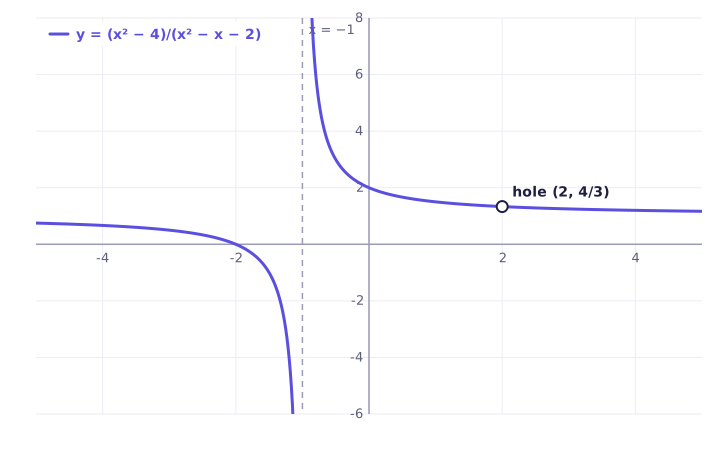
Consider
Factor top and bottom:
The denominator is 0 at x = 2 and at x = -1, so f is discontinuous at both. But they are different types.
- At x = 2, the factor (x - 2) cancels. For x \neq 2, f(x) = \frac{x + 2}{x + 1}, so \lim_{x \to 2} f(x) = \frac{4}{3}. The limit exists but f(2) does not: a removable discontinuity, a hole at \left(2, \frac{4}{3}\right).
- At x = -1, the factor (x + 1) remains in the denominator while the numerator x + 2 approaches 1, a nonzero value. The function blows up: an infinite discontinuity, a vertical asymptote x = -1.
Tip: for a rational function, factor completely. Factors that cancel give holes. Factors left in the denominator give vertical asymptotes.
Jump discontinuities
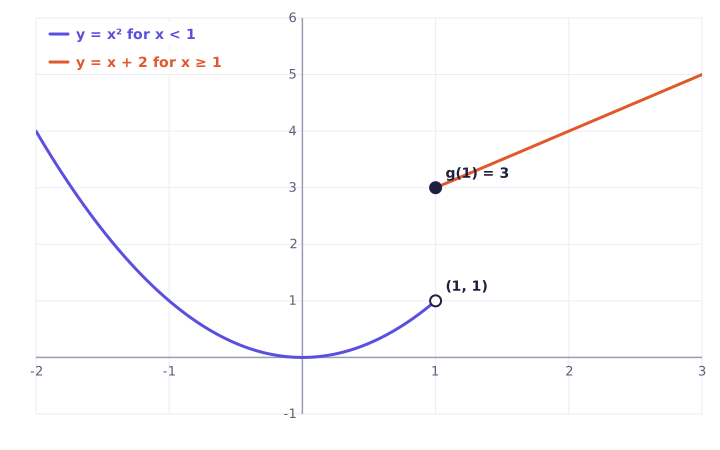
Jumps come from piecewise functions (and from expressions like \frac{|x|}{x}). Here is one:
The left-hand limit at 1 is 1^2 = 1 and the right-hand limit is 1 + 2 = 3. Both exist, but they disagree, so the graph jumps from height 1 to height 3.
Worked examples
Example 1: checking all three conditions
Is h(x) = \begin{cases} \frac{x^2 - 9}{x - 3} & x \neq 3 \\ 5 & x = 3 \end{cases} continuous at x = 3?
Step 1. Is h(3) defined? Yes, h(3) = 5.
Step 2. Does the limit exist? For x \neq 3, \frac{x^2-9}{x-3} = x + 3, so \lim_{x \to 3} h(x) = 6.
Step 3. Are they equal? 6 \neq 5. Condition 3 fails.
Conclusion. h has a removable discontinuity at x = 3. Redefining h(3) = 6 would make it continuous.
Example 2: finding k to make a piecewise function continuous
Find k so that f(x) = \begin{cases} kx + 1 & x < 2 \\ x^2 & x \geq 2 \end{cases} is continuous everywhere.
Step 1. Identify the only risky point. Each piece is a polynomial, so the only possible problem is the break at x = 2.
Step 2. Compute each side. Left: \lim_{x \to 2^-} (kx + 1) = 2k + 1. Right: \lim_{x \to 2^+} x^2 = 4. Function value: f(2) = 4.
Step 3. Set them equal and solve.
Check. With k = \frac{3}{2} the left piece gives \frac{3}{2}(2) + 1 = 4. Both sides meet at height 4.
Example 3: classifying a discontinuity
Classify the discontinuity of p(x) = \frac{x + 5}{x^2 - 25} at x = 5 and at x = -5.
Step 1. Factor. p(x) = \frac{x + 5}{(x - 5)(x + 5)}.
Step 2. At x = -5: the factor (x + 5) cancels, leaving \frac{1}{x - 5}, which approaches -\frac{1}{10}. Removable (a hole at \left(-5, -\frac{1}{10}\right)).
Step 3. At x = 5: after canceling, \frac{1}{x - 5} still has x - 5 in the denominator, and the numerator is 1 \neq 0. Infinite discontinuity, a vertical asymptote x = 5.
The Intermediate Value Theorem (IVT)
Continuity has a powerful consequence. If you walk continuously from one height to another, you must pass through every height in between.
Intermediate Value Theorem. If f is continuous on [a, b] and N is any number between f(a) and f(b), then there is at least one number c in (a, b) with
The most common use is to show that an equation has a solution, by taking N = 0: if a continuous function changes sign on an interval, it has a root there.
Example 4: proving a root exists
Show that x^3 + x - 1 = 0 has a solution between 0 and 1.
Step 1. Check continuity. f(x) = x^3 + x - 1 is a polynomial, so it is continuous on [0, 1].
Step 2. Evaluate the endpoints. f(0) = -1 and f(1) = 1 + 1 - 1 = 1.
Step 3. Apply the IVT. 0 is between -1 and 1, so there is some c in (0, 1) with f(c) = 0.
The IVT tells you a root exists, not where it is. (Here it is about 0.68.) Note that it requires continuity: \frac{1}{x} is negative at x = -1 and positive at x = 1, but it never equals 0, because it is not continuous on [-1, 1].
Continuity and differentiability
Continuity is the minimum requirement for a function to have a derivative. If f is differentiable at a, it must be continuous at a. A graph with a hole, jump or asymptote cannot have a tangent line there.
The reverse is false. A continuous function can still fail to be differentiable at a point:
- A corner. |x| is continuous at 0, but its slope is -1 on the left and 1 on the right, so there is no single tangent slope.
- A vertical tangent. \sqrt[3]{x} is continuous at 0, but its tangent line there is vertical, with undefined slope.
- A cusp. x^{2/3} is continuous at 0 but comes to a sharp point.
So when you study derivatives, remember the chain of implications: differentiable implies continuous, but continuous does not imply differentiable.
Common mistakes with continuity
- Checking only the limit. A limit can exist while the function value is missing or different. You must verify all three conditions.
- Calling every zero denominator an asymptote. Factor first. A factor that cancels gives a hole, not an asymptote.
- Matching only one side of a piecewise function. At a break point, compare the left limit, the right limit and the function value.
- Using the IVT without continuity. The theorem says nothing about functions with jumps or asymptotes in the interval.
- Expecting the IVT to give the value of c. It only guarantees that c exists.
Practice spotting discontinuities
Classifying discontinuities and solving for k are among the most common exam questions on limits, and both follow a fixed recipe. The interactive lesson below gives you graphs and formulas to analyze, checks each condition you claim instantly, and explains any step you miss. Continuity also sets you up for the next big idea, the derivative, since every differentiable function is continuous.
Practice it now
Continuity
Solve real problems on this topic with instant feedback, hints and a step-by-step walkthrough for every answer. Free, no sign-up needed to start.
Practice this lesson