Series Convergence Tests: Which Test to Use and When
Every series convergence test with examples: nth-term, integral, p-series, comparison, ratio, root and alternating, plus a which-test table.
By the PracticeCalculus team Published 7 min read
On this page
- What does it mean for a series to converge?
- 1. The nth-term test for divergence
- 2. Geometric series
- 3. The p-series test
- 4. The integral test
- 5. The direct comparison test
- 6. The limit comparison test
- 7. The ratio test
- 8. The root test
- 9. The alternating series test
- Which convergence test should you use?
- Common convergence test mistakes
- Practice choosing the right test
You are staring at \sum \frac{3^n}{n!} and you know there are eight different convergence tests, but which one? Most series questions are not hard once you pick the right test. The hard part is the picking. This guide covers every standard convergence test with a worked example, then gives you a decision table for choosing quickly.
What does it mean for a series to converge?
A series \sum a_n converges if its partial sums S_N = a_1 + a_2 + \cdots + a_N approach a finite number as N \to \infty. Otherwise it diverges.
Most of the time you cannot compute the sum exactly (geometric series are the big exception). Convergence tests answer a simpler question: does the sum exist at all? Each test below gives a converges, diverges, or inconclusive verdict.
1. The nth-term test for divergence
Example. \sum \frac{n}{2n+1}. The terms approach \frac12, not 0. Adding infinitely many numbers close to \frac12 cannot give a finite total, so the series diverges.
Tip: this test can never prove convergence. If a_n \to 0, the test says nothing and you must try another one.
2. Geometric series
Example. \sum \frac{5}{4^n} has r = \frac14, so it converges.
3. The p-series test
Examples. \sum \frac{1}{n^{3/2}} converges (p = 1.5). \sum \frac{1}{\sqrt n} diverges (p = 0.5). The harmonic series \sum \frac1n (p = 1) diverges, even though its terms shrink to 0.
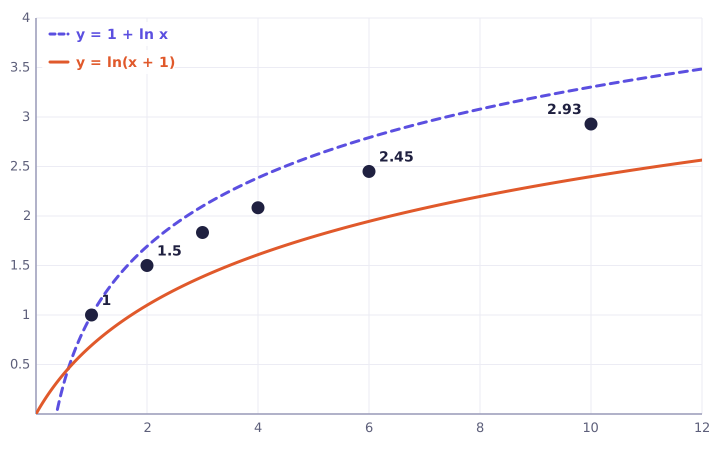
The harmonic series diverges extremely slowly. Its partial sums grow like \ln N: you need more than 12,000 terms just to pass 10. The graph shows the partial sums trapped between two logarithm curves, both of which go to infinity.
4. The integral test
If f is positive, continuous and decreasing for x \ge N, and a_n = f(n), then
Example. Does \sum_{n=2}^\infty \frac{1}{n\ln n} converge?
Step 1. Check the conditions. f(x) = \frac{1}{x\ln x} is positive, continuous and decreasing for x \ge 2.
Step 2. Evaluate the improper integral. With u = \ln x, du = \frac1x\,dx:
Step 3. Conclude. The integral diverges, so the series diverges.
The integral test is also where the p-series rule comes from: \int_1^\infty \frac{dx}{x^p} converges exactly when p > 1.
5. The direct comparison test
Suppose 0 \le a_n \le b_n for all large n.
- If \sum b_n converges, then the smaller \sum a_n converges.
- If \sum a_n diverges, then the larger \sum b_n diverges.
Example (convergence). \sum \frac{1}{n^2 + 5}. Since n^2 + 5 > n^2, we have \frac{1}{n^2+5} < \frac{1}{n^2}. The p-series \sum \frac{1}{n^2} converges, so this series converges.
Example (divergence). \sum_{n=3}^\infty \frac{\ln n}{n}. For n \ge 3, \ln n > 1, so \frac{\ln n}{n} > \frac1n. The harmonic series diverges, so this series diverges.
6. The limit comparison test
Direct comparison needs an inequality in the right direction, which can be awkward. The limit comparison test only needs the terms to behave alike. If a_n, b_n > 0 and
then \sum a_n and \sum b_n either both converge or both diverge.
Example. Does \sum \frac{2n+3}{n^3+1} converge?
Step 1. Pick b_n from the dominant terms. For large n, \frac{2n+3}{n^3+1} behaves like \frac{2n}{n^3} = \frac{2}{n^2}. Take b_n = \frac1{n^2}.
Step 2. Compute the limit.
Step 3. Conclude. L = 2 is positive and finite, and \sum\frac1{n^2} converges, so the original series converges.
7. The ratio test
Let
If L < 1 the series converges (absolutely). If L > 1 it diverges. If L = 1 the test is inconclusive.
Example. Does \sum \frac{3^n}{n!} converge?
Step 1. Form the ratio.
Step 2. Take the limit. \frac{3}{n+1} \to 0.
Step 3. Conclude. L = 0 < 1, so the series converges.
The ratio test shines with factorials and exponentials, because most of the expression cancels. It is useless for p-series and rational functions of n: both \sum\frac1n and \sum\frac1{n^2} give L = 1.
8. The root test
Let
The verdicts are the same as the ratio test: L < 1 converges, L > 1 diverges, L = 1 is inconclusive.
Example. Does \sum \left(\frac{n}{2n+1}\right)^n converge?
Since L = \frac12 < 1, the series converges. Use the root test whenever the whole term is raised to the nth power.
9. The alternating series test
An alternating series has the form \sum (-1)^{n+1} b_n with b_n > 0. It converges if
- b_{n+1} \le b_n for all large n (the sizes eventually decrease), and
- \lim_{n\to\infty} b_n = 0.
Example. The alternating harmonic series 1 - \frac12 + \frac13 - \frac14 + \cdots has b_n = \frac1n, which decreases to 0. So it converges (in fact to \ln 2).
Error bound. For a series that passes this test, stopping after N terms gives an error no larger than the next term: |S - S_N| \le b_{N+1}. For example, the first 99 terms of the alternating harmonic series are within \frac{1}{100} of \ln 2.
Absolute vs conditional convergence
If \sum |a_n| converges, then \sum a_n converges too. We call this absolute convergence. The alternating harmonic series converges, but \sum \left|\frac{(-1)^{n+1}}{n}\right| = \sum\frac1n diverges, so it converges only conditionally. By contrast, \sum \frac{(-1)^{n+1}}{n^2} converges absolutely, because \sum\frac{1}{n^2} converges.
Which convergence test should you use?
Run through this table from the top. The first row that matches is usually the fastest route.
| If the series looks like... | Try this test | Example |
|---|---|---|
| Terms that clearly do not go to 0 | nth-term test (diverges) | \sum \frac{n}{2n+1} |
| ar^n, a constant ratio | Geometric series | \sum \frac{5}{4^n} |
| \frac{1}{n^p} | p-series | \sum \frac{1}{n^{3/2}} |
| A rational or root expression in n | Limit comparison with \frac{1}{n^p} | \sum \frac{2n+3}{n^3+1} |
| Close to a known series, with an easy inequality | Direct comparison | \sum \frac{1}{n^2+5} |
| Factorials or c^n | Ratio test | \sum \frac{3^n}{n!} |
| The whole term raised to the nth power | Root test | \sum \left(\frac{n}{2n+1}\right)^n |
| Signs that alternate | Alternating series test | \sum \frac{(-1)^{n+1}}{n} |
| A function you can integrate easily, like \frac{1}{n\ln n} | Integral test | \sum \frac{1}{n\ln n} |
Tip: to find the right p-series for a comparison, keep only the highest power of n in the numerator and in the denominator. \frac{2n+3}{n^3+1} acts like \frac{n}{n^3} = \frac{1}{n^2}.
Common convergence test mistakes
- Using the nth-term test to prove convergence. a_n \to 0 proves nothing. The harmonic series is the classic counterexample.
- Treating L = 1 as a verdict. For the ratio and root tests, L = 1 means switch tests.
- Comparing in the wrong direction. Being smaller than a divergent series, or larger than a convergent one, tells you nothing.
- Forgetting the integral test conditions. The function must be positive and decreasing (at least eventually).
- Confusing the series with the sequence. "The terms converge to 0" and "the series converges" are different statements.
- Ignoring absolute values. The ratio and root tests use |a_n|, and an alternating series can converge without converging absolutely.
Practice choosing the right test
Recognizing which test fits is a pattern-matching skill, and it only gets fast with repetition. After a few dozen series you will glance at \frac{3^n}{n!} and think "ratio test" before you finish reading it. The interactive lesson below mixes series of every type and gives instant feedback on both your choice of test and your conclusion.
Practice it now
Choosing a test
Solve real problems on this topic with instant feedback, hints and a step-by-step walkthrough for every answer. Free, no sign-up needed to start.
Practice this lesson