Implicit Differentiation: Step-by-Step Method and Examples
Learn implicit differentiation step by step: find dy/dx for circles and curves you cannot solve for y, find tangent lines, and compute the second derivative.
By the PracticeCalculus team Published 6 min read
On this page
- What is implicit differentiation?
- How to do implicit differentiation, step by step
- Worked example 1: the slope of a circle
- Does implicit differentiation give the same answer as solving for y?
- Worked example 2: a product term
- Worked example 3: a curve you cannot solve for y
- Worked example 4: the derivative of arcsin x
- Finding the second derivative implicitly
- Common mistakes in implicit differentiation
- Quick reference
- Make it routine with practice
Not every curve comes as y = f(x). The circle x^2 + y^2 = 25 is not a function at all, and an equation like x^3 + y^3 = 6xy cannot be solved for y in any reasonable way. Yet both curves have perfectly good tangent lines. Implicit differentiation finds their slopes without ever solving for y.
What is implicit differentiation?
An equation like y = x^2 + 1 defines y explicitly: y is alone on one side. An equation like x^2 + y^2 = 25 defines y implicitly: the relationship between x and y is there, but tangled together.
Implicit differentiation means differentiating both sides of such an equation with respect to x, while treating y as an unknown function of x. The result is an equation you can solve for \frac{dy}{dx}.
The one new idea is how to differentiate a term with y in it. Since y is a function of x, the chain rule applies:
So \frac{d}{dx}(y^2) = 2y\frac{dy}{dx}, \frac{d}{dx}(\sin y) = \cos y\,\frac{dy}{dx} and \frac{d}{dx}(e^y) = e^y\frac{dy}{dx}. Compare with \frac{d}{dx}(x^2) = 2x, where no extra factor appears because the derivative of x with respect to x is 1.
How to do implicit differentiation, step by step
- Differentiate both sides with respect to x, term by term.
- Attach \frac{dy}{dx} every time you differentiate something containing y. Use the product rule on terms like xy or x^2y.
- Collect all terms with \frac{dy}{dx} on one side and everything else on the other.
- Factor out \frac{dy}{dx}.
- Divide to isolate \frac{dy}{dx}.
To find a slope at a specific point, plug in both x and y at the end.
Worked example 1: the slope of a circle
Find \frac{dy}{dx} for x^2 + y^2 = 25, and the tangent line at (3, 4).
Step 1. Differentiate both sides.
Step 2. Attach \frac{dy}{dx} to the y term. The constant 25 has derivative 0.
Step 3. Solve. Subtract 2x and divide by 2y:
Step 4. Evaluate at (3, 4). First check the point is on the circle: 9 + 16 = 25. The slope is -\frac{3}{4}.
Step 5. Tangent line. Using point-slope form:
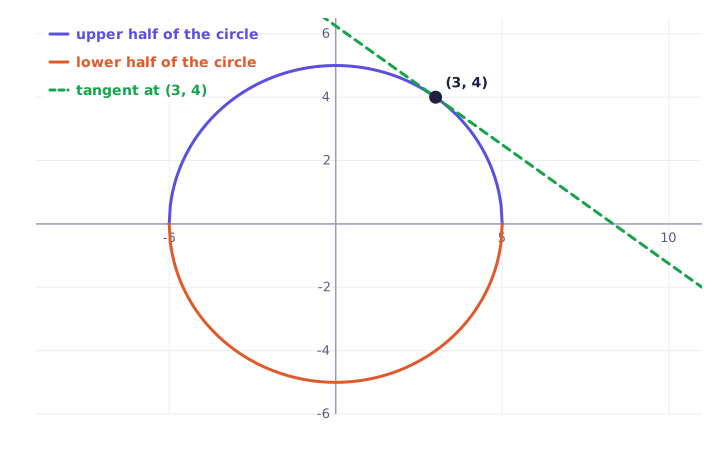
The answer passes a geometry check. The radius to (3, 4) has slope \frac{4}{3}, and a tangent to a circle is perpendicular to the radius, so its slope should be the negative reciprocal, -\frac{3}{4}. It is.
Notice that -\frac{x}{y} works on both halves of the circle at once. At (3, -4) it gives +\frac{3}{4}, correct for the lower half. Solving for y first would have forced you to handle y = \sqrt{25-x^2} and y = -\sqrt{25-x^2} separately.
Does implicit differentiation give the same answer as solving for y?
Yes, whenever you can solve for y. Take the upper half of the circle, y = \sqrt{25 - x^2} = (25 - x^2)^{1/2}. The chain rule gives
But \sqrt{25 - x^2} is just y, so this is -\frac{x}{y}, exactly what implicit differentiation produced. The two methods always agree. Implicit differentiation is simply faster, it covers every branch of the curve in one formula, and it still works when solving for y is impossible.
So when should you pick it? A good rule: if isolating y would need a square root with \pm, a cube root of something messy, or is simply not possible, differentiate implicitly. If the equation is already y = \ldots, differentiate it directly.
Worked example 2: a product term
Find \frac{dy}{dx} for x^2 + xy + y^2 = 7, and the slope at (1, 2).
Step 1. Differentiate term by term. The middle term xy is a product, so it needs the product rule: \frac{d}{dx}(xy) = 1\cdot y + x\frac{dy}{dx}.
Step 2. Collect the \frac{dy}{dx} terms.
Step 3. Divide.
Step 4. Evaluate. The point is on the curve, since 1 + 2 + 4 = 7. The slope is -\frac{2 + 2}{1 + 4} = -\frac{4}{5}.
Worked example 3: a curve you cannot solve for y
The folium of Descartes is x^3 + y^3 = 6xy. Find the slope at (3, 3).
Step 1. Differentiate. The right side is 6 times the product xy:
Step 2. Collect. Move the \frac{dy}{dx} terms left and the rest right:
Step 3. Factor and divide, cancelling the common 3:
Step 4. Evaluate at (3, 3). Check: 27 + 27 = 54 = 6\cdot 9. The slope is \frac{6 - 9}{9 - 6} = -1.
Worked example 4: the derivative of arcsin x
Implicit differentiation is how the inverse trig derivatives are found. Let y = \arcsin x, so \sin y = x with -\frac{\pi}{2} \le y \le \frac{\pi}{2}.
Step 1. Differentiate. \cos y\,\frac{dy}{dx} = 1, so \frac{dy}{dx} = \frac{1}{\cos y}.
Step 2. Rewrite in terms of x. Since \cos^2 y = 1 - \sin^2 y = 1 - x^2, and \cos y \ge 0 on that interval, \cos y = \sqrt{1 - x^2}.
The same trick, applied to e^y = x, proves that the derivative of \ln x is \frac{1}{x}, as shown in derivatives of exponential and log functions.
Finding the second derivative implicitly
For the circle, we found y' = -\frac{x}{y}. To get y'', differentiate this again with the quotient rule, remembering that y is still a function of x:
Step 1. Quotient rule.
Step 2. Substitute y' = -\frac{x}{y}.
Step 3. Clear the small fraction by multiplying top and bottom by y:
Step 4. Use the original equation. Since x^2 + y^2 = 25:
This makes sense. On the upper half (y > 0), y'' is negative, so the arc is concave down. On the lower half (y < 0), it is positive and the arc is concave up. At (3, 4), y'' = -\frac{25}{64}.
Tip: the move in step 4, replacing an expression with a constant from the original equation, comes up in almost every implicit second derivative. Always look for it before you stop simplifying.
Common mistakes in implicit differentiation
- Forgetting \frac{dy}{dx}. Writing \frac{d}{dx}(y^2) = 2y. Every y term gets the factor.
- Skipping the product rule. \frac{d}{dx}(xy) is y + x\frac{dy}{dx}, not \frac{dy}{dx} and not 1\cdot\frac{dy}{dx}.
- Attaching \frac{dy}{dx} to x terms. \frac{d}{dx}(x^3) = 3x^2, with no extra factor.
- Not differentiating the right side. The constant 25 becomes 0, but 6xy must be differentiated too.
- Plugging in only x. Implicit slopes usually depend on both coordinates. Use the full point.
- Forgetting to substitute y' when finding the second derivative, leaving y' inside the answer for y''.
Quick reference
| Term | Derivative with respect to x |
|---|---|
| x^n | nx^{n-1} |
| y^n | ny^{n-1}\,\frac{dy}{dx} |
| xy | y + x\,\frac{dy}{dx} |
| x^2y | 2xy + x^2\,\frac{dy}{dx} |
| \sin y | \cos y\,\frac{dy}{dx} |
| e^y | e^y\,\frac{dy}{dx} |
| \ln y | \frac{1}{y}\,\frac{dy}{dx} |
| constant | 0 |
Make it routine with practice
Implicit differentiation is a mechanical skill with one new habit: tag every y with a \frac{dy}{dx}. Do that consistently and the algebra takes care of itself. The interactive lesson below gives you curves to differentiate with instant feedback, and it is also the best preparation for related rates, which use exactly this technique with time as the variable.
Practice it now
Implicit differentiation
Solve real problems on this topic with instant feedback, hints and a step-by-step walkthrough for every answer. Free, no sign-up needed to start.
Practice this lesson