Derivative of eˣ: Formula, Proof and Examples
The derivative of eˣ is eˣ. See why with a limit proof, the chain rule form for e^u, a graph and worked examples like e^(3x) and x²eˣ.
Exponential and log derivatives Updated 2 min read
At a glance
- Derivative
- e^x
- Chain rule form
- \dfrac{d}{dx}e^u = e^u\,u'
- Every higher derivative
- e^x
- Value of e
- e \approx 2.71828
- Integral version
- \int e^x\,dx = e^x + C
On this page
The derivative of e^x is e^x. The function and its slope are equal at every point, which makes e^x the most important function in calculus.
Graph of eˣ
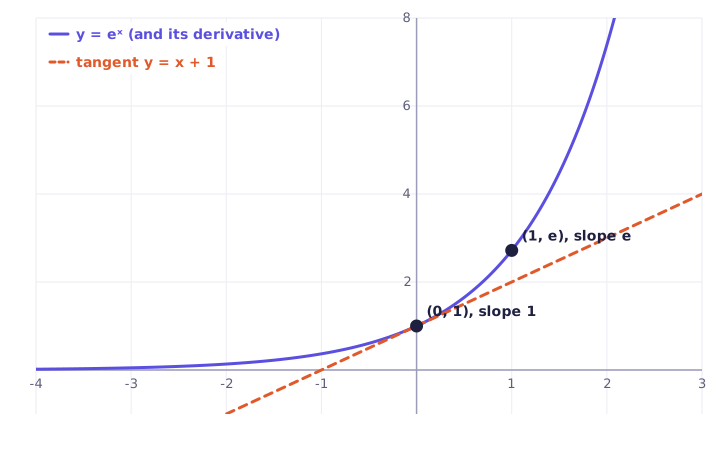
Because e^x > 0 for every x, the slope is always positive, so e^x always increases. And because the slope grows with the height, the curve bends upward faster and faster.
Proof from the limit definition
Use the limit definition of the derivative:
For any base a, the derivative of a^x is a^x times the constant \lim_{h \to 0}\frac{a^h - 1}{h}. For a = 2 that constant is about 0.693. For a = 3 it is about 1.099. The number e \approx 2.71828 is the base where the constant is exactly 1:
You can check this numerically: with h = 0.001, \frac{e^{0.001} - 1}{0.001} \approx 1.0005.
Chain rule version: derivative of e^u
When the exponent is something other than x, use the chain rule:
Copy the exponential exactly as it is, then multiply by the derivative of the exponent.
| Function | Exponent u | Derivative |
|---|---|---|
| e^{3x} | 3x | 3e^{3x} |
| e^{-x} | -x | -e^{-x} |
| e^{x^2} | x^2 | 2xe^{x^2} |
| e^{\sin x} | \sin x | \cos x\,e^{\sin x} |
| e^{\sqrt{x}} | \sqrt{x} | \frac{e^{\sqrt{x}}}{2\sqrt{x}} |
Some of these have their own pages: e^(2x), e^(−x) and e^(x²).
Worked examples
Example 1: product rule. For f(x) = x^2e^x, the product rule gives
Factoring out e^x makes it easy to find where f'(x) = 0: at x = 0 and x = -2.
Example 2: quotient rule. For g(x) = \frac{e^x}{x}, the quotient rule gives
Example 3: higher derivatives. Every derivative of e^x is e^x, so f^{(n)}(x) = e^x for every n. This is why the Maclaurin series of e^x is 1 + x + \frac{x^2}{2!} + \frac{x^3}{3!} + \cdots.
Common mistakes
- Using the power rule. \frac{d}{dx}e^x \ne xe^{x - 1}. The power rule needs a constant exponent.
- Forgetting the chain rule factor. \frac{d}{dx}e^{5x} = 5e^{5x}, not e^{5x}.
- Changing the exponent. The derivative of e^{x^2} keeps e^{x^2}; it does not become e^{2x}.
- Treating e as a variable. e is a constant, so \frac{d}{dx}e^2 = 0 and \frac{d}{dx}x^e = ex^{e - 1}.
The reverse fact, \int e^x\,dx = e^x + C, is on the integral of eˣ page. The inverse function is the natural log; see the derivative of ln x and the natural exponential function.
Practice it now
Exponentials and logarithms
Solve real problems on this topic with instant feedback, hints and a step-by-step walkthrough for every answer. Free, no sign-up needed to start.
Practice this lesson