Integral of csc x: Formula, Derivation and Examples
The integral of csc x is -ln|csc x + cot x| + C, also written ln|csc x - cot x| or ln|tan(x/2)|. See the derivation, why the forms agree and examples.
Trigonometric integrals Updated 2 min read
At a glance
- Antiderivative
- -\ln\lvert\csc x + \cot x\rvert + C
- Equivalent form
- \ln\lvert\csc x - \cot x\rvert + C
- Half-angle form
- \ln\left\lvert\tan\dfrac{x}{2}\right\rvert + C
- Method
- Multiply by \dfrac{\csc x + \cot x}{\csc x + \cot x}
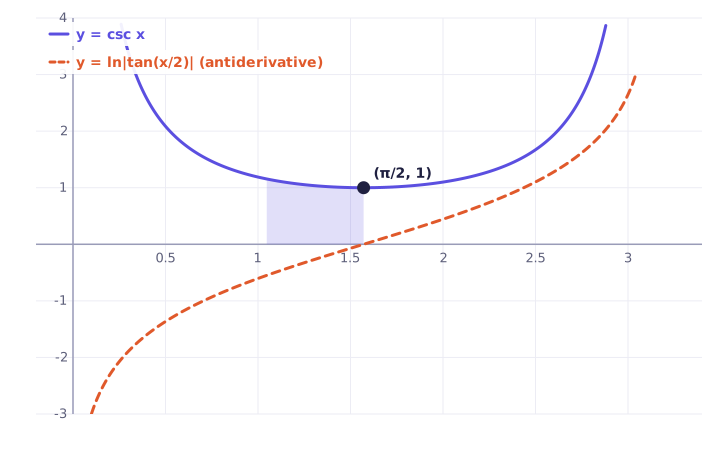
- From π/3 to π/2
- \dfrac{1}{2}\ln 3 \approx 0.549
On this page
The integral of \csc x is -\ln\lvert\csc x + \cot x\rvert + C. It is the cosecant twin of the integral of sec x, and it is derived with the same trick.
Graph of csc x and the area under it
Derivation, step by step
- Multiply by \frac{\csc x + \cot x}{\csc x + \cot x}: \int\csc x\,dx = \int\frac{\csc^2 x + \csc x\cot x}{\csc x + \cot x}\,dx
- Let u = \csc x + \cot x. Using the derivative of csc x and the derivative of cot x: du = (-\csc x\cot x - \csc^2 x)\,dx = -(\csc^2 x + \csc x\cot x)\,dx
- So the numerator is -du, and the integral is \int\frac{-du}{u} = -\ln\lvert u\rvert + C.
- Substitute back: -\ln\lvert\csc x + \cot x\rvert + C.
Why the three forms are equal
First, (\csc x + \cot x)(\csc x - \cot x) = \csc^2 x - \cot^2 x = 1. So
Second, \csc x - \cot x = \frac{1 - \cos x}{\sin x}, and the half-angle identity says \frac{1 - \cos x}{\sin x} = \tan\frac{x}{2}. That gives \ln\left\lvert\tan\frac{x}{2}\right\rvert.
Check by differentiating
Use the form \ln\lvert\csc x - \cot x\rvert:
Definite integrals
At x = \frac{\pi}{2}: \csc - \cot = 1 - 0 = 1, so the antiderivative is \ln 1 = 0. At x = \frac{\pi}{3}: \csc - \cot = \frac{2}{\sqrt{3}} - \frac{1}{\sqrt{3}} = \frac{1}{\sqrt{3}}. So
The integral from 0 to anything diverges, because \csc x has a vertical asymptote at x = 0 and \ln\tan\frac{x}{2} \to -\infty.
Substitution variants
Example 1. \int\csc(3x)\,dx = \frac{1}{3}\ln\lvert\csc 3x - \cot 3x\rvert + C.
Example 2. \int\frac{dx}{2\sin x\cos x} = \int\frac{dx}{\sin 2x} = \int\csc(2x)\,dx = \frac{1}{2}\ln\lvert\tan x\rvert + C, using the half-angle form with \frac{2x}{2} = x.
Example 3. \int\frac{\cos x}{\sin x}\,dx looks similar, but it is the integral of cot x, which equals \ln\lvert\sin x\rvert + C.
Common mistakes
- Answering -\csc x\cot x. That is the derivative of \csc x.
- Losing the minus sign in front of \ln\lvert\csc x + \cot x\rvert. Its derivative would then be -\csc x.
- Mixing the forms. -\ln\lvert\csc x - \cot x\rvert is wrong: the minus sign goes with the plus inside, and vice versa.
- Answering -\cot x. That is the integral of \csc^2 x, not \csc x.
Practise with trig integral problems.
Practice it now
Powers of sine and cosine
Solve real problems on this topic with instant feedback, hints and a step-by-step walkthrough for every answer. Free, no sign-up needed to start.
Practice this lesson