Derivative of csc x: Formula, Proof and Examples
The derivative of csc x is -csc x cot x. See the proof from 1/sin x, the chain rule for csc(u), a graph and worked examples like csc(3x).
Trigonometric derivatives Updated 2 min read
At a glance
- Derivative
- -\csc x\cot x for x \ne k\pi
- In sin and cos
- -\dfrac{\cos x}{\sin^2 x}
- Chain rule form
- \dfrac{d}{dx}\csc u = -\csc u\cot u \cdot u'
- Slope at x = π/2
- -\csc\frac{\pi}{2}\cot\frac{\pi}{2} = 0
- Integral version
- \int \csc x\cot x\,dx = -\csc x + C
On this page
The derivative of \csc x is -\csc x\cot x. Cosecant is \frac{1}{\sin x}, and like every "co" trig function, its derivative carries a minus sign.
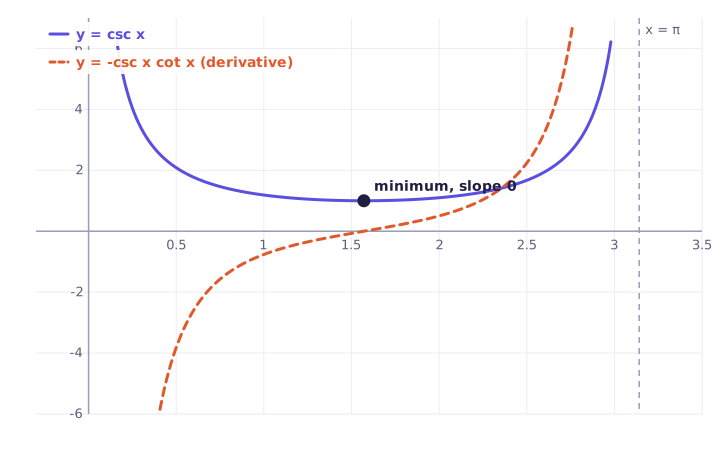
Graph of csc x and its derivative
Proof with the chain rule
Write \csc x = (\sin x)^{-1}. With the chain rule:
Split the fraction:
This is a special case of the derivative of 1/x pattern, \frac{d}{dx}\frac{1}{u} = -\frac{u'}{u^2}, with u = \sin x.
A pattern worth knowing
The six trig derivatives come in pairs. Swap each function for its "co" partner and flip the sign:
| Function | Derivative | Partner | Derivative |
|---|---|---|---|
| \sin x | \cos x | \cos x | -\sin x |
| \tan x | \sec^2 x | \cot x | -\csc^2 x |
| \sec x | \sec x\tan x | \csc x | -\csc x\cot x |
So if you remember the derivative of sec x, you get the one for \csc x for free.
The chain rule version: derivative of csc(u)
Example 1. \frac{d}{dx}\csc(3x) = -3\csc(3x)\cot(3x).
Example 2. \frac{d}{dx}\csc(x^2) = -2x\csc(x^2)\cot(x^2).
Example 3. \frac{d}{dx}\csc\left(\frac{x}{2}\right) = -\frac{1}{2}\csc\frac{x}{2}\cot\frac{x}{2}.
More worked examples
Example 4: a product. \frac{d}{dx}(x^2\csc x) = 2x\csc x - x^2\csc x\cot x.
Example 5: a power. \frac{d}{dx}\csc^2 x = 2\csc x\cdot(-\csc x\cot x) = -2\csc^2 x\cot x.
Example 6: a value. At x = \frac{\pi}{6}, \csc\frac{\pi}{6} = 2 and \cot\frac{\pi}{6} = \sqrt{3}, so the slope is -2\sqrt{3} \approx -3.46. The curve is falling steeply there, which matches the graph.
How to read the graph
Each branch of cosecant is a U shape sitting above or below the axis. On the upper branch between 0 and \pi, the curve falls on the left half and rises on the right half, with its lowest point at x = \frac{\pi}{2}. The derivative follows the same story: negative on the left, zero at the bottom, positive on the right. Near the asymptotes at 0 and \pi the curve is almost vertical, so the derivative grows without bound in size there. Keeping this picture in mind is a fast way to check the sign of any answer you compute.
Common mistakes
- Dropping the minus sign. The "co" rule: \cos, \cot and \csc all have negative derivatives.
- Writing -\cot^2 x or -\csc^2 x. -\csc^2 x is the derivative of \cot x. The derivative of \csc x is -\csc x\cot x.
- Mixing up the reciprocal. \csc x = \frac{1}{\sin x}, not \frac{1}{\cos x}.
The integral side is on the integral of csc x page. For more practice, try the trig derivative problems.
Practice it now
Sine, cosine and tangent
Solve real problems on this topic with instant feedback, hints and a step-by-step walkthrough for every answer. Free, no sign-up needed to start.
Practice this lesson