Integral of e^(−x): Formula, Steps and Examples
The integral of e^(−x) is −e^(−x) + C. See the substitution, why the area from 0 to infinity is 1, a graph and examples like x e^(−x).
Exponential and log integrals Updated 3 min read
At a glance
- Antiderivative
- -e^{-x} + C
- From 0 to ∞
- 1
- From 0 to 1
- 1 - \frac{1}{e} \approx 0.632
- General form
- \int e^{-kx}\,dx = -\frac{1}{k}e^{-kx} + C
- Method
- Substitution u = -x, du = -dx
On this page
The integral of e^{-x} is -e^{-x} + C. The only change from the integral of eˣ is the minus sign, which comes from the -1 in the exponent.
Graph of e⁻ˣ and its area
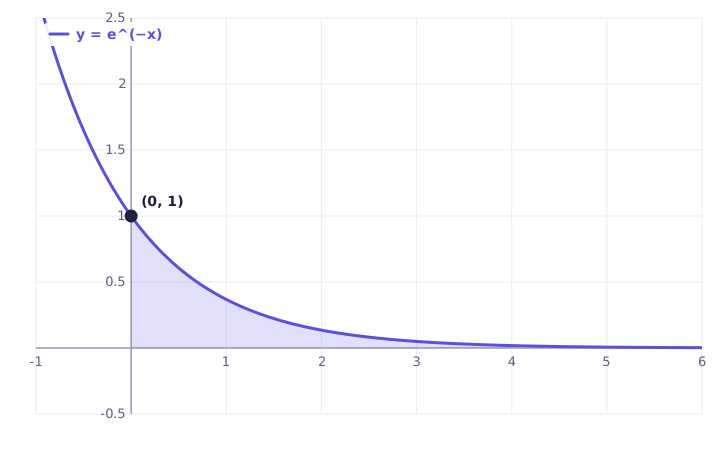
e^{-x} is exponential decay: it starts at 1 when x = 0 and loses the same fraction of its height over every unit step. That steady shrinking is what makes the infinite tail add up to a finite area.
How to integrate e⁻ˣ step by step
- Let u = -x. Then du = -dx, so dx = -du.
- Rewrite: \displaystyle\int e^{-x}\,dx = -\int e^u\,du.
- Integrate: -e^u + C.
- Substitute back: -e^{-x} + C.
This is the case k = -1 of the rule \int e^{kx}\,dx = \frac{1}{k}e^{kx} + C from the integral of e²ˣ page. For decay rates k > 0:
Check by differentiating
The two minus signs cancel. See the derivative of e⁻ˣ.
Definite and improper integrals
From 0 to 1: \left[-e^{-x}\right]_0^1 = -e^{-1} + 1 = 1 - \frac{1}{e} \approx 0.632.
From 0 to ∞: this is an improper integral, so take a limit:
A decay rate k. \int_0^\infty e^{-kx}\,dx = \frac{1}{k} for k > 0. Multiplying by k gives \int_0^\infty ke^{-kx}\,dx = 1, the total probability of the exponential distribution used for waiting times.
Half-life check. \int_0^{\ln 2} e^{-x}\,dx = 1 - \frac{1}{2} = \frac{1}{2}. Half of the total area sits before x = \ln 2 \approx 0.693.
Worked examples
Example 1: a scaled exponent. \displaystyle\int e^{-x/3}\,dx = -3e^{-x/3} + C.
Example 2: x times e⁻ˣ. Use integration by parts with u = x and dv = e^{-x}\,dx, so du = dx and v = -e^{-x}:
From 0 to \infty this equals 0 - (-1) = 1, because xe^{-x} \to 0 as x \to \infty.
Example 3: drug in the bloodstream. A drug leaves the body at a rate of 40e^{-0.5t} mg per hour. The amount removed in the first 4 hours is
Example 4: hyperbolic functions. \cosh x = \frac{e^x + e^{-x}}{2}, so
Common mistakes
- Dropping the minus sign. \int e^{-x}\,dx is not e^{-x} + C. Differentiate your answer: you should get +e^{-x}.
- Writing \frac{e^{-x+1}}{-x+1}. That is the power rule used on an exponential, which is never valid.
- Treating the improper integral as divergent. The interval is infinite, but the area is 1. Use a limit, do not stop at "infinity".
- Confusing e^{-x} with e^{-x^2}. The bell curve e^{-x^2} has no elementary antiderivative; see the integral of e^(x²).
For more on products like xe^{-x}, see the integral of x eˣ.
Practice it now
Integrating to infinity
Solve real problems on this topic with instant feedback, hints and a step-by-step walkthrough for every answer. Free, no sign-up needed to start.
Practice this lesson