Integral of sec³ x: Formula, Derivation and Examples
The integral of sec³ x is ½(sec x tan x + ln|sec x + tan x|) + C. See the integration by parts loop step by step, a full check and the arc length application.
Trigonometric integrals Updated 3 min read
At a glance
- Antiderivative
- \dfrac{1}{2}\sec x\tan x + \dfrac{1}{2}\ln\lvert\sec x + \tan x\rvert + C
- Method
- Integration by parts with u = \sec x, dv = \sec^2 x\,dx
- Key identity
- \tan^2 x = \sec^2 x - 1
- From 0 to π/4
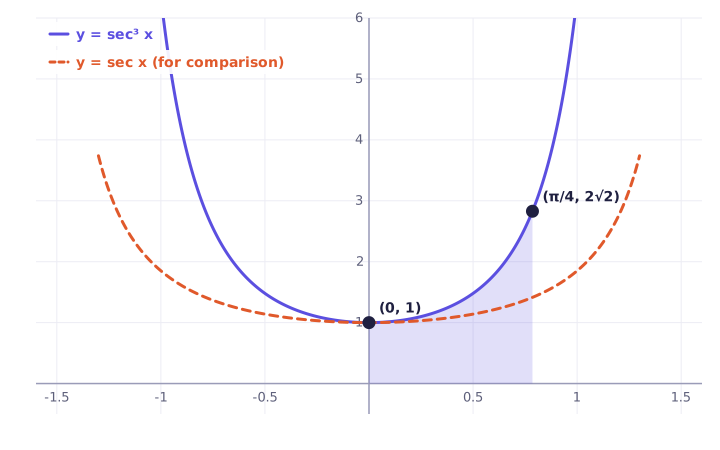
- \dfrac{\sqrt{2} + \ln(1 + \sqrt{2})}{2} \approx 1.148
- Reduction formula
- \int\sec^n x\,dx = \dfrac{\sec^{n-2}x\tan x}{n - 1} + \dfrac{n - 2}{n - 1}\int\sec^{n-2}x\,dx
On this page
The integral of \sec^3 x is \dfrac{1}{2}\left(\sec x\tan x + \ln\lvert\sec x + \tan x\rvert\right) + C. It is the classic example of integration by parts where the integral comes back around and you solve for it.
Graph of sec³ x and the area under it
Derivation by parts, step by step
Call the integral I = \int\sec^3 x\,dx.
- Split \sec^3 x = \sec x\cdot\sec^2 x and use the integration by parts rule with u = \sec x,\quad dv = \sec^2 x\,dx,\qquad du = \sec x\tan x\,dx,\quad v = \tan x
- Apply \int u\,dv = uv - \int v\,du: I = \sec x\tan x - \int\sec x\tan^2 x\,dx
- Replace \tan^2 x with \sec^2 x - 1: I = \sec x\tan x - \int\sec^3 x\,dx + \int\sec x\,dx = \sec x\tan x - I + \int\sec x\,dx
- The original integral I has appeared on the right. Add I to both sides: 2I = \sec x\tan x + \ln\lvert\sec x + \tan x\rvert
- Divide by 2 and add C.
Step 4 uses the integral of sec x. The choice dv = \sec^2 x\,dx works because \sec^2 x is the one piece you can integrate easily, to \tan x. The integration by parts guide has more examples of this loop.
Check by differentiating
First, by the product rule:
Replace \tan^2 x with \sec^2 x - 1 to get 2\sec^3 x - \sec x. The log term differentiates to \sec x. So
Definite integral
At x = \frac{\pi}{4}: \sec = \sqrt{2}, \tan = 1. At x = 0: \sec = 1, \tan = 0, and \ln 1 = 0. So
Application: integral of √(1 + x²) and arc length
Let x = \tan\theta, dx = \sec^2\theta\,d\theta. Then \sqrt{1 + x^2} = \sec\theta and
The arc length of the parabola y = \frac{x^2}{2} from x = 0 to x = 1 is \int_0^1\sqrt{1 + x^2}\,dx, which is exactly the shaded area above: about 1.148. More on this in the lesson on arc length and surface area.
The reduction formula
The same steps with \sec^n x give
With n = 3 this is our result. With n = 5, it reduces \sec^5 x to \sec^3 x, which you now know.
Common mistakes
- Using the power rule: \frac{\sec^4 x}{4}. Its derivative is \sec^4 x\tan x, not \sec^3 x.
- Choosing u = \sec^2 x, dv = \sec x\,dx. Then v = \ln\lvert\sec x + \tan x\rvert, and the new integral is much harder.
- Forgetting to divide by 2 after collecting the I terms.
- Losing the log term. The \int\sec x\,dx from step 3 is easy to drop.
Practise on integration by parts problems.
Practice it now
Integration by parts
Solve real problems on this topic with instant feedback, hints and a step-by-step walkthrough for every answer. Free, no sign-up needed to start.
Practice this lesson