Integral of √(1−x²): Formula, Steps and Examples
The integral of √(1−x²) is ½(x√(1−x²) + arcsin x) + C. Learn the trig substitution, the link to the area of a circle and worked examples.
Inverse trig integrals Updated 2 min read
At a glance
- Antiderivative
- \frac{1}{2}\left(x\sqrt{1-x^2} + \arcsin x\right) + C
- General form
- \frac{x}{2}\sqrt{a^2-x^2} + \frac{a^2}{2}\arcsin\frac{x}{a} + C
- Method
- Trig substitution x = \sin\theta, then \cos^2\theta = \frac{1 + \cos 2\theta}{2}
- From −1 to 1
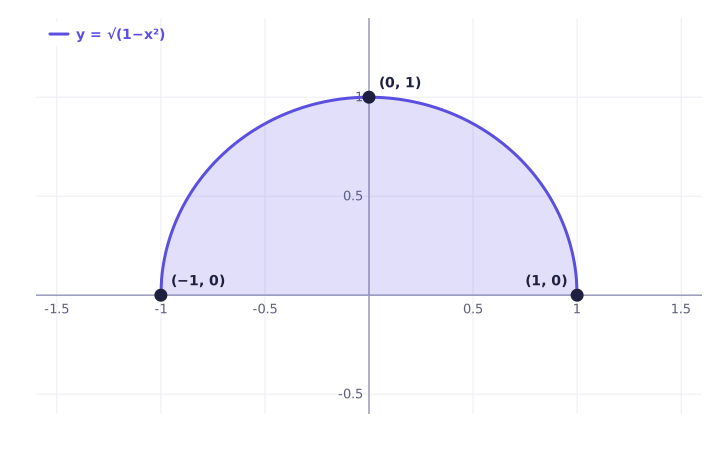
- \dfrac{\pi}{2}, the area of a half unit circle
- From 0 to 1
- \dfrac{\pi}{4}, a quarter circle
On this page
The integral of \sqrt{1-x^2} is \dfrac{1}{2}\left(x\sqrt{1-x^2} + \arcsin x\right) + C. It is the classic first example of trig substitution, and it is how calculus proves the area of a circle.
For a circle of radius a:
Graph: half of the unit circle
How to integrate √(1−x²) step by step
- Substitute. Let x = \sin\theta with -\frac{\pi}{2} \le \theta \le \frac{\pi}{2}. Then dx = \cos\theta\,d\theta and \sqrt{1-\sin^2\theta} = \cos\theta, which is not negative on this interval.
- Rewrite. \int \sqrt{1-x^2}\,dx = \int \cos\theta\cdot\cos\theta\,d\theta = \int \cos^2\theta\,d\theta
- Use the half-angle identity \cos^2\theta = \frac{1 + \cos 2\theta}{2}, as on the integral of cos²x page: \int \cos^2\theta\,d\theta = \frac{\theta}{2} + \frac{\sin 2\theta}{4} + C = \frac{\theta}{2} + \frac{\sin\theta\cos\theta}{2} + C
- Go back to x. \theta = \arcsin x, \sin\theta = x and \cos\theta = \sqrt{1-x^2}: \frac{1}{2}\arcsin x + \frac{1}{2}x\sqrt{1-x^2} + C
The general version uses x = a\sin\theta in the same way. The trig substitution guide covers the other two root shapes, \sqrt{a^2+x^2} and \sqrt{x^2-a^2}.
Check by differentiating
Differentiate each piece. By the product rule:
and \frac{d}{dx}\arcsin x = \frac{1}{\sqrt{1-x^2}}. Adding them:
Half of that is \sqrt{1-x^2}, as it should be.
Definite integrals and the area of a circle
Over the full interval, the root term vanishes at both ends:
Doubling it to include the lower half gives the area of the unit circle, \pi. With radius a, the same steps give \int_{-a}^{a}\sqrt{a^2-x^2}\,dx = \frac{\pi a^2}{2}, so a full circle has area \pi a^2.
Worked examples
Example 1: part of a circle. Find \int_0^{1/2}\sqrt{1-x^2}\,dx.
The picture: a 30^\circ wedge of area \frac{\pi}{12} plus a triangle of area \frac{\sqrt{3}}{8}.
Example 2: radius 3. \int_{-3}^{3}\sqrt{9-x^2}\,dx = \frac{9\pi}{2}, half of a circle of radius 3. No antiderivative work is needed once you see the shape.
Example 3: a general antiderivative. With a = 2:
Example 4: shift the circle. \int_0^2\sqrt{2x - x^2}\,dx. Complete the square: 2x - x^2 = 1 - (x-1)^2. This is the unit half circle centred at x = 1, so the answer is \frac{\pi}{2}.
Common mistakes
- Trying u = 1 - x^2. You would need an x\,dx to match du, and there is none.
- Forgetting to convert back. An answer in \theta is not finished. Use a right triangle with opposite side x and hypotenuse 1 to read off \cos\theta = \sqrt{1-x^2}.
- Dropping the \frac{a^2}{2}. In the general formula the arcsin term carries \frac{a^2}{2}, not \frac{1}{2}.
- Confusing it with \frac{1}{\sqrt{1-x^2}}. That one integrates straight to \arcsin x; see the integral of 1/√(1−x²).
Practice it now
Trig substitution
Solve real problems on this topic with instant feedback, hints and a step-by-step walkthrough for every answer. Free, no sign-up needed to start.
Practice this lesson