Integral of 1/√(1−x²): Formula, Steps and Examples
The integral of 1/√(1−x²) is arcsin x + C. See the sine substitution, the 1/√(a²−x²) version, a graph, definite integrals and examples.
Inverse trig integrals Updated 2 min read
At a glance
- Antiderivative
- \arcsin x + C
- General form
- \displaystyle\int \frac{dx}{\sqrt{a^2-x^2}} = \arcsin\frac{x}{a} + C
- Valid for
- -1 < x < 1 (or \lvert x\rvert < a)
- Method
- Substitution x = \sin\theta
- From 0 to 1
- \dfrac{\pi}{2} (an improper integral that converges)
On this page
The integral of \dfrac{1}{\sqrt{1-x^2}} is \arcsin x + C. It is the reverse of the derivative of arcsin x, and it works on the interval -1 < x < 1 where the square root is real and nonzero.
For any constant a > 0:
Graph of 1/√(1−x²)
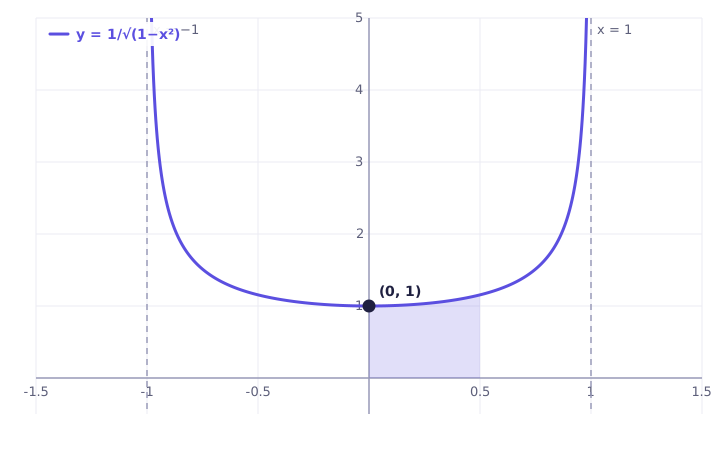
How to integrate 1/√(1−x²) step by step
The square root of 1 - x^2 looks like the Pythagorean identity 1 - \sin^2\theta = \cos^2\theta, so substitute x = \sin\theta.
- Let x = \sin\theta with -\frac{\pi}{2} < \theta < \frac{\pi}{2}. Then dx = \cos\theta\,d\theta.
- Simplify the root. On this interval \cos\theta > 0, so \sqrt{1 - \sin^2\theta} = \cos\theta.
- Integrate: \int \frac{\cos\theta\,d\theta}{\cos\theta} = \int 1\,d\theta = \theta + C
- Go back to x: \theta = \arcsin x.
For \frac{1}{\sqrt{a^2-x^2}}, use x = a\sin\theta. Then dx = a\cos\theta\,d\theta and \sqrt{a^2 - a^2\sin^2\theta} = a\cos\theta. The two factors of a cancel, which is why the answer has no \frac{1}{a} in front. This is the first case of trig substitution.
Check by differentiating
The step uses a\sqrt{1 - \frac{x^2}{a^2}} = \sqrt{a^2 - x^2}, which holds because a > 0.
Definite integrals
| Integral | Value |
|---|---|
| \int_0^{1/2} \frac{dx}{\sqrt{1-x^2}} | \frac{\pi}{6} |
| \int_0^{\sqrt{2}/2} \frac{dx}{\sqrt{1-x^2}} | \frac{\pi}{4} |
| \int_0^{1} \frac{dx}{\sqrt{1-x^2}} | \frac{\pi}{2} |
| \int_{-1}^{1} \frac{dx}{\sqrt{1-x^2}} | \pi |
The last two are improper integrals, since the integrand is unbounded at x = \pm 1. They still converge because the blow-up is only like \frac{1}{\sqrt{1-x}}.
Worked examples
Example 1. \displaystyle\int \frac{dx}{\sqrt{9 - x^2}} = \arcsin\frac{x}{3} + C, using a = 3.
Example 2: a coefficient on x². \displaystyle\int \frac{dx}{\sqrt{1 - 4x^2}}. Let u = 2x, du = 2\,dx:
Example 3: complete the square. \displaystyle\int \frac{dx}{\sqrt{4x - x^2}}. Write 4x - x^2 = 4 - (x - 2)^2, then use a = 2 and u = x - 2:
Example 4: a definite integral. \displaystyle\int_0^{3} \frac{dx}{\sqrt{36 - x^2}} = \arcsin\frac{3}{6} - \arcsin 0 = \frac{\pi}{6}.
Common mistakes
- Adding a \frac{1}{a}. That belongs to the arctan formula \int \frac{dx}{a^2+x^2} = \frac{1}{a}\arctan\frac{x}{a}. The arcsin formula has none. Compare with the integral of 1/(1+x²).
- Reaching for arcsin when there is an x on top. \int \frac{x}{\sqrt{1-x^2}}\,dx is a plain u-substitution with answer -\sqrt{1-x^2} + C.
- Confusing \frac{1}{\sqrt{1-x^2}} with \sqrt{1-x^2}. The square root on its own integrates to something longer; see the integral of √(1−x²).
- Using the formula outside \lvert x\rvert < a. For \lvert x\rvert > a the root is not real. Integrals like \int \frac{dx}{\sqrt{x^2-1}} give \ln\lvert x + \sqrt{x^2-1}\rvert instead.
To integrate the inverse sine function itself, see the integral of arcsin x. The arcsine page covers its domain and graph.
Practice it now
Trig substitution
Solve real problems on this topic with instant feedback, hints and a step-by-step walkthrough for every answer. Free, no sign-up needed to start.
Practice this lesson