The Power Rule for Derivatives: Rules, Examples and Tricks
Master the power rule: how it works, negative and fractional exponents, rewriting roots and fractions, plus the sum and constant multiple rules.
By the PracticeCalculus team Published 7 min read
On this page
- What is the power rule?
- Why the power rule works
- The constant, constant multiple and sum rules
- Worked example 1: a polynomial
- Negative exponents: rewriting fractions
- Fractional exponents: rewriting roots
- Worked example 5: simplify before you differentiate
- Putting it all together
- Worked example 6: a tangent line
- Higher derivatives with the power rule
- The power rule as a rate of change
- Common mistakes with the power rule
- Quick reference
- Practice until it is automatic
Computing derivatives with the limit definition means a page of algebra for every function. The power rule replaces all of that with a one-line shortcut, and combined with two simple companion rules, it lets you differentiate any polynomial, root or power of x in seconds. It is the first rule you learn and the one you will use most.
What is the power rule?
The power rule tells you the derivative of x raised to a constant power:
In words: bring the exponent down in front, then subtract one from the exponent.
The rule works for every real number n: positive whole numbers, negative numbers and fractions. The only requirement is that the variable is in the base and the exponent is a constant.
Why the power rule works
For a positive whole number n, you can see the pattern from the limit definition of the derivative. Expanding (x + h)^n gives
So
and as h \to 0 everything except n x^{n-1} disappears. That is the power rule. For n = 2 this is exactly the familiar calculation (x+h)^2 = x^2 + 2xh + h^2, which gives 2x. The proof for negative and fractional exponents uses other tools, but the rule stays the same.
The constant, constant multiple and sum rules
The power rule rarely appears alone. Three companion rules let you combine it with coefficients and multiple terms.
| Rule | Formula | Example |
|---|---|---|
| Constant rule | \frac{d}{dx} c = 0 | \frac{d}{dx} 7 = 0 |
| Constant multiple rule | \frac{d}{dx} [c f(x)] = c f'(x) | \frac{d}{dx} 4x^3 = 12x^2 |
| Sum and difference rule | \frac{d}{dx} [f \pm g] = f' \pm g' | \frac{d}{dx} (x^2 + x) = 2x + 1 |
The constant rule says a horizontal line has slope 0. The constant multiple rule says stretching a graph vertically by c multiplies every slope by c. The sum rule says you can differentiate a polynomial one term at a time.
Worked example 1: a polynomial
Differentiate f(x) = 3x^4 - 5x^2 + 7x - 2.
Step 1. Split into terms. By the sum rule, differentiate each term separately.
Step 2. Apply the power rule with constant multiples.
- 3x^4 \to 3 \cdot 4x^3 = 12x^3
- -5x^2 \to -5 \cdot 2x = -10x
- 7x \to 7 \cdot 1 = 7
- -2 \to 0
Step 3. Combine.
Negative exponents: rewriting fractions
A power of x in a denominator is a negative exponent in disguise:
Rewrite first, then apply the power rule. Pay close attention when you subtract one: the exponent becomes more negative.
Worked example 2: a fraction with a coefficient
Differentiate y = \frac{4}{x^3}.
Step 1. Rewrite as a power. y = 4x^{-3}.
Step 2. Apply the power rule. Bring down -3 and subtract one: -3 - 1 = -4.
Step 3. Rewrite without negative exponents (optional, but usually expected).
A special case is worth memorizing: \frac{d}{dx} \frac{1}{x} = \frac{d}{dx} x^{-1} = -x^{-2} = -\frac{1}{x^2}, the same result the limit definition gives.
Tip: watch where the coefficient lives. \frac{1}{3x^2} is \frac{1}{3}x^{-2}, but \frac{3}{x^2} is 3x^{-2}. Only the power of x moves up to the numerator as a negative exponent.
Fractional exponents: rewriting roots
Roots are fractional powers:
Worked example 3: a square root
Differentiate y = \sqrt{x}.
Step 1. Rewrite. y = x^{1/2}.
Step 2. Apply the power rule. \frac{1}{2} - 1 = -\frac{1}{2}, so
Worked example 4: a root of a power
Differentiate y = \sqrt[3]{x^2}.
Step 1. Rewrite. y = x^{2/3}.
Step 2. Apply the power rule. \frac{2}{3} - 1 = -\frac{1}{3}, so
Notice the derivative is undefined at x = 0. The graph of x^{2/3} has a sharp cusp there.
Worked example 5: simplify before you differentiate
Differentiate y = \frac{x^2 + 1}{\sqrt{x}}.
You could use the quotient rule, but splitting the fraction is faster.
Step 1. Split into separate terms.
Step 2. Subtract exponents. x^{2 - 1/2} = x^{3/2}, so
Step 3. Apply the power rule to each term.
Step 4. Rewrite with roots (optional).
The same trick works for products: expand (2x + 1)^2 = 4x^2 + 4x + 1, then differentiate to get 8x + 4.
Putting it all together
Differentiate y = 6\sqrt[3]{x^5} - \frac{2}{x} + 9.
Step 1. Rewrite every term as a power of x.
Step 2. Apply the power rule term by term. For the first term, \frac{5}{3} - 1 = \frac{2}{3}. For the second, -1 - 1 = -2. The constant 9 becomes 0.
Step 3. Rewrite in root and fraction form.
Notice how the two minus signs in the middle term combined into a plus. Sign slips like that are the main thing to watch once you are comfortable with the rule itself.
Worked example 6: a tangent line
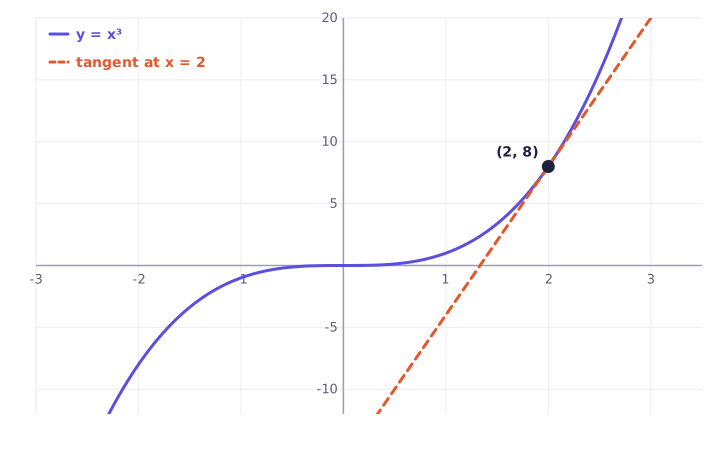
Find the equation of the tangent line to y = x^3 at x = 2.
Step 1. Find the point. y(2) = 2^3 = 8, so the point is (2, 8).
Step 2. Find the slope. \frac{dy}{dx} = 3x^2, so the slope at x = 2 is 3(2)^2 = 12.
Step 3. Use point-slope form.
Higher derivatives with the power rule
Because the derivative of a polynomial is another polynomial, you can apply the power rule again and again. The second derivative f''(x) is the derivative of f'(x), and it measures how the slope itself is changing (concavity).
Worked example 7: first, second and third derivatives
Find f', f'' and f''' for f(x) = 2x^5 - x^3 + 4x.
Step 1. First derivative. Apply the power rule term by term:
Step 2. Second derivative. Differentiate f'. The constant 4 disappears:
Step 3. Third derivative.
Each round lowers every exponent by one, so a polynomial of degree n becomes 0 after n + 1 derivatives.
The power rule as a rate of change
Derivatives are rates, so the power rule turns position formulas into velocity formulas instantly. Suppose a ball's height in meters after t seconds is
The variable is t instead of x, but the rule is the same. The velocity is
and the acceleration is a(t) = v'(t) = -10 meters per second squared. Setting v(t) = 0 gives t = 2, the moment the ball stops rising, at a height of s(2) = -20 + 40 + 2 = 22 meters. Every one of those answers came from the power rule and nothing else.
Common mistakes with the power rule
- Subtracting one wrong with negative exponents. \frac{d}{dx} x^{-3} = -3x^{-4}. Going from -3 to -2 is the most common error.
- Differentiating a fraction piece by piece. \frac{d}{dx} \frac{1}{x^3} is not \frac{1}{3x^2}. Rewrite as x^{-3} first.
- Forgetting that constants become 0. The derivative of -2, \pi^2 or e^3 is 0, not the constant itself.
- Applying the power rule to exponentials. \frac{d}{dx} 2^x is not x \cdot 2^{x-1}. The variable is in the exponent, so the power rule does not apply.
- Using it on a power of something other than x. \frac{d}{dx} (3x+1)^5 needs the chain rule, which adds a factor of 3.
- Moving a coefficient with the power. \frac{5}{x^2} = 5x^{-2}, not 5^{-1}x^{-2}.
Quick reference
| Function | Rewrite as | Derivative |
|---|---|---|
| x^n | x^n | n x^{n-1} |
| c (constant) | 0 | |
| x | x^1 | 1 |
| \frac{1}{x} | x^{-1} | -\frac{1}{x^2} |
| \frac{1}{x^2} | x^{-2} | -\frac{2}{x^3} |
| \sqrt{x} | x^{1/2} | \frac{1}{2\sqrt{x}} |
| \sqrt[3]{x} | x^{1/3} | \frac{1}{3\sqrt[3]{x^2}} |
| x\sqrt{x} | x^{3/2} | \frac{3}{2}\sqrt{x} |
Practice until it is automatic
The power rule itself is easy. The skill that takes practice is the rewriting: turning roots and fractions into powers, and handling negative and fractional exponents without slipping. The interactive lesson below gives you a steady stream of problems, checks every answer instantly, and shows you exactly which exponent went wrong. A short session today will make every later derivative faster.
Practice it now
The power rule
Solve real problems on this topic with instant feedback, hints and a step-by-step walkthrough for every answer. Free, no sign-up needed to start.
Practice this lesson