Power Rule for Derivatives: Formula, Examples and Proof
The power rule: the derivative of x^n is n·x^(n−1). Formula, examples with negative and fractional powers, a short proof and common mistakes.
Derivative rules Updated 2 min read
At a glance
- Applies to
- Any power of x with a constant exponent n (positive, negative, fraction or decimal)
- In words
- Bring the exponent down in front, then subtract one from the exponent
- Does not apply to
- Exponentials like 2^x or e^x, where the variable is in the exponent
- Integral version
- \int x^n\,dx = \frac{x^{n+1}}{n+1} + C for n \ne -1
- Related rules
- Constant multiple rule, sum rule, chain rule
On this page
The power rule is the first derivative shortcut most students learn, and the one they use most. It differentiates any power of x in one step, with no limits required.
The power rule formula
For any constant exponent n:
Two moves: bring the exponent down as a coefficient, then subtract one from the exponent.
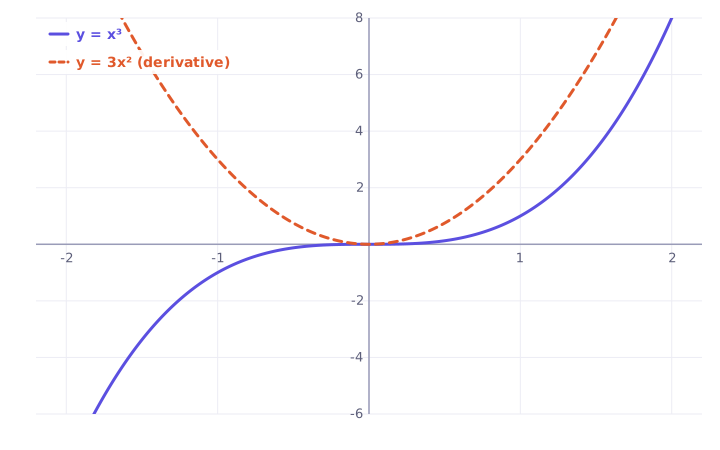
Examples
| Function | Rewrite | Derivative |
|---|---|---|
| x^5 | x^5 | 5x^4 |
| x | x^1 | 1 |
| 7 | 7x^0 | 0 |
| \frac{1}{x^2} | x^{-2} | -2x^{-3} = -\frac{2}{x^3} |
| \sqrt{x} | x^{1/2} | \frac{1}{2}x^{-1/2} = \frac{1}{2\sqrt{x}} |
| \sqrt[3]{x^2} | x^{2/3} | \frac{2}{3}x^{-1/3} |
Example: a polynomial. Combine the power rule with the sum rule and constant multiple rule:
Example: a negative power. To differentiate f(x) = \frac{3}{x^4}, rewrite it as 3x^{-4}:
Notice that the exponent goes from -4 to -5, not to -3. Subtracting one from a negative number makes it more negative.
When to use the power rule
Use it whenever you see a variable raised to a constant power, after any rewriting. In practice that means:
- polynomials, one term at a time;
- roots, after converting them to fractional exponents;
- terms with x in the denominator, after converting them to negative exponents;
- the outer layer of a function like (x^2+1)^5, together with the chain rule.
If the exponent contains x, as in x^x or 3^x, the power rule is the wrong tool. Those need exponential rules or logarithmic differentiation.
The power rule in reverse: integration
Integration undoes differentiation, so the power rule has a mirror image. To integrate x^n, add one to the exponent, then divide by the new exponent:
For example, \int x^3\,dx = \frac{x^4}{4} + C. The single exception is n = -1, where \int x^{-1}\,dx = \ln|x| + C. See the reverse power rule.
Why the power rule works
For a whole-number exponent, expand (x+h)^n with the binomial theorem inside the limit definition of the derivative:
As h \to 0, every term with an h in it vanishes, leaving nx^{n-1}. The rule extends to all real exponents using logarithmic differentiation.
Common mistakes
- Subtracting one before bringing the exponent down. \frac{d}{dx}x^4 is 4x^3, not 3x^3.
- Using it on exponentials. \frac{d}{dx}2^x \ne x \cdot 2^{x-1}. The variable is in the exponent, so you need the exponential rule.
- Not rewriting first. You cannot apply the power rule to \frac{1}{x^2} until you write it as x^{-2}.
- Forgetting the chain rule. For (3x+1)^4 the power rule gives only part of the answer. You also multiply by the inside derivative, 3. See the chain rule.
For a longer walkthrough with more practice problems, read the full guide to the power rule.
Practice it now
The power rule
Solve real problems on this topic with instant feedback, hints and a step-by-step walkthrough for every answer. Free, no sign-up needed to start.
Practice this lesson