Constant Multiple Rule for Derivatives: Formula and Examples
The constant multiple rule: the derivative of c·f(x) is c·f'(x). The formula, worked examples, a quick proof and the mistakes students make with it.
Derivative rules Updated 3 min read
At a glance
- Applies to
- A constant c multiplied by any differentiable function f
- In words
- Keep the constant, differentiate the function
- Includes division
- Dividing by a constant k is multiplying by \frac{1}{k}
- Integral version
- \int c\,f(x)\,dx = c \int f(x)\,dx
- Related rules
- Power rule, sum rule, product rule
On this page
The constant multiple rule says that a constant factor can be pulled out in front of a derivative. To differentiate c\,f(x), keep the c and differentiate f. Together with the power rule and the sum rule, it lets you differentiate any polynomial at sight.
The constant multiple rule formula
If c is a constant and f is differentiable, then
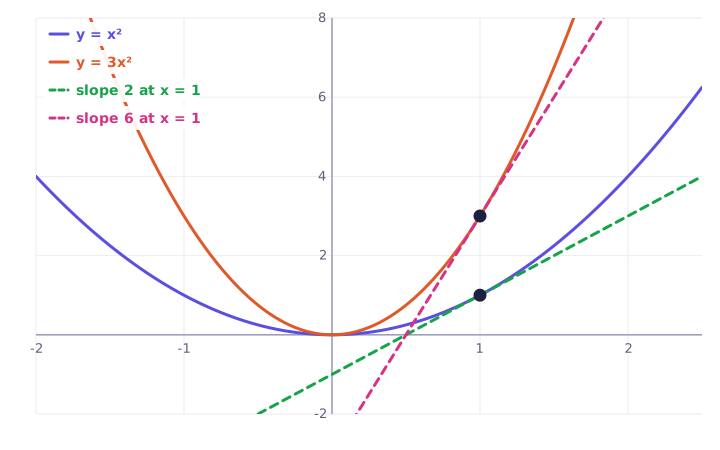
Geometrically, multiplying a function by c stretches its graph vertically by a factor of c. Every slope gets multiplied by c too.
Examples
| Function | Derivative |
|---|---|
| 5x^3 | 5 \cdot 3x^2 = 15x^2 |
| -4\sin x | -4\cos x |
| 2e^x | 2e^x |
| \frac{x^2}{7} | \frac{2x}{7} |
| \pi x | \pi |
| \frac{3}{x^2} = 3x^{-2} | -6x^{-3} = -\frac{6}{x^3} |
Example: a constant in the denominator. The function \frac{1}{3x} has a variable in the denominator, so rewrite it as \frac{1}{3}x^{-1} first:
Example: combined with the sum rule. Each term keeps its coefficient:
How to recognize a constant multiple
A constant multiple is any factor that does not change when x changes. Look for it in these places:
- A number in front of a term, such as the 5 in 5x^3 or the -4 in -4\sin x.
- A number in the denominator, such as the 7 in \frac{x^2}{7}. Dividing by 7 is the same as multiplying by \frac{1}{7}.
- A named constant, such as \pi, e^2 or \ln 3. These look like functions or powers, but they contain no x, so they are just numbers.
- A letter that stands for a fixed value, such as a, k or m in a physics formula. In \frac{d}{dx}\,k x^2 = 2kx, the k is treated exactly like a number.
If the factor contains x anywhere, it is not a constant, and you need the product rule or quotient rule instead.
Why the constant multiple rule works
From the limit definition of the derivative, the constant factors out of the difference quotient and then out of the limit:
The second step uses the constant multiple law for limits from the limit laws.
Linearity
The constant multiple rule and the sum rule together say that differentiation is linear:
for any constants a and b. Integration has the same property, which is why \int 5x^2\,dx = 5\int x^2\,dx.
Common mistakes
- Using the product rule when it is not needed. For 7x^3 the product rule gives 0 \cdot x^3 + 7 \cdot 3x^2, which is correct but slow. Just write 21x^2.
- Mixing it up with the constant rule. \frac{d}{dx}\,8x = 8, not 0. Only a constant standing alone becomes 0.
- Pulling a constant out of a function's input. \sin(3x) is not 3\sin x. A constant inside the function needs the chain rule: \frac{d}{dx}\sin(3x) = 3\cos(3x).
- Treating a variable as a constant. In x\,e^x, the x is not a constant, so you need the product rule.
For more practice combining these rules, see the full guide to the power rule.
Practice it now
Sums and constants
Solve real problems on this topic with instant feedback, hints and a step-by-step walkthrough for every answer. Free, no sign-up needed to start.
Practice this lesson