Reverse Power Rule for Integrals: Formula, Examples and n = −1
The reverse power rule: the integral of x^n is x^(n+1)/(n+1) + C for n ≠ −1. Formula, examples with roots and negative powers, and the ln|x| exception.
Integration rules Updated 3 min read
At a glance
- Applies to
- Any power of x with a constant exponent n \ne -1
- In words
- Add one to the exponent, then divide by the new exponent
- Exception
- \int x^{-1}\,dx = \ln\lvert x\rvert + C
- Check
- Differentiate the answer with the power rule; you should get x^n back
- Related rules
- Power rule, linearity of the integral, u-substitution
On this page
The reverse power rule finds the antiderivative of any power of x. It is the power rule run backwards: instead of lowering the exponent and multiplying, you raise the exponent and divide.
The reverse power rule formula
For any constant exponent n \ne -1:
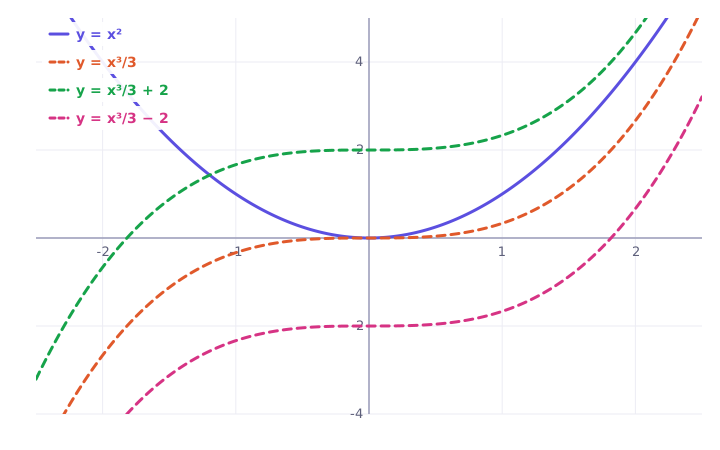
Two moves: add one to the exponent, then divide by the new exponent. The +C is there because every function has infinitely many antiderivatives that differ by a constant.
You can always check the answer by differentiating it:
Examples
| Integrand | Rewrite | Antiderivative |
|---|---|---|
| x^4 | x^4 | \frac{x^5}{5} + C |
| x | x^1 | \frac{x^2}{2} + C |
| 5 | 5x^0 | 5x + C |
| \sqrt{x} | x^{1/2} | \frac{2}{3}x^{3/2} + C |
| \frac{1}{x^3} | x^{-3} | -\frac{1}{2x^2} + C |
| \frac{1}{\sqrt{x}} | x^{-1/2} | 2\sqrt{x} + C |
| \frac{1}{x} | x^{-1} | \ln\lvert x\rvert + C (exception) |
Example: a polynomial. Combine the rule with linearity and integrate term by term:
Example: a negative power. Rewrite \frac{4}{x^5} as 4x^{-5}:
The exponent goes from -5 up to -4. Adding one to a negative number makes it less negative.
Example: a fractional power. For \int \sqrt[3]{x}\,dx, write x^{1/3}. The new exponent is \frac{4}{3}, and dividing by \frac{4}{3} means multiplying by \frac{3}{4}:
The n = −1 exception
When n = -1 the formula asks you to divide by zero, so it breaks. The antiderivative of x^{-1} is the natural logarithm:
The absolute value makes the answer valid for negative x too. This is why \frac{1}{x} gets its own row on every integral table.
When to use the reverse power rule
Use it when the integrand is a sum of terms of the form kx^n, possibly after rewriting:
- polynomials, one term at a time;
- roots, after converting to fractional exponents;
- terms with x in the denominator, after converting to negative exponents;
- products or quotients you can expand or split first, such as \frac{x^3 + 1}{x} = x^2 + x^{-1}.
If the base is something other than plain x, such as (3x-2)^5, you need u-substitution. If the variable is in the exponent, as in 2^x, you need the exponential rule \int a^x\,dx = \frac{a^x}{\ln a} + C.
Common mistakes
- Dividing by the old exponent. \int x^3\,dx = \frac{x^4}{4} + C, not \frac{x^4}{3} + C.
- Applying it to products. \int x(x+1)\,dx is not \frac{x^2}{2}\cdot\left(\frac{x^2}{2}+x\right). Expand to x^2 + x first.
- Using it on \frac{1}{x}. \int x^{-1}\,dx is \ln\lvert x\rvert + C, not \frac{x^0}{0}.
- Forgetting +C. An indefinite integral is a whole family of functions.
- Treating a power of a binomial like a power of x. \int (2x+1)^3\,dx \ne \frac{(2x+1)^4}{4} + C. Differentiating that answer gives an extra factor of 2.
For the bigger picture of antiderivatives, including the trig and exponential rules, read the full guide to antiderivatives.
Practice it now
The reverse power rule
Solve real problems on this topic with instant feedback, hints and a step-by-step walkthrough for every answer. Free, no sign-up needed to start.
Practice this lesson