Derivative of 1/x: Formula, Proof and Examples
The derivative of 1/x is -1/x². See the limit definition proof, the power rule with x⁻¹, the chain rule for 1/u and worked examples like 1/(2x + 5).
Powers, roots and polynomials Updated 2 min read
At a glance
- Derivative
- -\dfrac{1}{x^2} for x \ne 0
- As a power
- \dfrac{d}{dx}\,x^{-1} = -x^{-2}
- Chain rule form
- \dfrac{d}{dx}\,\dfrac{1}{u} = -\dfrac{u'}{u^2}
- Sign
- Always negative, so \frac{1}{x} decreases on each side of 0
- Integral version
- \int \frac{1}{x}\,dx = \ln\lvert x\rvert + C
On this page
The derivative of \dfrac{1}{x} is -\dfrac{1}{x^2}. The minus sign tells you the curve is always going downhill, on both sides of the vertical asymptote.
Graph of 1/x and its derivative
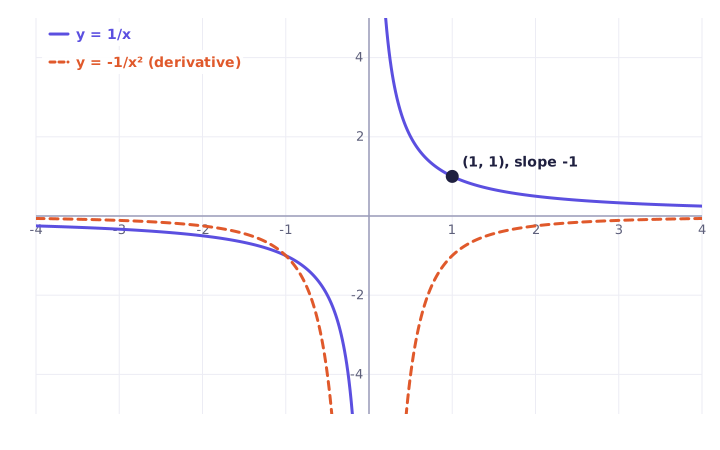
Near x = 0 the branches are nearly vertical, and -\frac{1}{x^2} is a huge negative number. Far from 0 the curve flattens, and -\frac{1}{x^2} approaches 0.
Proof from the limit definition
Combine the fractions on top over the common denominator x(x + h):
Divide by h and let h \to 0:
Proof with the power rule
Since \frac{1}{x} = x^{-1}, the power rule gives -1 \cdot x^{-2} = -\frac{1}{x^2}. The quotient rule agrees: \frac{0 \cdot x - 1 \cdot 1}{x^2} = -\frac{1}{x^2}.
The chain rule version: derivative of 1/u
| Function | Inside u | Derivative |
|---|---|---|
| \frac{1}{2x + 5} | 2x + 5 | -\frac{2}{(2x + 5)^2} |
| \frac{1}{x^2 + 1} | x^2 + 1 | -\frac{2x}{(x^2 + 1)^2} |
| \frac{1}{\sin x} | \sin x | -\frac{\cos x}{\sin^2 x} |
| \frac{1}{e^x + 1} | e^x + 1 | -\frac{e^x}{(e^x + 1)^2} |
The third row is the same as -\csc x\cot x, the derivative of csc x.
Worked examples
Example 1: a sum. \frac{d}{dx}\left(x + \frac{1}{x}\right) = 1 - \frac{1}{x^2}. Setting this to 0 gives x = \pm 1, where x + \frac{1}{x} has its turning points.
Example 2: a tangent line. At x = 2, y = \frac{1}{2} and the slope is -\frac{1}{4}:
Example 3: second derivative. \frac{d}{dx}\left(-x^{-2}\right) = 2x^{-3} = \frac{2}{x^3}. It is positive for x > 0 and negative for x < 0, so the right branch is concave up and the left branch concave down.
Common mistakes
- Answering \ln x or \frac{1}{x^2}. The derivative is -\frac{1}{x^2}. The function \ln x is the antiderivative, not the derivative.
- Losing the minus sign. x^{-1} brings down -1.
- Writing x^0. Lowering -1 by one gives -2, not 0.
- Forgetting u'. \frac{d}{dx}\frac{1}{3x} is -\frac{3}{(3x)^2} = -\frac{1}{3x^2}, not -\frac{1}{9x^2}.
The integral side is on the integral of 1/x page, and the curve itself is on the reciprocal function page.
Practice it now
The power rule
Solve real problems on this topic with instant feedback, hints and a step-by-step walkthrough for every answer. Free, no sign-up needed to start.
Practice this lesson