Derivative of e^(x²): Formula, Steps and Examples
The derivative of e^(x²) is 2x·e^(x²). See the chain rule steps, the second derivative, how it differs from (eˣ)², and examples like e^(−x²).
Exponential and log derivatives Updated 2 min read
At a glance
- Derivative
- 2x\,e^{x^2}
- Second derivative
- (4x^2 + 2)\,e^{x^2}
- Critical point
- x = 0, a minimum
- Related function
- \dfrac{d}{dx}e^{-x^2} = -2x\,e^{-x^2}
- Integral
- \int e^{x^2}\,dx has no elementary formula
On this page
The derivative of e^{x^2} is 2x\,e^{x^2}. The exponential is copied unchanged and multiplied by the derivative of the exponent x^2.
Step by step with the chain rule
The function is a composition: an outer exponential e^u and an inside u = x^2. By the chain rule:
- Differentiate the outside and keep the inside: since the derivative of eˣ is e^x, this gives e^{x^2}.
- Differentiate the inside: \frac{d}{dx}x^2 = 2x.
- Multiply: e^{x^2}\cdot 2x = 2x\,e^{x^2}.
It is usual to write the 2x in front so nobody mistakes it for part of the exponent.
Graph of e^(x²) and its derivative
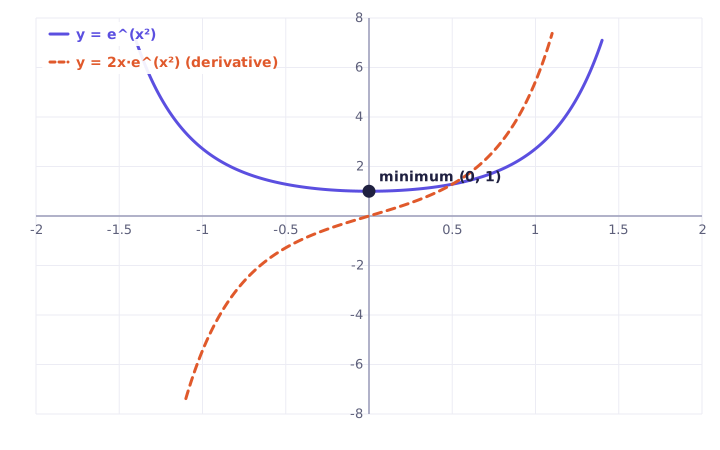
The derivative 2x\,e^{x^2} is negative for x < 0 and positive for x > 0, because e^{x^2} is always positive. So the graph falls, bottoms out at x = 0, then rises. It is symmetric about the y-axis, and its derivative is an odd function.
Second derivative
Differentiate 2x\,e^{x^2} with the product rule:
Since 4x^2 + 2 > 0, the curve is concave up everywhere and has no inflection points.
e^(x²) versus (eˣ)²
These look alike but are different functions:
| Function | Simplified | Derivative |
|---|---|---|
| e^{x^2} | e^{(x^2)} | 2x\,e^{x^2} |
| (e^x)^2 | e^{2x} | 2e^{2x} |
At x = 3: e^{x^2} = e^9 \approx 8103, but (e^x)^2 = e^6 \approx 403. See the derivative of e^(2x) for the second one.
Worked examples
Example 1: the bell curve. For f(x) = e^{-x^2}, the inside derivative is -2x:
This shape is the core of the normal distribution. The maximum is at x = 0.
Example 2: a constant in the exponent. For g(x) = e^{3x^2 + 1},
Example 3: a product. For h(x) = x\,e^{x^2},
Notice that h'(x) is always positive, so h is always increasing.
Common mistakes
- Forgetting the 2x. \frac{d}{dx}e^{x^2} = e^{x^2} is wrong; that only works for plain e^x.
- Writing e^{2x}. The exponent never changes when you differentiate an exponential.
- Using the power rule. x^2 e^{x^2 - 1} treats the exponential as a power of e with a variable base. It is not.
- Expecting an easy integral. You can differentiate e^{x^2} in one line, but its antiderivative has no elementary formula. Read the integral of e^(x²) for why, and what to do instead.
Practise more chain rule exponentials with derivatives of exponential and logarithmic functions.
Practice it now
Chain rule: e and ln
Solve real problems on this topic with instant feedback, hints and a step-by-step walkthrough for every answer. Free, no sign-up needed to start.
Practice this lesson