Derivative of sinh x: Formula, Proof and Examples
The derivative of sinh x is cosh x. See the proof from the exponential definition, why there is no minus sign, chain rule examples and a graph.
Hyperbolic derivatives Updated 2 min read
At a glance
- Derivative
- \cosh x
- Definition
- \sinh x = \dfrac{e^x - e^{-x}}{2}
- Chain rule form
- \dfrac{d}{dx}\sinh u = \cosh u\cdot u'
- Second derivative
- \sinh x
- Inverse derivative
- \dfrac{d}{dx}\operatorname{arsinh} x = \dfrac{1}{\sqrt{x^2 + 1}}
On this page
The derivative of \sinh x is \cosh x. The hyperbolic sine behaves like the ordinary sine in many ways, but its derivative has no surprises with signs.
Proof from the definition
The hyperbolic sine and cosine are defined with exponentials:
Differentiate \sinh x term by term. The derivative of eˣ is e^x, and the derivative of e^(−x) is -e^{-x}:
The two minus signs cancel, which is why the answer is +\cosh x.
Graph of sinh x and its derivative
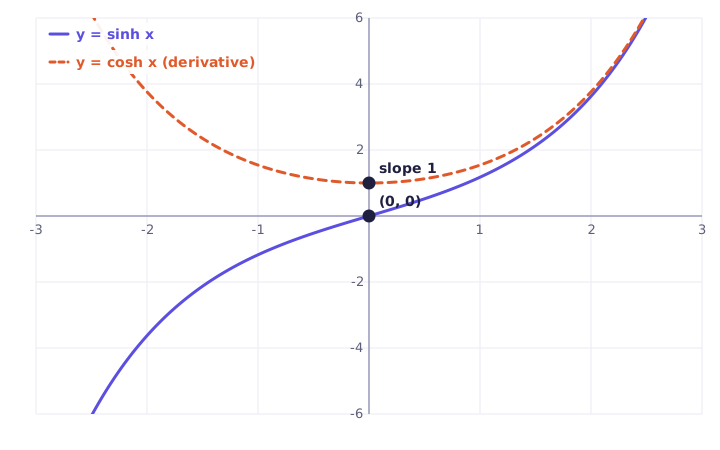
Because \cosh x \ge 1 for every x, the graph of \sinh x always rises, and its smallest slope is 1 at the origin. Its tangent line at 0 is y = x.
Hyperbolic vs circular derivatives
| Circular | Derivative | Hyperbolic | Derivative |
|---|---|---|---|
| \sin x | \cos x | \sinh x | \cosh x |
| \cos x | -\sin x | \cosh x | \sinh x |
| \tan x | \sec^2 x | \tanh x | \operatorname{sech}^2 x |
The ordinary sine cycles with period four: \sin \to \cos \to -\sin \to -\cos \to \sin. The hyperbolic sine cycles with period two: \sinh \to \cosh \to \sinh. So y = \sinh x solves y'' = y, while y = \sin x solves y'' = -y.
Chain rule version and examples
Example 1. \frac{d}{dx}\sinh(3x) = 3\cosh(3x).
Example 2. \frac{d}{dx}\sinh(x^2) = 2x\cosh(x^2).
Example 3: product rule. \frac{d}{dx}\,x\sinh x = \sinh x + x\cosh x.
Example 4: a power. \frac{d}{dx}\sinh^2 x = 2\sinh x\cosh x = \sinh(2x), using the identity \sinh 2x = 2\sinh x\cosh x.
Example 5: a log. \frac{d}{dx}\ln(\sinh x) = \frac{\cosh x}{\sinh x} = \coth x for x > 0.
Derivative of the inverse, arsinh x
The inverse hyperbolic sine has a log formula, \operatorname{arsinh} x = \ln\!\left(x + \sqrt{x^2 + 1}\right). Its derivative is
You can prove it like the derivative of arcsin x: set \sinh y = x, differentiate to get \cosh y\,y' = 1, and use \cosh y = \sqrt{1 + \sinh^2 y} = \sqrt{1 + x^2}. This result is why \int\frac{dx}{\sqrt{x^2 + 1}} = \operatorname{arsinh} x + C.
Common mistakes
- Adding a minus sign. \frac{d}{dx}\sinh x = \cosh x, not -\cosh x. Only circular cosine picks up a minus.
- Confusing \sinh x with \sin x. They share a pattern but are different functions with different graphs.
- Forgetting the chain rule. \frac{d}{dx}\sinh(5x) = 5\cosh(5x).
For the companion results, see the derivative of cosh x and the derivative of tanh x. The hyperbolic functions page covers their graphs and identities.
Practice it now
Chain rule: e and ln
Solve real problems on this topic with instant feedback, hints and a step-by-step walkthrough for every answer. Free, no sign-up needed to start.
Practice this lesson