Natural Exponential Function eˣ: Graph, Derivative, Integral and e
The natural exponential function e^x: what e is, its graph, why it is its own derivative and integral, key limits, series and worked examples.
Exponential and logarithmic functions Updated 3 min read
At a glance
- Domain
- (-\infty, \infty)
- Range
- (0, \infty)
- Derivative
- e^x
- Integral
- e^x + C
- Value of e
- e \approx 2.71828
- Inverse
- \ln x
- Asymptote
- y = 0 as x \to -\infty
On this page
The natural exponential function f(x) = e^x is the exponential function whose base is Euler's number e \approx 2.71828. It is the single most important function in calculus, because it is its own derivative: the rate at which e^x grows always equals its current value.
Formula and the number e
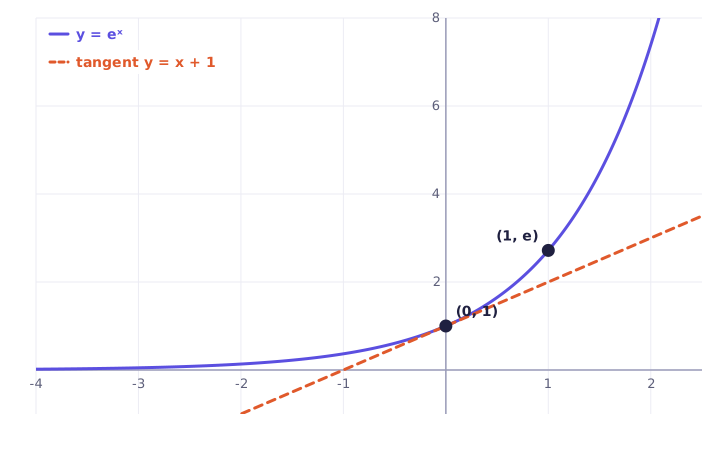
Every exponential function b^x has a slope at x = 0 proportional to its height. The base e is the one choice that makes the slope at x = 0 exactly 1, which is why derivatives of e^x come out so clean.
Graph of eˣ
Key properties
- Domain all reals, range (0, \infty): e^x is always positive.
- Always increasing and always concave up, since f'(x) = f''(x) = e^x > 0.
- Horizontal asymptote y = 0: \lim_{x \to -\infty}e^x = 0, while \lim_{x \to \infty}e^x = \infty.
- Inverse of the natural log: e^{\ln x} = x for x > 0 and \ln(e^x) = x for all x. See the natural logarithm.
- Exponent rules: e^{a+b} = e^ae^b, e^{a-b} = \frac{e^a}{e^b}, (e^a)^b = e^{ab}, e^0 = 1.
- Grows faster than any power: \lim_{x \to \infty}\frac{x^n}{e^x} = 0 for every n.
- Power series: e^x = \sum_{n=0}^{\infty}\frac{x^n}{n!} = 1 + x + \frac{x^2}{2!} + \frac{x^3}{3!} + \cdots, valid for all x.
Derivative of eˣ
With the chain rule:
The exponent is never brought down in front. That is the power rule, which does not apply here.
Integral of eˣ
Worked examples
Example 1. \frac{d}{dx}e^{3x} = 3e^{3x}.
Example 2: chain rule. \frac{d}{dx}e^{x^2} = 2x\,e^{x^2}.
Example 3: product rule. \frac{d}{dx}\left(x e^x\right) = e^x + xe^x = (1 + x)e^x.
Example 4: definite integral. \int_0^{\ln 2}e^x\,dx = e^{\ln 2} - e^0 = 2 - 1 = 1.
Example 5: u-substitution. With u = x^2, \int 2x\,e^{x^2}\,dx = e^{x^2} + C.
Example 6: exponential growth. The solution of y' = ky with y(0) = y_0 is y = y_0e^{kt}. This is why e appears in population growth, radioactive decay and continuous compound interest.
Common mistakes
- Using the power rule. \frac{d}{dx}e^x \ne xe^{x-1}.
- Forgetting the chain rule factor. \frac{d}{dx}e^{5x} = 5e^{5x}, not e^{5x}.
- Integrating e^{kx} without dividing by k. \int e^{4x}\,dx = \frac{1}{4}e^{4x} + C.
- Treating e^2 as a variable. e^2 is a constant, so its derivative is 0.
- Writing e^{a+b} = e^a + e^b. Exponents add when you multiply: e^{a+b} = e^ae^b.
How it connects
e^x is the inverse of \ln x and the building block of the hyperbolic functions. Any exponential can be rewritten with base e: b^x = e^{x\ln b}. For a full walkthrough with more practice, read the guide to derivatives of exponential and logarithmic functions, and see Taylor series for its series expansion.
Practice it now
Exponentials and logarithms
Solve real problems on this topic with instant feedback, hints and a step-by-step walkthrough for every answer. Free, no sign-up needed to start.
Practice this lesson