Natural Logarithm ln(x): Graph, Rules, Derivative and Integral
The natural logarithm ln x: its graph, log rules, why its derivative is 1/x, the integral x ln x - x + C, and worked calculus examples.
Exponential and logarithmic functions Updated 3 min read
At a glance
- Domain
- (0, \infty)
- Range
- (-\infty, \infty)
- Derivative
- \frac{1}{x}
- Integral
- x\ln x - x + C
- Key values
- \ln 1 = 0, \ln e = 1
- Inverse
- e^x
- Asymptote
- x = 0
On this page
The natural logarithm \ln x answers the question "what power of e gives x?". It is the inverse of the natural exponential function, and its derivative is the remarkably simple \frac{1}{x}, which makes it the logarithm of choice in calculus.
Definition and formula
Equivalently, \ln x is the area under the reciprocal function from 1 to x:
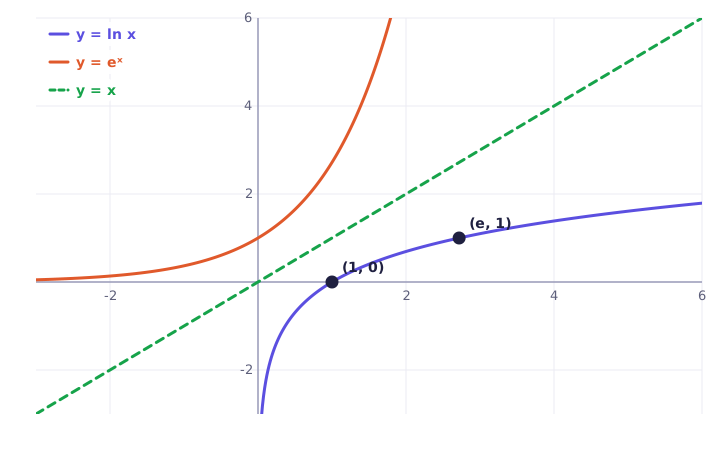
Graph of ln x
Key properties
- Domain (0, \infty), range all reals.
- Key values: \ln 1 = 0, \ln e = 1, \ln e^k = k.
- Increasing everywhere (\frac{1}{x} > 0) and concave down (-\frac{1}{x^2} < 0).
- Vertical asymptote x = 0: \lim_{x \to 0^+}\ln x = -\infty. Also \lim_{x \to \infty}\ln x = \infty, but very slowly; \ln x grows slower than any positive power of x.
- Inverse identities: e^{\ln x} = x for x > 0 and \ln e^x = x for all x.
Log rules
| Rule | Formula |
|---|---|
| Product | \ln(ab) = \ln a + \ln b |
| Quotient | \ln\frac{a}{b} = \ln a - \ln b |
| Power | \ln(a^k) = k\ln a |
| Change of base | \log_b x = \frac{\ln x}{\ln b} |
These hold for a, b > 0. There is no rule for \ln(a + b).
Derivative of ln x
Proof sketch: if y = \ln x then e^y = x. Differentiating implicitly gives e^y y' = 1, so y' = \frac{1}{e^y} = \frac{1}{x}. With the chain rule:
Integral of ln x
Using integration by parts with u = \ln x, dv = dx, so du = \frac{1}{x}\,dx and v = x:
The reverse direction is the more common one: \int \frac{1}{x}\,dx = \ln|x| + C.
Worked examples
Example 1: chain rule. \frac{d}{dx}\ln(x^2 + 1) = \frac{2x}{x^2 + 1}.
Example 2: simplify first. \frac{d}{dx}\ln\frac{x^3}{x + 1} = \frac{d}{dx}\left[3\ln x - \ln(x + 1)\right] = \frac{3}{x} - \frac{1}{x + 1}.
Example 3: product rule. \frac{d}{dx}(x^2\ln x) = 2x\ln x + x.
Example 4: definite integral. \int_1^e \ln x\,dx = \left[x\ln x - x\right]_1^e = (e - e) - (0 - 1) = 1.
Example 5: logarithmic integral. With u = x^2 + 4, \int \frac{2x}{x^2 + 4}\,dx = \ln(x^2 + 4) + C. No absolute value is needed since x^2 + 4 > 0.
Common mistakes
- Splitting a log of a sum. \ln(x + 1) \ne \ln x + \ln 1.
- Writing \frac{d}{dx}\ln(5x) = \frac{1}{5x}. The chain rule gives \frac{5}{5x} = \frac{1}{x}.
- Writing \int \ln x\,dx = \frac{1}{x} + C. That is the derivative, not the integral.
- Confusing \ln x^2 with (\ln x)^2. The first is 2\ln x; the second is a square.
- Taking \ln of 0 or a negative number. Check the domain, especially after a substitution.
How it connects
Taking \ln of both sides turns hard products and powers into sums, the idea behind logarithmic differentiation. Logs with other bases are just rescaled natural logs; see logarithmic functions. For more worked practice, read the guide to derivatives of exponential and logarithmic functions.
Practice it now
Exponentials and logarithms
Solve real problems on this topic with instant feedback, hints and a step-by-step walkthrough for every answer. Free, no sign-up needed to start.
Practice this lesson