Exponential Functions bˣ: Graphs, Growth, Derivative and Integral
Exponential functions f(x) = b^x: growth and decay graphs, properties, the derivative b^x ln b, the integral b^x / ln b + C and worked examples.
Exponential and logarithmic functions Updated 3 min read
At a glance
- Domain
- (-\infty, \infty)
- Range
- (0, \infty)
- Derivative
- b^x \ln b
- Integral
- \frac{b^x}{\ln b} + C
- Growth or decay
- Growth if b > 1, decay if 0 < b < 1
- Inverse
- \log_b x
On this page
An exponential function has a constant base raised to a variable power, f(x) = b^x. Each time x increases by 1, the output is multiplied by the same factor b, which is why exponentials model compound interest, population growth, half-lives and anything else that changes by a fixed percentage.
Formula
More generally f(x) = A\,b^x, where A = f(0) is the starting value. The restrictions on b matter: b = 1 gives the constant 1, and a negative base such as (-2)^x is not real for most fractional x. The most important base is e; see the natural exponential function.
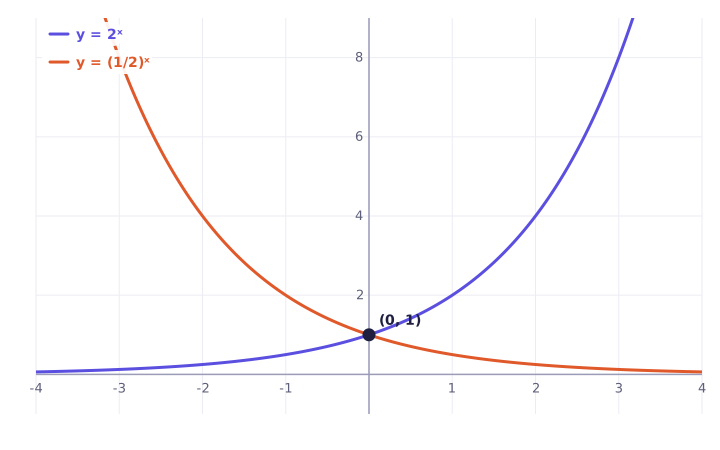
Graphs of exponential functions
Key properties
- Domain all reals, range (0, \infty); the graph always passes through (0, 1).
- Growth (b > 1): increasing, b^x \to \infty as x \to \infty and b^x \to 0 as x \to -\infty.
- Decay (0 < b < 1): decreasing, with the opposite limits.
- Horizontal asymptote y = 0 in both cases. No x-intercepts.
- Concave up for every valid base.
- Inverse is the logarithmic function \log_b x.
- Change of base: b^x = e^{x\ln b}.
- Exponent rules: b^{m}b^{n} = b^{m+n}, \frac{b^m}{b^n} = b^{m-n}, (b^m)^n = b^{mn}, b^{-n} = \frac{1}{b^n}.
Derivative of bˣ
Rewrite with base e and use the chain rule:
The derivative is proportional to the function itself. For b > 1, \ln b > 0 (growth); for 0 < b < 1, \ln b < 0 (decay). With an inner function, \frac{d}{dx}b^{g(x)} = b^{g(x)}\ln b \cdot g'(x).
Integral of bˣ
Differentiate the right side to check: \frac{b^x\ln b}{\ln b} = b^x.
Worked examples
Example 1. \frac{d}{dx}5^x = 5^x\ln 5.
Example 2: chain rule. \frac{d}{dx}3^{x^2} = 3^{x^2}\ln 3 \cdot 2x.
Example 3: definite integral. \int_0^2 2^x\,dx = \left[\frac{2^x}{\ln 2}\right]_0^2 = \frac{4 - 1}{\ln 2} = \frac{3}{\ln 2} \approx 4.33.
Example 4: half-life. A sample with a half-life of 5 years has A(t) = A_0\left(\frac{1}{2}\right)^{t/5}. The decay rate is
so the sample loses about 13.9\% of its current amount per year at every instant.
Example 5: compound interest. At 5\% yearly interest, P(t) = P_0(1.05)^t. Compounded continuously it becomes P_0e^{0.05t}.
Common mistakes
- Using the power rule. \frac{d}{dx}2^x \ne x\,2^{x-1}.
- Forgetting the \ln b factor, or writing \log_{10} b instead of \ln b.
- Multiplying instead of dividing when integrating. \int 2^x\,dx = \frac{2^x}{\ln 2} + C, not 2^x\ln 2 + C.
- Writing 2 \cdot 3^x = 6^x. The coefficient does not combine with the base.
How it connects
Exponentials outgrow every polynomial, a fact that drives many limits at infinity and L'Hôpital's rule problems. Geometric sequences are exponentials sampled at whole numbers, which leads to geometric series. For more derivatives practice, read the guide to derivatives of exponential and logarithmic functions.
Practice it now
Exponentials and logarithms
Solve real problems on this topic with instant feedback, hints and a step-by-step walkthrough for every answer. Free, no sign-up needed to start.
Practice this lesson