Secant, Cosecant and Cotangent: Graphs, Derivatives, Integrals
The reciprocal trig functions sec x, csc x and cot x: definitions, graphs, asymptotes, all three derivatives and integrals, with worked examples.
Trigonometric functions Updated 3 min read
At a glance
- Domain of sec x
- x \ne \frac{\pi}{2} + k\pi
- Range of sec x
- (-\infty, -1] \cup [1, \infty)
- Derivative
- \sec x \tan x
- Integral
- \ln\lvert\sec x + \tan x\rvert + C
- Periods
- \sec and \csc: 2\pi; \cot: \pi
On this page
The reciprocal trig functions are secant, cosecant and cotangent. Each is one over a basic trig function: \sec x = \frac{1}{\cos x}, \csc x = \frac{1}{\sin x} and \cot x = \frac{1}{\tan x}. They appear constantly in derivative and integral formulas, so even if you rarely graph them, you need their calculus facts.
Definitions
A quick way to remember the pairing: each function on the left has exactly one "co" between it and its partner. Secant goes with cosine, cosecant goes with sine.
| Function | Reciprocal of | Undefined where | Period | Range |
|---|---|---|---|---|
| \sec x | \cos x | x = \frac{\pi}{2} + k\pi | 2\pi | \lvert y\rvert \ge 1 |
| \csc x | \sin x | x = k\pi | 2\pi | \lvert y\rvert \ge 1 |
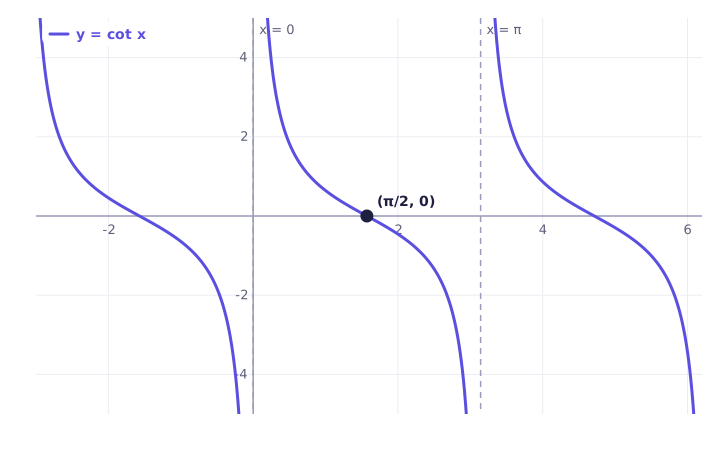
| \cot x | \tan x | x = k\pi | \pi | all reals |
Graphs of secant and cosecant
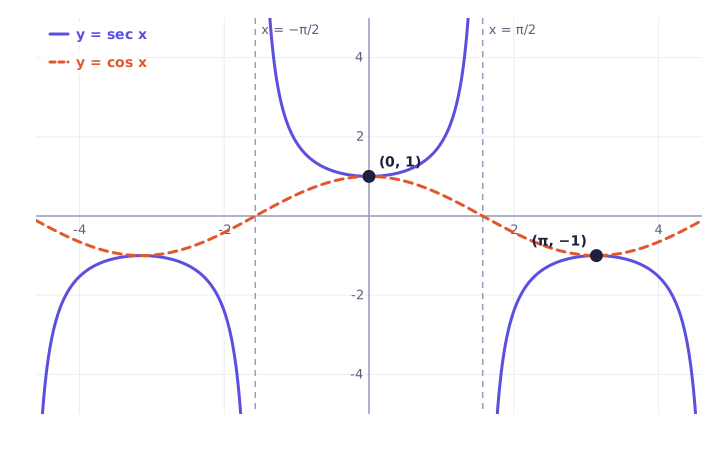
Secant is never between -1 and 1: dividing 1 by a number in [-1, 1] always gives something at least 1 in size. The cosecant graph is the same shape shifted right by \frac{\pi}{2}, with asymptotes at the multiples of \pi.
Derivatives of sec, csc and cot
| Function | Derivative |
|---|---|
| \sec x | \sec x\tan x |
| \csc x | -\csc x\cot x |
| \cot x | -\csc^2 x |
Why (\sec x)' = \sec x\tan x. Write \sec x = (\cos x)^{-1} and use the chain rule:
The same steps with \sin x give (\csc x)' = -\csc x\cot x, and the quotient rule on \frac{\cos x}{\sin x} gives (\cot x)' = \frac{-\sin^2 x - \cos^2 x}{\sin^2 x} = -\csc^2 x.
Integrals of sec, csc and cot
| Function | Integral |
|---|---|
| \sec x | \ln\lvert\sec x + \tan x\rvert + C |
| \csc x | -\ln\lvert\csc x + \cot x\rvert + C |
| \cot x | \ln\lvert\sin x\rvert + C |
| \sec^2 x | \tan x + C |
| \csc^2 x | -\cot x + C |
| \sec x\tan x | \sec x + C |
| \csc x\cot x | -\csc x + C |
The secant integral. Multiply top and bottom by \sec x + \tan x:
The numerator is exactly the derivative of the denominator, so with u = \sec x + \tan x the integral is \int\frac{du}{u} = \ln|\sec x + \tan x| + C.
The cotangent integral. With u = \sin x, \int\frac{\cos x}{\sin x}\,dx = \int\frac{du}{u} = \ln|\sin x| + C.
Worked examples
Example 1. Differentiate f(x) = \sec(2x). By the chain rule, f'(x) = 2\sec(2x)\tan(2x).
Example 2. Differentiate g(x) = x\cot x. By the product rule, g'(x) = \cot x - x\csc^2 x.
Example 3. Evaluate \int_0^{\pi/3}\sec x\tan x\,dx. The antiderivative is \sec x, so the answer is \sec\frac{\pi}{3} - \sec 0 = 2 - 1 = 1.
Example 4. Evaluate \int \csc^2(5x)\,dx. With u = 5x, the result is -\frac{1}{5}\cot(5x) + C.
Common mistakes
- Mixing up reciprocals and inverses. \sec x = \frac{1}{\cos x}, but \cos^{-1}x means arccosine.
- Pairing secant with sine. Secant is the reciprocal of cosine, and cosecant the reciprocal of sine.
- Losing the minus signs. The derivatives of \csc x and \cot x are both negative.
- Guessing \int\sec x\,dx = \sec x\tan x. That is the derivative, not the integral.
Where you will use them
The identities 1 + \tan^2 x = \sec^2 x and 1 + \cot^2 x = \csc^2 x drive trig substitution, where \sqrt{1 + x^2} becomes \sec\theta. Secant also shows up as the derivative of tangent, (\tan x)' = \sec^2 x. For a side by side summary of all six trig derivatives, see derivatives of trig functions.
Practice it now
Chain rule: trig
Solve real problems on this topic with instant feedback, hints and a step-by-step walkthrough for every answer. Free, no sign-up needed to start.
Practice this lesson