Sine Function sin(x): Graph, Derivative, Integral and Properties
The sine function sin(x): its graph, domain, range, period, key values, derivative cos(x), integral and the mistakes students make with it.
Trigonometric functions Updated 3 min read
At a glance
- Domain
- (-\infty, \infty)
- Range
- [-1, 1]
- Derivative
- \cos x
- Integral
- -\cos x + C
- Period
- 2\pi
- Symmetry
- Odd: \sin(-x) = -\sin x
On this page
The sine function takes an angle x, measured in radians, and returns the y-coordinate of the point at that angle on the unit circle. It produces the smooth repeating wave behind sound, light, tides and anything else that oscillates, and it is one of the two building blocks (with cosine) of every other trig function.
Definition of sin x
Start at the point (1, 0) on the unit circle and travel a distance x counterclockwise (clockwise if x is negative). You land at the point (\cos x, \sin x). So
In a right triangle this matches the familiar ratio \sin\theta = \frac{\text{opposite}}{\text{hypotenuse}}, but the unit circle version works for every real number, including negative angles and angles larger than 2\pi.
Graph of y = sin x
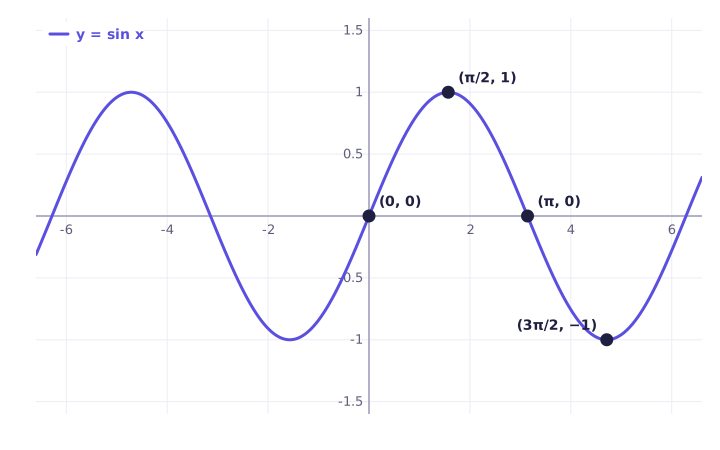
The graph passes through the origin, rises to its maximum at x = \frac{\pi}{2}, returns to zero at x = \pi, reaches its minimum at x = \frac{3\pi}{2}, and finishes one full cycle at x = 2\pi.
Key values of sine
| x | 0 | \frac{\pi}{6} | \frac{\pi}{4} | \frac{\pi}{3} | \frac{\pi}{2} | \pi | \frac{3\pi}{2} | 2\pi |
|---|---|---|---|---|---|---|---|---|
| \sin x | 0 | \frac{1}{2} | \frac{\sqrt{2}}{2} | \frac{\sqrt{3}}{2} | 1 | 0 | -1 | 0 |
Properties of the sine function
- Domain and range. Every real number is allowed, and the output always lies in [-1, 1].
- Period. \sin(x + 2\pi) = \sin x. More generally A\sin(bx) has amplitude |A| and period \frac{2\pi}{|b|}.
- Zeros. \sin x = 0 exactly when x = k\pi for an integer k.
- Odd symmetry. \sin(-x) = -\sin x, so the graph is symmetric about the origin.
- Pythagorean identity. \sin^2 x + \cos^2 x = 1 for all x.
- Shift relation. \sin x = \cos\left(x - \frac{\pi}{2}\right): the sine wave is a cosine wave shifted right by \frac{\pi}{2}.
Derivative of sin x
You can read this off the graph: sine is steepest (slope 1) at x = 0, where \cos 0 = 1, and flat at its peak x = \frac{\pi}{2}, where \cos\frac{\pi}{2} = 0. The proof uses the limit \lim_{h \to 0}\frac{\sin h}{h} = 1, which is the reason radians are required. Differentiating again gives \frac{d^2}{dx^2}\sin x = -\sin x, and the derivatives cycle through \sin, \cos, -\sin, -\cos every four steps.
With the chain rule, \frac{d}{dx}\sin(u) = \cos(u)\cdot u'.
Integral of sin x
Check it by differentiating: \frac{d}{dx}(-\cos x) = -(-\sin x) = \sin x. Over one hump the area is \int_0^{\pi}\sin x\,dx = -\cos\pi + \cos 0 = 2, and over a full period the signed area is \int_0^{2\pi}\sin x\,dx = 0.
Worked examples
Example 1: chain rule. Differentiate f(x) = \sin(x^2). The inside is x^2 with derivative 2x, so f'(x) = 2x\cos(x^2).
Example 2: product rule. Differentiate g(x) = x\sin x. By the product rule, g'(x) = \sin x + x\cos x.
Example 3: u-substitution. Evaluate \int \sin(5x)\,dx. Let u = 5x, so du = 5\,dx:
Example 4: a famous limit. \lim_{x \to 0}\frac{\sin(3x)}{x} = 3\lim_{x\to 0}\frac{\sin(3x)}{3x} = 3 \cdot 1 = 3.
Common mistakes
- Wrong sign on the integral. \int\sin x\,dx is -\cos x + C, not \cos x + C. The derivative has no minus sign; the integral does.
- Using degrees. \frac{d}{dx}\sin x = \cos x is false if x is in degrees. Set your calculator to radians.
- Treating \sin as multiplication. \sin(2x) \ne 2\sin x and \sin(a + b) \ne \sin a + \sin b.
- Confusing \sin^{-1}x with \frac{1}{\sin x}. \sin^{-1}x is the inverse function arcsine, while \frac{1}{\sin x} is the cosecant.
How sine connects to other topics
Sine and cosine define the rest of the family: tangent is \frac{\sin x}{\cos x}, and secant, cosecant and cotangent are reciprocals. Its inverse on \left[-\frac{\pi}{2}, \frac{\pi}{2}\right] is arcsine. In Calculus 2, sine appears in trig substitution and has the Taylor series \sin x = x - \frac{x^3}{3!} + \frac{x^5}{5!} - \cdots. For more on differentiating every trig function, read the guide to derivatives of trig functions.
Practice it now
Sine, cosine and tangent
Solve real problems on this topic with instant feedback, hints and a step-by-step walkthrough for every answer. Free, no sign-up needed to start.
Practice this lesson