AP Calc Unit 6 Review: Integration and Accumulation (AB and BC)
AP Calculus Unit 6 review for AB and BC: Riemann sums, the Fundamental Theorem, accumulation functions, u-substitution and BC techniques, with practice.
AP Calculus units Updated 4 min read
At a glance
- AB exam weight
- 15–20%
- BC exam weight
- 15–20%
- Big ideas
- Riemann sums, definite integrals, the Fundamental Theorem, antiderivatives
- BC only
- Integration by parts, linear partial fractions, improper integrals
- Comes before
- Unit 7, differential equations, and Unit 8, applications of integration
- Practice here
- Calculus 1: Integrals
AP Calculus Unit 6, Integration and Accumulation of Change, is where the second half of calculus begins. It turns rates into amounts: if you know how fast something is changing, an integral tells you how much it changed in total. It is one of the two largest units on the exam and the one that feeds the most free-response questions.
| AP Calculus AB | AP Calculus BC | |
|---|---|---|
| Exam weight | 15–20% | 15–20% |
| Extra topics | none | integration by parts, partial fractions, improper integrals |
What Unit 6 covers
College Board splits the unit into these topics. Each row links to a lesson where you can practice it with new numbers every time.
| Topic | What you learn | Practice |
|---|---|---|
| Accumulation of change | The area under a rate graph is the change in the amount | Signed area |
| Riemann sums | Left, right and midpoint sums, from formulas and tables | Riemann sums |
| Trapezoidal sums | Averaging left and right sums | Trapezoid sums |
| Definite integrals | The limit of Riemann sums, and properties of integrals | Signed area |
| Fundamental Theorem, part 1 | Derivatives of accumulation functions | Accumulation functions |
| Fundamental Theorem, part 2 | Evaluating \int_a^b f(x)\,dx = F(b) - F(a) | The Fundamental Theorem |
| Antiderivatives | Reverse power rule, trig and exponential integrals | Reverse power rule |
| Substitution | u-substitution for indefinite and definite integrals | u-substitution |
| Integration by parts (BC) | \int u\,dv = uv - \int v\,du | Integration by parts |
| Partial fractions (BC) | Splitting rational functions with linear factors | Partial fractions |
| Improper integrals (BC) | Integrals to infinity and over vertical asymptotes | Infinite limits |
The key ideas
Riemann sums estimate area. Split [a, b] into pieces, multiply each width by a height and add. For an increasing function, a left sum underestimates and a right sum overestimates. A trapezoid sum averages the two.
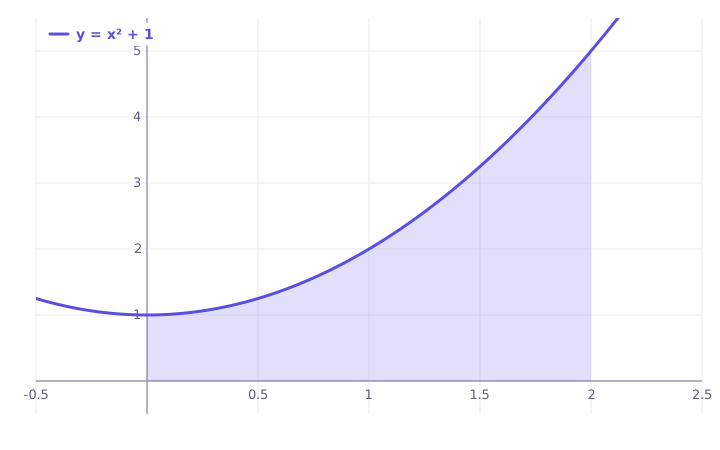
The definite integral is net change. If r(t) is a rate, then \int_a^b r(t)\,dt is the total change from t = a to t = b. This idea is behind every "rate in, rate out" free-response question.
The Fundamental Theorem connects everything. Part 1 says an accumulation function is an antiderivative:
Part 2 says you can evaluate a definite integral with any antiderivative F:
Read more on the Fundamental Theorem of Calculus, part 1 and part 2.
Sample questions
1. A table (calculator not allowed). The rate of water flow r(t), in liters per minute, is measured at t = 0, 2, 5 with values 4, 6, 9. A trapezoid sum estimates the total flow:
Notice the unequal widths. AP tables often have them, so never assume equal spacing.
2. An accumulation function. If g(x) = \int_1^x \sqrt{t^3 + 1}\,dt, then by the Fundamental Theorem g'(2) = \sqrt{8 + 1} = 3. You never need to find the antiderivative.
3. Substitution. Evaluate \int_0^1 2x(x^2 + 1)^3\,dx with u = x^2 + 1, so du = 2x\,dx and the bounds become 1 and 2:
4. BC: integration by parts. With u = x and dv = \cos x\,dx:
How to study Unit 6
- Learn to read the integral in words. "The total number of liters that flowed in during the first 5 minutes" is \int_0^5 r(t)\,dt. Free-response questions ask you to explain the meaning of an integral in context, with units.
- Practice tables with unequal widths. They are the most common setup for Riemann and trapezoid sums on the exam.
- Differentiate accumulation functions fast. Questions about g(x) = \int_a^x f(t)\,dt come back in Unit 5 style: where g increases, has extrema or is concave up.
- Drill the antiderivatives. Use the integrals reference and the calculus formula sheet until the basic ones are automatic.
- Work through problem sets. Try the Riemann sum practice problems and u-substitution practice problems, each with full solutions.
For the full course map, see the AP Calculus AB guide or the AP Calculus BC guide.
AP and Advanced Placement are registered trademarks of College Board, which is not affiliated with PracticeCalculus and does not endorse this guide. Unit names and weights come from College Board's course framework; check it for any changes.
Practice it now
Area with rectangles
Solve real problems on this topic with instant feedback, hints and a step-by-step walkthrough for every answer. Free, no sign-up needed to start.
Practice this lesson