AP Calc Unit 5 Review: Analyzing Functions (AB and BC)
AP Calculus Unit 5 review for AB and BC: the Mean Value Theorem, extrema, increasing and decreasing, concavity, curve sketching and optimization.
AP Calculus units Updated 4 min read
At a glance
- AB exam weight
- 15–20%
- BC exam weight
- 10–15%
- Big ideas
- Mean Value Theorem, extrema, first and second derivative tests, optimization
- BC only
- None, AB and BC cover the same Unit 5 topics
- Comes before
- Unit 6, integration and accumulation of change
- Practice here
- Calculus 1: Applications of derivatives
AP Calculus Unit 5, Analytical Applications of Differentiation, teaches you to read a function through its derivatives. The first derivative says where a function rises and falls. The second derivative says how it bends. Together they find maximums and minimums, which is what optimization is all about. It is one of the largest units on the AB exam.
| AP Calculus AB | AP Calculus BC | |
|---|---|---|
| Exam weight | 15–20% | 10–15% |
| Extra topics | none | none |
What Unit 5 covers
College Board splits the unit into these topics. Each row links to a lesson where you can practice it with new numbers every time.
| Topic | What you learn | Practice |
|---|---|---|
| Mean Value Theorem | Average rate equals instantaneous rate somewhere | Linear approximation and MVT |
| Extreme Value Theorem and critical points | When extrema must exist, and where to look | Critical points |
| Increasing and decreasing | Using the sign of f' | Increasing and decreasing |
| First derivative test | Relative extrema from sign changes of f' | Increasing and decreasing |
| Candidates test | Absolute extrema on a closed interval | Absolute extrema |
| Concavity | Using the sign of f'', and points of inflection | Second derivative |
| Second derivative test | Classifying a critical point with f'' | Second derivative |
| Sketching f, f' and f'' | Moving between the three graphs | Applications practice |
| Optimization | Building and maximizing a function from a story | Optimization |
| Implicit relations | Horizontal and vertical tangents on curves like circles | Implicit differentiation |
The key ideas
The Mean Value Theorem guarantees a matching slope. If f is continuous on [a, b] and differentiable on (a, b), at least one point has a tangent line parallel to the secant line. Read the Mean Value Theorem and the Extreme Value Theorem pages for the exact conditions.
f' controls direction, f'' controls shape. f' > 0 means increasing and f' < 0 means decreasing. f'' > 0 means concave up and f'' < 0 means concave down. A point of inflection is where f'' changes sign.
Optimization is extrema with a story. Write the quantity to maximize or minimize as a function of one variable, find its critical points, and justify that your answer is a max or min, using the first derivative test, the second derivative test, or the candidates test.
Sample questions
1. Mean Value Theorem. For f(x) = x^2 on [1, 3], the average rate of change is \frac{9 - 1}{3 - 1} = 4. Setting f'(c) = 2c = 4 gives c = 2, which is inside the interval.
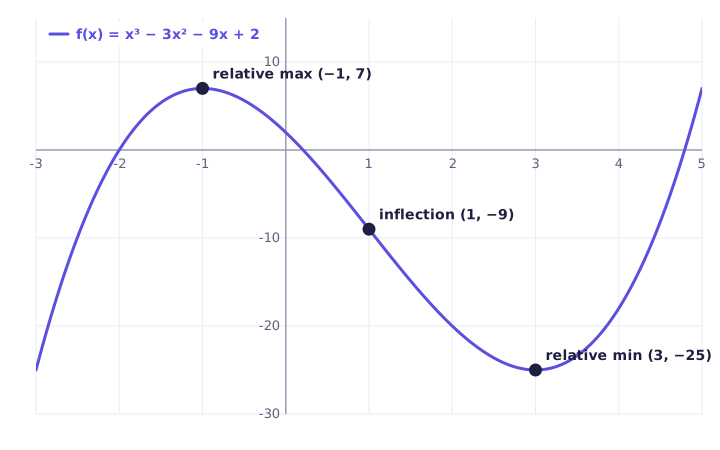
2. Relative extrema. For f(x) = x^3 - 3x^2 - 9x + 2:
f' changes from positive to negative at x = -1, so f(-1) = 7 is a relative max. It changes from negative to positive at x = 3, so f(3) = -25 is a relative min. Since f''(x) = 6x - 6 changes sign at x = 1, there is a point of inflection at (1, -9).
3. Candidates test. On [-2, 4], check the endpoints and critical points: f(-2) = 0, f(-1) = 7, f(3) = -25 and f(4) = -18. The absolute max is 7 at x = -1 and the absolute min is -25 at x = 3.
4. Optimization. A farmer has 100 m of fence to enclose a rectangle along a river, fencing only three sides. With width x, the area is A(x) = x(100 - 2x). Then A'(x) = 100 - 4x = 0 at x = 25, and A''(x) = -4 < 0, so this is a max. The best area is 25 \times 50 = 1250 m².
How to study Unit 5
- Practice with the graph of f'. Many free-response questions give only f'. Read increasing from where f' is above the axis, and concave up from where f' is rising.
- Justify with sign changes. Write "because f' changes from negative to positive at x = 3". Graders want the reason, not just the answer.
- Never skip the endpoints. On a closed interval the absolute max is often at an endpoint.
- Check MVT conditions first. State continuity and differentiability before you conclude anything.
- Work through problem sets. Try the optimization practice problems, curve sketching problems and Mean Value Theorem problems, each with full solutions. The guide to curve sketching with derivatives pulls the whole unit together.
For the full course map, see the AP Calculus AB guide or the AP Calculus BC guide.
AP and Advanced Placement are registered trademarks of College Board, which is not affiliated with PracticeCalculus and does not endorse this guide. Unit names and weights come from College Board's course framework; check it for any changes.
Practice it now
Critical points
Solve real problems on this topic with instant feedback, hints and a step-by-step walkthrough for every answer. Free, no sign-up needed to start.
Practice this lesson