AP Calc BC Unit 9 Review: Parametric, Polar and Vectors
AP Calculus BC Unit 9 review: parametric derivatives and arc length, vector-valued motion, polar slopes and polar area, with sample questions and practice.
AP Calculus units Updated 4 min read
At a glance
- AB exam weight
- Not on the AB exam
- BC exam weight
- 10–15%
- Big ideas
- Parametric derivatives, arc length, motion in the plane, polar area
- BC only
- The whole unit
- Comes before
- Unit 10, infinite sequences and series
- Practice here
- Calculus 2: Parametric and polar
AP Calculus Unit 9, Parametric Equations, Polar Coordinates, and Vector-Valued Functions, is the first of the two BC-only units. It takes derivatives and integrals off the x-axis and into the plane: a particle moving along a path, a curve given by its angle and distance from the origin, a position written as a vector. The calculus is the same. What changes is how you set it up.
| AP Calculus AB | AP Calculus BC | |
|---|---|---|
| Exam weight | not on the AB exam | 10–15% (BC only) |
| Extra topics | none | the whole unit is BC only |
What Unit 9 covers
College Board splits the unit into these topics. Each row links to a lesson where you can practice it with new numbers every time.
| Topic | What you learn | Practice |
|---|---|---|
| Parametric equations | Slopes \frac{dy}{dx} = \frac{dy/dt}{dx/dt} and tangent lines | Parametric curves |
| Second derivatives of parametric equations | Concavity of a parametric curve | Parametric curves |
| Arc length of parametric curves | \int_a^b \sqrt{(x')^2 + (y')^2}\,dt | Parametric arc length |
| Vector-valued functions | Differentiating \langle x(t), y(t)\rangle | Parametric motion |
| Integrating vector-valued functions | Position from velocity, component by component | Parametric motion |
| Motion in the plane | Velocity, speed, acceleration and distance traveled | Parametric motion |
| Polar coordinates and differentiation | Converting, and slopes of polar curves | Polar slopes |
| Area of a polar region | \frac{1}{2}\int r^2\,d\theta for one curve | Polar area |
| Area between two polar curves | Outer squared minus inner squared | Polar area |
The key ideas
A parametric curve is a path traced over time. Both x and y depend on a parameter t. The slope is a ratio of rates:
Vectors bundle motion together. If position is \vec{r}(t) = \langle x(t), y(t)\rangle, then velocity is \vec{v}(t) = \langle x'(t), y'(t)\rangle and acceleration is \vec{a}(t) = \langle x''(t), y''(t)\rangle. Speed is the length of the velocity vector, and total distance is the integral of speed.
Polar curves use angle and distance. A point is (r, \theta) with x = r\cos\theta and y = r\sin\theta. For slopes, differentiate x and y with respect to \theta and divide. For area, add up thin sectors:
Sample questions
1. Parametric slope and concavity. For x = t^2 and y = t^3 - 3t:
At t = 2 the slope is \frac{9}{4}. The curve has horizontal tangents at t = \pm 1. For concavity, \frac{d}{dt}\left(\frac{dy}{dx}\right) = \frac{3}{2}\left(1 + \frac{1}{t^2}\right), so at t = 2:
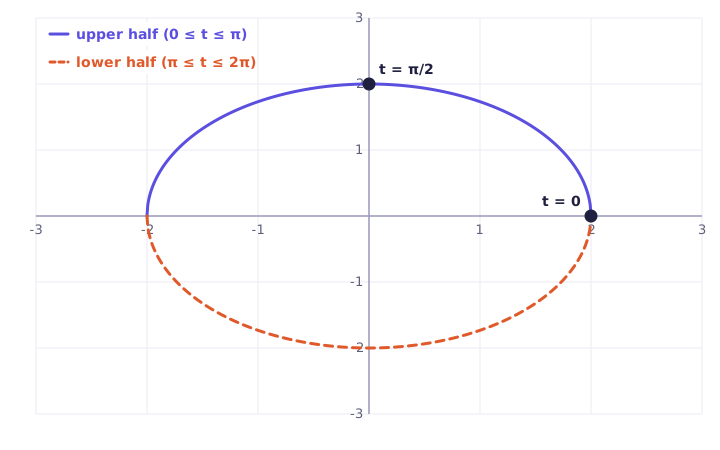
2. Parametric arc length. For x = 2\cos t and y = 2\sin t on [0, \pi], (x')^2 + (y')^2 = 4\sin^2 t + 4\cos^2 t = 4, so the length is \int_0^\pi 2\,dt = 2\pi, half the circumference of a circle of radius 2.
3. Motion in the plane. A particle has position \vec{r}(t) = \langle t^2, 3t\rangle. Then \vec{v}(t) = \langle 2t, 3\rangle and \vec{a}(t) = \langle 2, 0\rangle. At t = 2 the speed is \sqrt{4^2 + 3^2} = 5.
4. Polar area. The area inside the cardioid r = 1 + \cos\theta is
using \int_0^{2\pi}\cos\theta\,d\theta = 0 and \int_0^{2\pi}\cos^2\theta\,d\theta = \pi.
How to study Unit 9
- Divide by \frac{dx}{dt} twice. It appears in the first derivative and again in the second. Leaving it out of \frac{d^2y}{dx^2} is the most common Unit 9 mistake.
- Treat vectors one component at a time. Differentiate, integrate and add initial positions for x and y separately.
- Find polar intersections first. For the area between two polar curves, set the r values equal to get the \theta limits, then use \frac{1}{2}\int \left(r_{\text{outer}}^2 - r_{\text{inner}}^2\right)d\theta.
- Use your calculator where allowed. Many polar and arc length integrals have no simple antiderivative, so they appear on the calculator section.
- Work through problem sets. Try the parametric and polar practice problems, each with full solutions.
For the full course map, see the AP Calculus BC guide, or compare the two courses in the AP Calculus AB guide.
AP and Advanced Placement are registered trademarks of College Board, which is not affiliated with PracticeCalculus and does not endorse this guide. Unit names and weights come from College Board's course framework; check it for any changes.
Practice it now
Parametric curves
Solve real problems on this topic with instant feedback, hints and a step-by-step walkthrough for every answer. Free, no sign-up needed to start.
Practice this lesson