Fundamental Theorem of Calculus: Parts 1 and 2 With Examples
Learn both parts of the fundamental theorem of calculus: evaluate definite integrals with antiderivatives and differentiate integrals with variable limits.
By the PracticeCalculus team Published 7 min read
On this page
- What the fundamental theorem of calculus says
- Why it works: area accumulates at a rate equal to the height
- How to evaluate a definite integral (FTC part 2)
- Signed area: when the integral is negative
- Derivatives of integrals (FTC part 1)
- Quick reference
- Common mistakes with the fundamental theorem
- Practice evaluating integrals
Computing the area under y = x^2 with Riemann sums takes a page of algebra and a limit. The fundamental theorem of calculus does it in one line: \left[\frac{x^3}{3}\right]_0^2 = \frac{8}{3}. It is the reason integrals are practical at all, and it connects the two halves of calculus into one subject.
What the fundamental theorem of calculus says
In plain language: differentiation and integration are inverse processes. The theorem comes in two parts, one for each direction.
Part 1 (derivative of an integral). If f is continuous on [a, b], then the area function g(x) = \int_a^x f(t)\,dt is differentiable and
Part 2 (evaluating integrals). If f is continuous on [a, b] and F is any antiderivative of f (so F' = f), then
We write F(b) - F(a) as \Big[F(x)\Big]_a^b for short.
Most textbooks number them this way, though a few swap the labels. What matters is recognizing which job you are doing: evaluating a number, or differentiating an integral.
Why it works: area accumulates at a rate equal to the height
Picture the area under y = f(t) from a to x, and push x a tiny bit to the right, by h. The extra area is a thin strip of width h and height about f(x), so
As h \to 0 this becomes g'(x) = f(x): the rate at which area grows is the height of the curve. That is part 1. Part 2 follows: g is an antiderivative of f, any other antiderivative F differs from it by a constant, and \int_a^b f = g(b) - g(a) = F(b) - F(a).
How to evaluate a definite integral (FTC part 2)
- Find an antiderivative F(x). Skip the +C, it cancels.
- Compute F(b), the top limit.
- Compute F(a), the bottom limit.
- Subtract: F(b) - F(a).
Worked example 1: a polynomial
Evaluate \int_0^2 x^2\,dx.
Step 1. An antiderivative of x^2 is \frac{x^3}{3}.
Step 2. F(2) = \frac{8}{3}.
Step 3. F(0) = 0.
Step 4.
This is exactly the limit of Riemann sums computed the long way, with no sigma notation needed.
Worked example 2: roots and constants
Evaluate \int_1^4 (3\sqrt{x} - 2)\,dx.
Step 1. Write 3\sqrt{x} = 3x^{1/2}. Its antiderivative is 3\cdot\frac{x^{3/2}}{3/2} = 2x^{3/2}, and the antiderivative of -2 is -2x. So F(x) = 2x^{3/2} - 2x.
Step 2. F(4) = 2(4)^{3/2} - 2(4) = 2(8) - 8 = 8.
Step 3. F(1) = 2(1) - 2(1) = 0.
Step 4.
Worked example 3: the area under one arch of sine
Evaluate \int_0^{\pi} \sin x\,dx.
Step 1. An antiderivative of \sin x is -\cos x.
Steps 2 to 4.
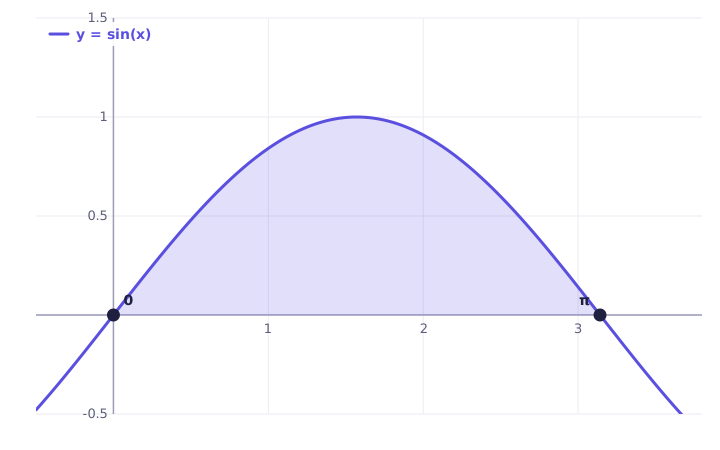
The two minus signs are where most errors happen. Write the brackets out in full, as above, every time.
Worked example 4: a logarithm
Evaluate \int_1^e \frac{1}{x}\,dx.
Worked example 5: exponentials and a constant that does not vanish
Evaluate \int_0^1 (e^x + 2x)\,dx.
Step 1. An antiderivative is F(x) = e^x + x^2.
Step 2. F(1) = e + 1.
Step 3. F(0) = e^0 + 0 = 1. Watch this one: e^0 is 1, not 0, so the bottom limit does not disappear.
Step 4.
Signed area: when the integral is negative
A definite integral counts area above the x-axis as positive and area below as negative. For example,
The arch above the axis (area 2) cancels the arch below (area 2). If a question asks for the total area rather than the integral, split at the zeros and add absolute values: 2 + 2 = 4.
Worked example 6: displacement versus distance traveled
The same idea appears in motion problems, where part 2 is often called the net change theorem: integrating a rate gives the total change. A particle moves with velocity v(t) = 3t^2 - 6t m/s. Find its displacement and the total distance it travels from t = 0 to t = 3.
Step 1. Displacement. An antiderivative of v is t^3 - 3t^2, so
The particle ends where it started.
Step 2. Find where it turns around. v(t) = 3t(t - 2) is negative on (0, 2) and positive on (2, 3).
Step 3. Distance. Integrate |v| by splitting at t = 2:
It moves 4 m backward and then 4 m forward, so the total distance is 8 m even though the displacement is 0.
Derivatives of integrals (FTC part 1)
Part 1 lets you differentiate an integral without evaluating it, which matters when the integrand has no simple antiderivative.
Worked example 7: x in the upper limit
Find \frac{d}{dx}\int_1^x \sqrt{t^3 + 1}\,dt.
There is no nice antiderivative of \sqrt{t^3 + 1}, and you do not need one. By part 1, replace t with x:
The lower limit 1 does not matter. Changing it only shifts the area function by a constant.
Worked example 8: a function in the upper limit
Find \frac{d}{dx}\int_0^{x^2}\cos t\,dt.
Here the upper limit is u = x^2, so the chain rule adds a factor of u' = 2x:
Check by evaluating first: \int_0^{x^2}\cos t\,dt = \sin(x^2) - \sin 0 = \sin(x^2), and \frac{d}{dx}\sin(x^2) = 2x\cos(x^2). It matches.
The general rule is
Worked example 9: x in the lower limit
Find \frac{d}{dx}\int_x^3 e^{t^2}\,dt.
Step 1. Flip the limits. Swapping the limits changes the sign: \int_x^3 e^{t^2}\,dt = -\int_3^x e^{t^2}\,dt.
Step 2. Apply part 1.
If both limits depend on x, split the integral at a constant: \frac{d}{dx}\int_{u(x)}^{v(x)} f(t)\,dt = f(v(x))\,v'(x) - f(u(x))\,u'(x).
Quick reference
| Task | Rule |
|---|---|
| Evaluate \int_a^b f(x)\,dx | F(b) - F(a) where F' = f |
| \frac{d}{dx}\int_a^x f(t)\,dt | f(x) |
| \frac{d}{dx}\int_a^{u(x)} f(t)\,dt | f(u(x))\,u'(x) |
| \frac{d}{dx}\int_{x}^{a} f(t)\,dt | -f(x) |
| \frac{d}{dx}\int_{u(x)}^{v(x)} f(t)\,dt | f(v(x))\,v'(x) - f(u(x))\,u'(x) |
| Swap limits | \int_b^a f = -\int_a^b f |
Common mistakes with the fundamental theorem
- Subtracting in the wrong order. It is F(\text{top}) - F(\text{bottom}). Reversing it flips the sign of your answer.
- Dropping parentheses with negatives. In example 3, (-\cos\pi) - (-\cos 0) needs every bracket. Writing -\cos\pi - \cos 0 gives 0 instead of 2.
- Forgetting the chain rule factor. \frac{d}{dx}\int_0^{x^2}\cos t\,dt is 2x\cos(x^2), not \cos(x^2).
- Integrating when part 1 applies. If the question asks for a derivative of an integral, you rarely need to find an antiderivative at all.
- Confusing integral with total area. If the curve dips below the axis, \int_a^b f is not the area. Split at the zeros.
- Applying it across a discontinuity. \int_{-1}^1 \frac{1}{x^2}\,dx is not \left[-\frac{1}{x}\right]_{-1}^1 = -2. The integrand blows up at 0, so the theorem does not apply. That is an improper integral.
Practice evaluating integrals
Once the theorem clicks, every definite integral becomes an antiderivative plus some careful arithmetic. Most errors are sign slips, so repetition with feedback is the fastest way to get reliable. The interactive lesson below checks each answer instantly and shows the full bracket work whenever a sign goes astray. For harder integrands, the next step is u-substitution.
Practice it now
Evaluating definite integrals
Solve real problems on this topic with instant feedback, hints and a step-by-step walkthrough for every answer. Free, no sign-up needed to start.
Practice this lesson