Geometric Series: Sum Formula, Convergence and Examples
Learn the geometric series sum formula, why it converges only when |r| < 1, how partial sums behave, and how to turn repeating decimals into fractions.
By the PracticeCalculus team Published 7 min read
On this page
- What is a geometric series?
- The geometric series sum formula
- When does a geometric series converge?
- Seeing the partial sums approach the limit
- Worked example 1: a sum that starts at n = 1
- Worked example 2: a negative ratio
- Worked example 3: a divergent series
- Worked example: a finite geometric sum
- Repeating decimals as geometric series
- A real-world example: the bouncing ball
- From geometric series to power series
- Common geometric series mistakes
- Quick reference
- Practice until the formula is automatic
Add 1 + \frac12 + \frac14 + \frac18 + \cdots forever. Infinitely many positive terms, yet the total never passes 2. Geometric series are the one kind of infinite sum you can add up exactly with a single formula, and they are the foundation for everything else in the study of series, from convergence tests to power series.
What is a geometric series?
A geometric series is a sum in which each term is the previous term multiplied by a fixed number r, called the common ratio:
Here a is the first term. To find r, divide any term by the one before it. For 1 + \frac12 + \frac14 + \cdots, the first term is a = 1 and the ratio is r = \frac12.
The geometric series sum formula
The nth partial sum adds the first n terms:
The infinite sum is the limit of S_n as n \to \infty. If |r| < 1, then r^n \to 0 and the partial sums settle down:
A handy way to remember it: sum = first term over one minus ratio.
Where the formula comes from
Write out S_n, multiply by r and subtract:
Every middle term cancels, leaving S_n - rS_n = a - ar^n. Factor and divide:
That subtraction trick is worth remembering. It works on finite and infinite geometric sums alike.
When does a geometric series converge?
Everything depends on the size of r:
| Ratio | What r^n does | The series |
|---|---|---|
| \lvert r\rvert < 1 | shrinks to 0 | converges to \frac{a}{1-r} |
| r = 1 | stays 1 | diverges (a + a + a + \cdots) |
| r = -1 | flips between 1 and -1 | diverges (partial sums bounce) |
| \lvert r\rvert > 1 | grows without bound | diverges |
(We assume a \ne 0 throughout.) So a geometric series converges if and only if |r| < 1. This clean rule is why geometric series are used as a benchmark in the comparison and ratio tests.
Seeing the partial sums approach the limit
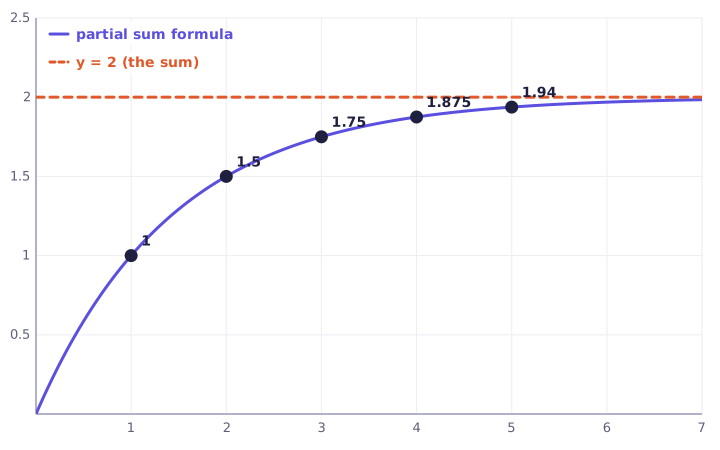
For 1 + \frac12 + \frac14 + \cdots, the partial sum formula gives S_n = \frac{1 - (1/2)^n}{1 - 1/2} = 2 - 2\left(\frac12\right)^n. The first few values are 1, 1.5, 1.75, 1.875, 1.9375. Each one closes half the remaining gap to 2.
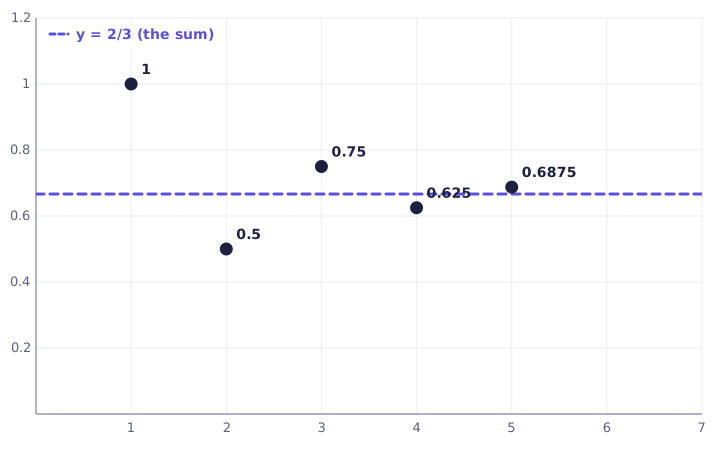
When r is negative, the partial sums alternate around the limit instead of climbing to it. For 1 - \frac12 + \frac14 - \frac18 + \cdots (with r = -\frac12), the partial sums are 1, 0.5, 0.75, 0.625, 0.6875, \dots, bouncing above and below the sum \frac{1}{1 + 1/2} = \frac23.
Worked example 1: a sum that starts at n = 1
Find \sum_{n=1}^{\infty} 3\left(\frac25\right)^n.
Step 1. Find the first term. Plug in n = 1: a = 3\cdot\frac25 = \frac65.
Step 2. Find the ratio. Each term is multiplied by \frac25, so r = \frac25.
Step 3. Check convergence. |r| = \frac25 < 1, so the series converges.
Step 4. Apply the formula.
Worked example 2: a negative ratio
Find \sum_{n=0}^{\infty} \frac{(-2)^n}{3^{n+1}}.
Step 1. Rewrite in standard form. \frac{(-2)^n}{3^{n+1}} = \frac13\cdot\frac{(-2)^n}{3^n} = \frac13\left(-\frac23\right)^n.
Step 2. Read off a and r. At n = 0 the term is \frac13, so a = \frac13 and r = -\frac23.
Step 3. Check. |r| = \frac23 < 1. It converges.
Step 4. Sum.
Worked example 3: a divergent series
Does \sum_{n=0}^\infty \frac{3^n}{2^n} converge?
This is geometric with a = 1 and r = \frac32. Since |r| > 1, the terms grow and the series diverges. Plugging into \frac{a}{1-r} would give \frac{1}{1 - 3/2} = -2, a meaningless answer. Always check |r| < 1 before using the formula.
Worked example: a finite geometric sum
The partial sum formula works for any finite geometric sum, even when |r| > 1. Find 2 + 6 + 18 + \cdots + 2\cdot 3^9.
Step 1. Identify a, r and n. The first term is a = 2, the ratio is r = 3, and the exponents run from 0 to 9, so there are n = 10 terms.
Step 2. Apply S_n = \frac{a(1-r^n)}{1-r}.
Counting the terms correctly is the main trap here: from 3^0 to 3^9 is ten terms, not nine.
Repeating decimals as geometric series
Every repeating decimal is secretly a geometric series, which is why every repeating decimal is a fraction.
Worked example 4: 0.272727...
Here a = \frac{27}{100} and r = \frac{1}{100}, so
Worked example 5: 0.999... equals 1
This is not an approximation. The infinite decimal and 1 are the same number.
Worked example 6: a decimal that repeats later
Write 1.2\overline{3} = 1.2333\ldots as a fraction.
Separate the non-repeating part: 1.2333\ldots = 1.2 + 0.0333\ldots. The repeating part is geometric with a = \frac{3}{100} and r = \frac{1}{10}:
So 1.2\overline{3} = \frac{6}{5} + \frac{1}{30} = \frac{36}{30} + \frac{1}{30} = \frac{37}{30}.
A real-world example: the bouncing ball
A ball is dropped from 10 meters, and each bounce reaches \frac34 of the previous height. How far does it travel in total?
Step 1. The first drop is 10 meters.
Step 2. The rebounds. The ball rises to 7.5 m, then 5.625 m, and so on, a geometric series with a = 7.5 and r = \frac34. Their sum is \frac{7.5}{1 - 3/4} = 30 meters.
Step 3. Count each rebound twice, once up and once down: 2 \cdot 30 = 60 meters.
Step 4. Total: 10 + 60 = 70 meters, even though the ball bounces infinitely many times.
From geometric series to power series
Replace the ratio with a variable and the sum formula becomes a statement about functions:
This single identity is the seed of power series. Substitute -x for x and you get \frac{1}{1+x} = 1 - x + x^2 - \cdots. Substitute -x^2 and you get \frac{1}{1+x^2} = 1 - x^2 + x^4 - \cdots, which integrates term by term to the series for \arctan x. The condition |x| < 1 comes straight from |r| < 1, and it is the first example of an interval of convergence.
Common geometric series mistakes
- Using the wrong first term. When the sum starts at n = 1 or higher, a is the first term you actually add, not the coefficient in front.
- Applying the formula when |r| \ge 1. The formula only works for convergent series. A negative "sum" of positive terms is a red flag.
- Misreading the ratio. In \frac{2^n}{3^{n+1}}, the ratio is \frac23, not \frac{2}{3^{n+1}}. Rewrite terms as a\cdot r^n first.
- Forgetting the sign in 1 - r. With r = -\frac23, the denominator is 1 + \frac23.
- Confusing the sequence and the series. The terms \left(\frac12\right)^n approach 0. Their sum approaches 2.
Quick reference
| Quantity | Formula |
|---|---|
| General term | ar^n (starting at n = 0) |
| Common ratio | r = \frac{\text{term}_{n+1}}{\text{term}_n} |
| nth partial sum | S_n = \frac{a(1-r^n)}{1-r} |
| Infinite sum, \lvert r\rvert < 1 | \frac{a}{1-r} |
| Diverges when | \lvert r\rvert \ge 1 |
Practice until the formula is automatic
Geometric series show up again and again: in the ratio test, in comparison arguments, and as the starting point for power series. Getting quick at finding a and r pays off for the rest of the course. The interactive lesson below gives you instant feedback on each step, so a wrong first term or a sign slip gets caught right away.
Practice it now
Geometric series
Solve real problems on this topic with instant feedback, hints and a step-by-step walkthrough for every answer. Free, no sign-up needed to start.
Practice this lesson