Product and Quotient Rules: Formulas, Mnemonics and Examples
Learn the product rule and quotient rule step by step, with easy mnemonics, when to simplify first, and fully worked derivative examples.
By the PracticeCalculus team Published 8 min read
On this page
- What are the product and quotient rules?
- Mnemonics that make them stick
- Why the product rule works
- Worked example 1: a polynomial times a trig function
- Worked example 2: checking the rule on a product of polynomials
- Worked example 3: finding where a product has a flat tangent
- Worked example 4: the quotient rule with polynomials
- Worked example 5: deriving the derivative of tan x
- When to simplify first instead
- Products of three functions
- Common mistakes with the product and quotient rules
- Quick reference
- Practice until the pattern is automatic
You know how to differentiate x^3 and you know how to differentiate \sin x. But what is the derivative of x^3 \sin x, or of \frac{x^2+1}{x-1}? It is tempting to differentiate each piece and multiply or divide the results, and that gives the wrong answer every time. The product rule and the quotient rule are the correct tools, and once you have the patterns down they take seconds.
What are the product and quotient rules?
The product rule is the formula for the derivative of two functions multiplied together. The quotient rule is the formula for the derivative of one function divided by another. Both are shortcuts that come from the limit definition of the derivative, so you never have to go back to limits for a product or a fraction.
Write u and v for two differentiable functions of x, and u' and v' for their derivatives.
Product rule:
Quotient rule:
Notice that neither rule is "multiply the derivatives" or "divide the derivatives." For example, \frac{d}{dx}(x \cdot x) = \frac{d}{dx}x^2 = 2x, but multiplying the derivatives would give 1 \cdot 1 = 1. The rules exist precisely because the naive guess fails.
Mnemonics that make them stick
For the product rule, say: "derivative of the first times the second, plus the first times the derivative of the second." Since addition does not care about order, you can also write it as uv' + u'v. Either way, each term has exactly one derivative in it.
For the quotient rule, the classic rhyme is:
Tip: "Low d-high minus high d-low, over the square of what's below." Here "high" is the numerator u, "low" is the denominator v, and "d" means "the derivative of." So: v \cdot u' minus u \cdot v', all over v^2.
The order in the quotient rule matters because of the minus sign. Always start with the derivative of the top. If you swap the two terms, your answer will have the wrong sign.
Why the product rule works
Picture a rectangle with sides u and v, so its area is uv. Now nudge x a little. The side u grows by a small amount \Delta u and the side v grows by \Delta v. The new area adds three pieces: a strip of size \Delta u \cdot v, a strip of size u \cdot \Delta v, and a tiny corner \Delta u \cdot \Delta v.
Divide by \Delta x and let \Delta x \to 0. The two strips become u'v and uv'. The corner shrinks to zero much faster than the strips, so it disappears. What is left is exactly u'v + uv'. The area changes because both sides change, and each side contributes its own strip.
Worked example 1: a polynomial times a trig function
Differentiate y = x^3 \sin x.
Step 1. Name the factors. u = x^3 and v = \sin x.
Step 2. Differentiate each factor. u' = 3x^2 and v' = \cos x.
Step 3. Plug into u'v + uv'.
Step 4. Factor if it helps. Pulling out x^2 gives y' = x^2(3\sin x + x\cos x). Both forms are correct.
Worked example 2: checking the rule on a product of polynomials
Differentiate y = (2x+1)(x^2-3).
Step 1. u = 2x + 1, so u' = 2. And v = x^2 - 3, so v' = 2x.
Step 2. Apply the product rule.
Step 3. Simplify.
Check by expanding first. (2x+1)(x^2-3) = 2x^3 + x^2 - 6x - 3, whose derivative is 6x^2 + 2x - 6. Same answer. For two polynomials, expanding and using the power rule is often just as fast. The product rule earns its keep when the factors cannot be multiplied out, like x^3 \sin x or x^2 e^x.
Worked example 3: finding where a product has a flat tangent
Find where y = x^2 e^x has a horizontal tangent line.
Step 1. u = x^2, u' = 2x, v = e^x, v' = e^x.
Step 2. Apply the product rule.
Step 3. Factor. Both terms share x e^x:
Step 4. Set it equal to zero. Since e^x is never zero, y' = 0 only when x = 0 or x = -2. The points are (0, 0) and (-2, 4e^{-2}) \approx (-2, 0.54).
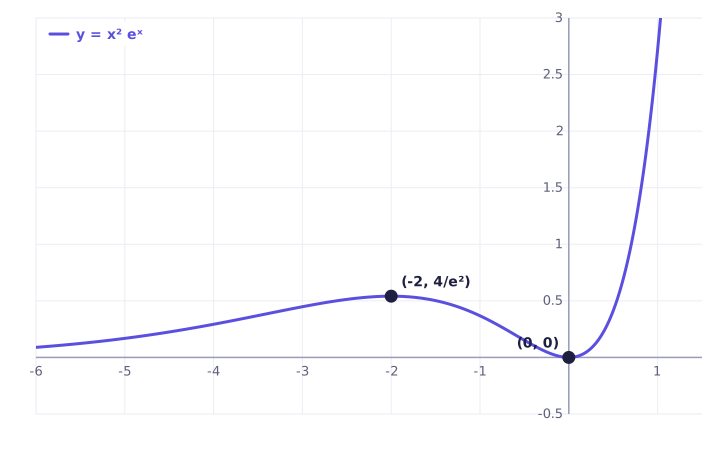
Factoring the derivative is the habit that pays off here. A factored derivative tells you its zeros at a glance.
Worked example 4: the quotient rule with polynomials
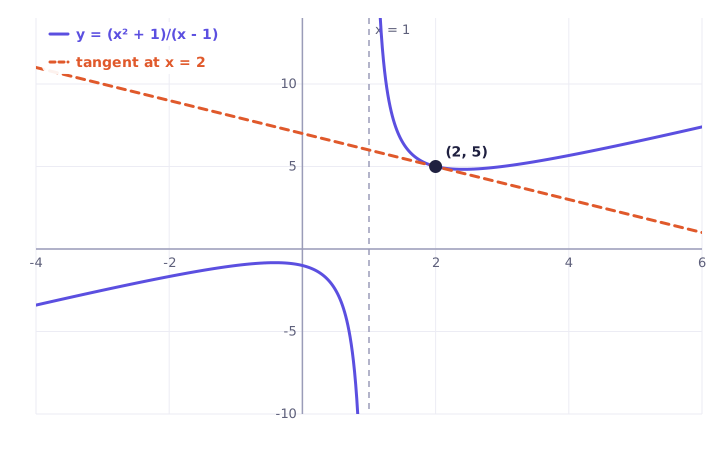
Differentiate y = \dfrac{x^2 + 1}{x - 1}.
Step 1. Name the top and bottom. High: u = x^2 + 1, so u' = 2x. Low: v = x - 1, so v' = 1.
Step 2. Low d-high minus high d-low.
Step 3. Expand the numerator only.
Step 4. Write the answer. Leave the denominator squared; expanding it rarely helps.
At x = 2 the function equals \frac{5}{1} = 5 and the slope is \frac{4 - 4 - 1}{1} = -1, so the tangent line there is y = -x + 7.
Worked example 5: deriving the derivative of tan x
Differentiate y = \tan x by writing it as \dfrac{\sin x}{\cos x}.
Step 1. High: u = \sin x, u' = \cos x. Low: v = \cos x, v' = -\sin x.
Step 2. Apply the quotient rule.
Step 3. Use \sin^2 x + \cos^2 x = 1.
This is how the derivatives of \tan x, \cot x, \sec x and \csc x are all found. See derivatives of trig functions for the full set.
When to simplify first instead
The quotient rule is reliable but messy. Before reaching for it, ask whether a little algebra makes it unnecessary.
A constant on the bottom. y = \dfrac{x^3 - 5x}{4} is just \tfrac{1}{4}(x^3 - 5x), so y' = \tfrac{1}{4}(3x^2 - 5).
A constant on top. y = \dfrac{5}{x^2} is 5x^{-2}, so y' = -10x^{-3} = -\dfrac{10}{x^3}. The quotient rule gives the same thing, but with four extra lines.
A single power of x on the bottom. Divide term by term:
Similarly, \dfrac{x^2 + \sqrt{x}}{x} = x + x^{-1/2}, with derivative 1 - \tfrac{1}{2}x^{-3/2}.
A product you can expand. As in example 2, multiplying out two short polynomials and using the power rule avoids the product rule entirely.
Tip: if the denominator is a single term, divide. If it is a sum like x - 1 or x^2 + 4, use the quotient rule.
Products of three functions
The product rule extends naturally. For three factors, differentiate one at a time and add:
For example, with y = x e^x \sin x:
Each term has exactly one factor differentiated.
Common mistakes with the product and quotient rules
- Multiplying the derivatives. \frac{d}{dx}(x^2 \sin x) \neq 2x \cos x. The correct answer is 2x\sin x + x^2 \cos x.
- Reversing the quotient rule numerator. Writing uv' - u'v flips the sign of the whole answer. Start with the derivative of the top.
- Forgetting to square the denominator. The bottom is v^2, not v.
- Dropping parentheses. In (x-1)(2x) - (x^2+1)(1), the minus sign applies to all of x^2 + 1. Losing the parentheses turns -1 into +1.
- Using the quotient rule on a constant denominator. It works, but it is slow and creates chances for errors. Pull the constant out.
- Expanding the denominator. (x-1)^2 is easier to read, and easier to use for finding where the derivative is undefined, when left factored.
Quick reference
| Situation | Rule | Example |
|---|---|---|
| u \cdot v | u'v + uv' | (x^2 \sin x)' = 2x\sin x + x^2\cos x |
| u \cdot v \cdot w | u'vw + uv'w + uvw' | (x e^x \sin x)' has three terms |
| \frac{u}{v} | \frac{u'v - uv'}{v^2} | \left(\frac{x}{x+1}\right)' = \frac{1}{(x+1)^2} |
| \frac{u}{c}, c constant | \frac{u'}{c} | \left(\frac{x^3}{4}\right)' = \frac{3x^2}{4} |
| \frac{c}{x^n} | rewrite as cx^{-n} | \left(\frac{5}{x^2}\right)' = -\frac{10}{x^3} |
| \frac{\text{poly}}{x^n} | divide term by term first | \left(\frac{x^3+2x}{x}\right)' = 2x |
When an inside function appears, such as \sin(3x) inside a product, combine these rules with the chain rule.
Practice until the pattern is automatic
The product and quotient rules are mechanical, which is good news: a few dozen problems is enough to make them second nature. Work through the interactive lesson below. Each answer is checked instantly, and if you swap the terms in a quotient or forget a factor, you will see exactly where it went wrong before moving on.
Practice it now
The product rule
Solve real problems on this topic with instant feedback, hints and a step-by-step walkthrough for every answer. Free, no sign-up needed to start.
Practice this lesson