Volumes of Revolution: Disk, Washer and Shell Methods
Learn the disk, washer and shell methods for volumes of revolution, when to use which, and worked examples rotating regions about the axes and other lines.
By the PracticeCalculus team Published 6 min read
On this page
Spin a flat region around a line and it sweeps out a 3D solid: a vase, a bowl, a bead. Finding its volume sounds hard, but if you slice it the right way, every slice is a simple shape (a disk, a washer or a thin cylindrical shell) and the integral adds them up. The hard part is choosing the slice and getting the radius right.
What is a volume of revolution?
A solid of revolution is the 3D shape you get by rotating a 2D region around a line, called the axis of rotation. Its volume is found by cutting it into thin slices whose volumes you know, then integrating.
There are three standard methods:
| Method | Slice shape | Slice relative to axis | Formula |
|---|---|---|---|
| Disk | Solid circle | Perpendicular | \pi\int R^2 |
| Washer | Circle with a hole | Perpendicular | \pi\int (R^2 - r^2) |
| Shell | Hollow cylinder | Parallel | 2\pi\int (\text{radius})(\text{height}) |
The disk method
Rotate the region under y = f(x) from a to b around the x-axis. A vertical slice of thickness dx becomes a thin coin with radius R(x) = f(x) and volume \pi R^2\,dx. Adding the coins:
Worked example 1: rotating y = √x about the x-axis
Find the volume when the region under y = \sqrt{x} from x = 0 to x = 4 is rotated about the x-axis.
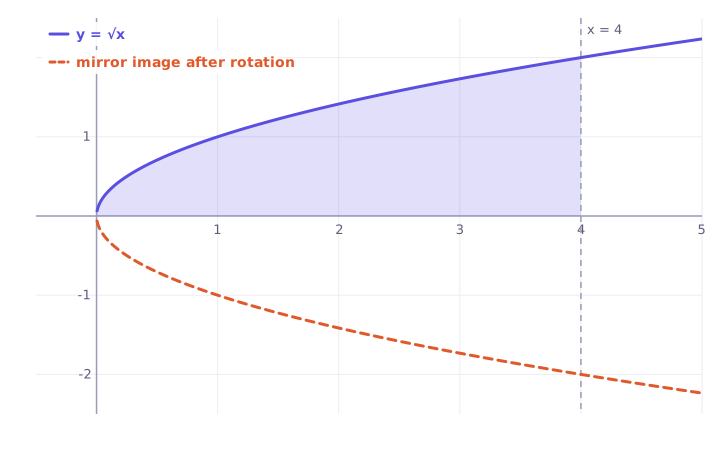
Step 1. Radius. The region touches the axis, so slices are disks with R(x) = \sqrt{x}.
Step 2. Set up.
Step 3. Integrate.
Tip: a quick sanity check for the disk method is a cone. Rotating y = \frac{r}{h}x from 0 to h gives \pi\int_0^h \frac{r^2}{h^2}x^2\,dx = \frac{1}{3}\pi r^2 h, the familiar cone formula.
The washer method
If there is a gap between the region and the axis, each slice has a hole in the middle. With outer radius R(x) and inner radius r(x):
Worked example 2: the region between y = x and y = x²
Rotate the region between y = x and y = x^2 about the x-axis.
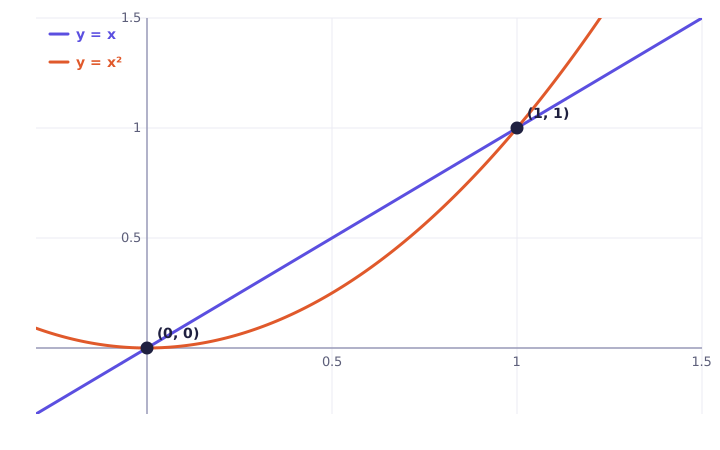
Step 1. Limits. x = x^2 gives x = 0 and x = 1 (see area between curves).
Step 2. Radii. On [0, 1], x \ge x^2, so the line is farther from the axis. R(x) = x and r(x) = x^2.
Step 3. Set up and integrate.
Worked example 3: rotating about the line y = 2
Rotate the same region about the horizontal line y = 2.
Step 1. Radii as distances. Every point of the region is below y = 2, so the distance from a curve to the axis is 2 - y. The parabola y = x^2 is lower, so it is farther from y = 2:
Step 2. Expand.
Step 3. Integrate.
Notice how the inner and outer curves swapped roles compared with example 2. Always measure from the axis.
The shell method
Now slice parallel to the axis. Rotating a thin vertical strip around the y-axis produces a hollow cylinder (a shell). Unrolled, a shell is nearly a flat sheet with length 2\pi(\text{radius}), height h(x) and thickness dx. So for rotation about the y-axis:
where x is the radius of the shell and h(x) is the height of the strip (top minus bottom).
Worked example 4: the same region, about the y-axis
Rotate the region between y = x and y = x^2 about the y-axis.
Step 1. Radius and height. A vertical strip at x is a distance x from the y-axis. Its height is x - x^2.
Step 2. Set up and integrate.
Check with washers. Slicing horizontally, solve each curve for x: the outer radius is x = \sqrt{y} and the inner is x = y, for 0 \le y \le 1:
Both methods agree.
Worked example 5: where shells are the only easy option
Rotate the region under y = 2x^2 - x^3 from x = 0 to x = 2 about the y-axis.
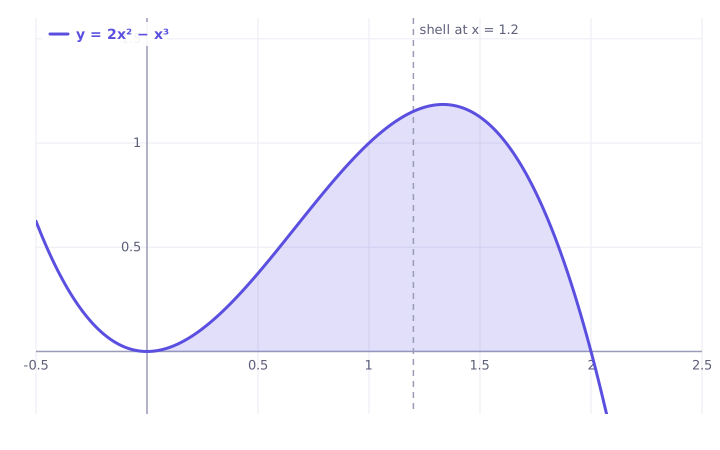
Washers would need x as a function of y, which means solving a cubic. Shells avoid that entirely.
Step 1. Radius and height. Radius x, height 2x^2 - x^3.
Step 2. Set up.
Step 3. Integrate.
Disk, washer or shell: how to choose
Ask two questions: which axis, and which variable are the curves written in?
| Curves given as | Axis of rotation | Easiest method | Integrate in |
|---|---|---|---|
| y = f(x) | Horizontal (x-axis, y = k) | Disk or washer | x |
| y = f(x) | Vertical (y-axis, x = h) | Shell | x |
| x = g(y) | Vertical | Disk or washer | y |
| x = g(y) | Horizontal | Shell | y |
The pattern: disks and washers slice perpendicular to the axis, shells slice parallel to it. Choose whichever lets you integrate in the variable the curves are already written in. For shells around x = h, the radius becomes |h - x| instead of x.
Common mistakes with volumes of revolution
- Writing (R - r)^2 instead of R^2 - r^2. Square each radius separately, then subtract.
- Forgetting \pi (or 2\pi). Disks and washers use \pi; shells use 2\pi.
- Measuring radius from the wrong place. The radius is the distance to the axis of rotation, not to the x-axis. For y = 2, the radius of y = x^2 is 2 - x^2.
- Swapping inner and outer radii. The outer radius belongs to the curve farther from the axis, which is not always the top curve.
- Mixing variables. A dy integral needs radii and limits in terms of y.
Practice volumes until the setup is automatic
The integrals in these problems are usually easy. The marks are in the setup: the right slice, the right radius, the right limits. The interactive lesson below drills exactly that, with instant feedback on each radius and each integral, so a swapped inner radius gets caught the moment it happens.
Practice it now
Volumes with disks
Solve real problems on this topic with instant feedback, hints and a step-by-step walkthrough for every answer. Free, no sign-up needed to start.
Practice this lesson