Integral of 1/(x ln x): Formula, Steps and Examples
The integral of 1/(x ln x) is ln|ln x| + C. See the u = ln x substitution, why its improper integral diverges, a graph and worked examples.
Exponential and log integrals Updated 3 min read
At a glance
- Antiderivative
- \ln\lvert\ln x\rvert + C
- Method
- Substitution u = \ln x, du = \frac{1}{x}\,dx
- Domain
- x > 0, x \ne 1
- From e to e²
- \ln 2 \approx 0.693
- From 2 to ∞
- Diverges
On this page
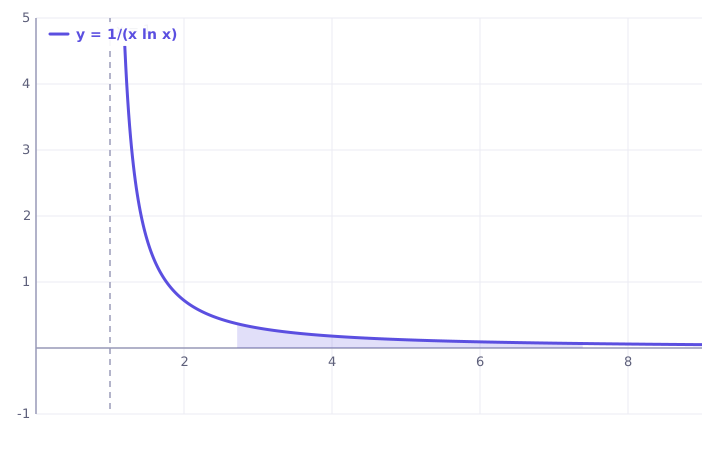
The integral of \dfrac{1}{x\ln x} is \ln\lvert\ln x\rvert + C. It is a textbook example of a substitution that is hiding in plain sight: the \frac{1}{x} is the derivative of the \ln x next to it.
The integrand is defined for x > 0 with x \ne 1, since \ln 1 = 0 would make the denominator zero.
Graph of 1/(x ln x)
How to integrate 1/(x ln x) step by step
- Spot the pair. Rewrite the integrand as \frac{1}{\ln x}\cdot\frac{1}{x}. The second factor is the derivative of \ln x.
- Substitute. Let u = \ln x, so du = \frac{1}{x}\,dx: \int\frac{1}{\ln x}\cdot\frac{1}{x}\,dx = \int\frac{1}{u}\,du
- Integrate. \int\frac{du}{u} = \ln\lvert u\rvert + C, from the integral of 1/x.
- Substitute back. \ln\lvert\ln x\rvert + C.
The absolute value matters on 0 < x < 1, where \ln x is negative. For x > 1 you can drop it and write \ln(\ln x).
This is the u-substitution rule at work. Whenever you see \frac{1}{x} multiplied by some function of \ln x, try u = \ln x.
Check by differentiating
Use the chain rule twice:
Definite and improper integrals
From e to e²: \ln(\ln e^2) - \ln(\ln e) = \ln 2 - \ln 1 = \ln 2.
From e to e^e: \ln(e) - \ln(1) = 1. Each step of the form [e^{a}, e^{ea}] adds the same area, 1.
From 2 to ∞: this improper integral diverges.
The growth is painfully slow. Even at b = 10^{100}, \ln(\ln b) \approx \ln 230.3 \approx 5.44. A calculator would never convince you it diverges, but the antiderivative proves it.
The integral test. Because this integral diverges, the integral test says the series \sum_{n=2}^\infty\frac{1}{n\ln n} diverges too, even though its terms shrink faster than \frac{1}{n}.
Worked examples
Example 1: a log squared. \displaystyle\int_2^\infty\frac{dx}{x(\ln x)^2}. With u = \ln x, the antiderivative is -\frac{1}{\ln x}:
This one converges. An extra power of \ln x is enough.
Example 2: log on top. \displaystyle\int\frac{\ln x}{x}\,dx = \int u\,du = \frac{(\ln x)^2}{2} + C.
Example 3: a power of the log. \displaystyle\int\frac{dx}{x\sqrt{\ln x}} = \int u^{-1/2}\,du = 2\sqrt{\ln x} + C, for x > 1.
Example 4: a constant inside. \displaystyle\int\frac{dx}{x\ln(5x)}. Here \frac{d}{dx}\ln(5x) = \frac{1}{x} as well, so the answer is \ln\lvert\ln(5x)\rvert + C.
Example 5: one more layer. \displaystyle\int\frac{dx}{x\ln x\,\ln(\ln x)} = \ln\lvert\ln(\ln x)\rvert + C, using u = \ln(\ln x).
Common mistakes
- Splitting into \frac{1}{x}\cdot\frac{1}{\ln x} and integrating each factor. You cannot integrate a product factor by factor. \ln x\cdot\ln\lvert\ln x\rvert is wrong.
- Using integration by parts. It is possible but leads nowhere useful. Substitution finishes in one line.
- Writing \ln\lvert x\ln x\rvert. That is the antiderivative of \frac{\ln x + 1}{x\ln x}, not of \frac{1}{x\ln x}.
- Integrating across x = 1. The integrand blows up there, so \int_{1/2}^{2}\frac{dx}{x\ln x} is not a normal integral.
The integral of ln x and the integral of x ln x cover the other common log integrals. For more on this kind of substitution, see the u-substitution guide and the u-substitution practice problems.
Practice it now
U-substitution
Solve real problems on this topic with instant feedback, hints and a step-by-step walkthrough for every answer. Free, no sign-up needed to start.
Practice this lesson