Area Between Curves Practice Problems with Answers
10 area between curves practice problems with answers and full solutions: finding intersections, top minus bottom, crossing curves and integrating in y.
Applications of integrals Updated 4 min read
At a glance
- Problems
- 10, with answers and full solutions
- Level
- Calculus 1, Calculus 2 and AP Calculus, Unit 8
- You need
- Definite integrals and solving equations
- Main idea
- Integrate the top curve minus the bottom curve between the points where they meet
- Practice with new numbers
- Area between curves lesson
On this page
These area between curves practice problems start with simple regions and move on to crossing curves and integrating with respect to y. Try each one first. The answers come first so you can check quickly, then the full solutions.
The formula:
Find where the curves meet, decide which one is on top, and integrate the difference. For a longer explanation with pictures, read the area between curves guide.
Problems
Two curves, one region
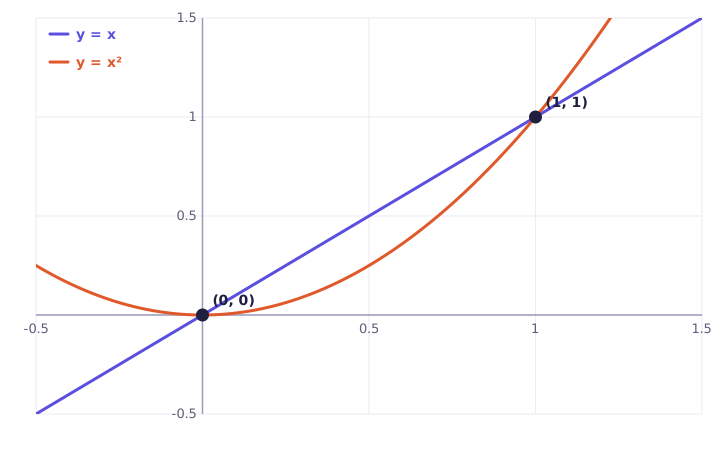
- y = x and y = x^2
- y = 4 - x^2 and y = 0
- y = 2x and y = x^2
- y = x^2 - 4 and y = 2 - x
- y = \sqrt{x} and y = x^2
Given limits
- y = \cos x and y = \sin x from x = 0 to x = \frac{\pi}{4}
- y = e^x and y = 1 from x = 0 to x = 1
- y = x and y = \frac{1}{x} from x = 1 to x = 2
Harder setups
- The region bounded by x = y^2 and x = y + 2
- The total area between y = x^3 and y = x on [-1, 1]
Answers
| Problem | Answer |
|---|---|
| 1 | \frac{1}{6} |
| 2 | \frac{32}{3} |
| 3 | \frac{4}{3} |
| 4 | \frac{125}{6} |
| 5 | \frac{1}{3} |
| 6 | \sqrt{2} - 1 \approx 0.414 |
| 7 | e - 2 \approx 0.718 |
| 8 | \frac{3}{2} - \ln 2 \approx 0.807 |
| 9 | \frac{9}{2} |
| 10 | \frac{1}{2} |
Step-by-step solutions
1. Set x = x^2: x = 0 or x = 1. At x = \frac{1}{2}, the line gives 0.5 and the parabola 0.25, so the line is on top:
2. The parabola meets the x-axis at x = \pm 2:
3. Set 2x = x^2: x = 0 or x = 2. At x = 1, the line is higher:
4. Set x^2 - 4 = 2 - x: x^2 + x - 6 = 0, so x = -3 or x = 2. At x = 0, the line gives 2 and the parabola -4, so the line is on top:
5. The curves meet at x = 0 and x = 1, and \sqrt{x} is on top in between:
6. On \left[0, \frac{\pi}{4}\right], \cos x \geq \sin x:
7. On [0, 1], e^x \geq 1:
8. For x > 1, x > \frac{1}{x}:
9. Both curves are written as x in terms of y, so integrate in y. Set y^2 = y + 2: y = -1 or y = 2. At y = 0, the line gives x = 2 and the parabola x = 0, so the line is on the right:
10. The curves meet at x = -1, 0, 1. On [0, 1], x \geq x^3. On [-1, 0], x^3 \geq x. By symmetry the two pieces are equal:
Integrating x - x^3 over [-1, 1] in one go gives 0, which is wrong.
Common mistakes on these problems
- Bottom minus top. A negative answer is the giveaway. Test a point to find the top curve.
- Not splitting at a crossing. In problem 10, one integral cancels the two regions and gives 0.
- Using the wrong limits. The limits come from where the curves meet, not from the x-intercepts of one curve.
- Mixing x and y. In problem 9, the integrand and the limits must both be in y.
Keep practicing
For unlimited regions with instant feedback, try the area between curves lesson and the applications practice set. Next, spin these regions around an axis in the volumes of revolution problems.
Practice it now
Area between curves
Solve real problems on this topic with instant feedback, hints and a step-by-step walkthrough for every answer. Free, no sign-up needed to start.
Practice this lesson