Derivative of an Inverse Function: Formula and Examples
The inverse function rule: the derivative of f⁻¹ at x is 1/f'(f⁻¹(x)). The formula, why slopes are reciprocals, worked examples and arcsin and ln.
Derivative rules Updated 3 min read
At a glance
- Applies to
- A one-to-one differentiable function f, at points where f'(f^{-1}(x)) \ne 0
- Point form
- If f(a) = b, then (f^{-1})'(b) = \frac{1}{f'(a)}
- Leibniz form
- \frac{dx}{dy} = \frac{1}{dy/dx}
- Graph meaning
- Reflecting across y = x swaps rise and run, so slopes become reciprocals
- Gives
- Derivatives of \ln x, \sqrt{x}, \arcsin x and \arctan x
On this page
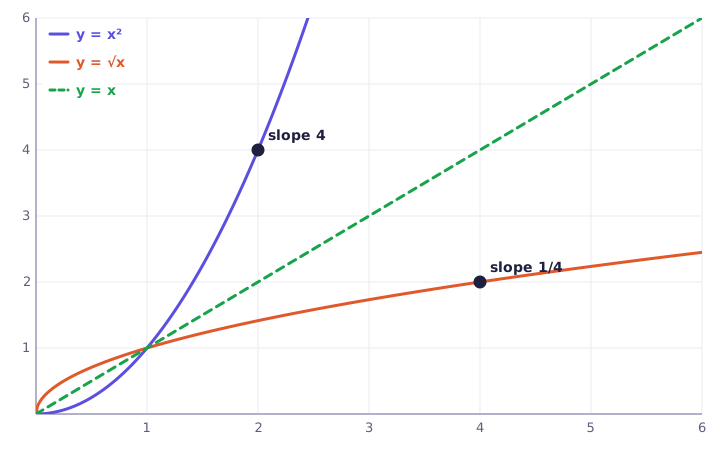
The inverse function rule gives the derivative of an inverse function from the derivative of the original. If f has slope m at the point (a, b), then f^{-1} has slope \frac{1}{m} at the mirror point (b, a). You do not need a formula for the inverse to use it.
The inverse function rule formula
Let f be one-to-one and differentiable, with inverse f^{-1}. If f'(f^{-1}(x)) \ne 0, then f^{-1} is differentiable at x and
The point form is usually easier to use. If f(a) = b and f'(a) \ne 0:
In Leibniz notation, with y = f(x) and x = f^{-1}(y), this reads \frac{dx}{dy} = \frac{1}{dy/dx}.
Why the rule works
Start from the identity f(f^{-1}(x)) = x and differentiate both sides using the chain rule:
Divide by f'(f^{-1}(x)) and you have the rule. Geometrically, reflecting a graph across y = x swaps x and y, which swaps rise and run, so every slope turns into its reciprocal.
Worked examples
Example 1: no formula for the inverse. Let f(x) = x^3 + x + 1, which is increasing and therefore one-to-one. Find (f^{-1})'(3).
Step 1. Solve f(a) = 3: a^3 + a + 1 = 3 gives a = 1.
Step 2. Differentiate: f'(x) = 3x^2 + 1, so f'(1) = 4.
Step 3. Take the reciprocal: (f^{-1})'(3) = \frac{1}{4}.
Example 2: the derivative of \ln x. Here f(x) = e^x, f'(x) = e^x and f^{-1}(x) = \ln x:
Example 3: the derivative of \arcsin x. Here f(x) = \sin x on \left[-\frac{\pi}{2}, \frac{\pi}{2}\right], so f'(x) = \cos x:
The last step uses \cos\theta = \sqrt{1 - \sin^2\theta}, which is positive on that interval. See arcsine.
Example 4: the derivative of \arctan x. With f(x) = \tan x and f'(x) = \sec^2 x = 1 + \tan^2 x:
Derivatives the rule produces
| Function f | Inverse f^{-1} | Derivative of the inverse |
|---|---|---|
| x^2 for x \ge 0 | \sqrt{x} | \frac{1}{2\sqrt{x}} |
| e^x | \ln x | \frac{1}{x} |
| \sin x | \arcsin x | \frac{1}{\sqrt{1 - x^2}} |
| \cos x | \arccos x | -\frac{1}{\sqrt{1 - x^2}} |
| \tan x | \arctan x | \frac{1}{1 + x^2} |
Common mistakes
- Evaluating f' at the wrong input. (f^{-1})'(b) uses f'(a) where f(a) = b, not f'(b). In Example 1, f'(3) = 28 would give the wrong answer \frac{1}{28}.
- Confusing f^{-1} with \frac{1}{f}. f^{-1} is the inverse function, not the reciprocal. \sin^{-1}x means \arcsin x, not \csc x.
- Ignoring where f' = 0. If f'(a) = 0, the inverse has a vertical tangent at b and is not differentiable there. For f(x) = x^3, the inverse \sqrt[3]{x} is not differentiable at 0.
The same result also comes out of implicit differentiation: write x = f(y) and differentiate both sides. For more on \ln x and e^x, read the guide to derivatives of exponential and logarithmic functions.
Practice it now
Exponentials and logarithms
Solve real problems on this topic with instant feedback, hints and a step-by-step walkthrough for every answer. Free, no sign-up needed to start.
Practice this lesson