Implicit Differentiation: Steps, Formula and Examples
Implicit differentiation finds dy/dx when y is not solved for. The key rule, a four-step method, worked examples with tangent lines and common mistakes.
Derivative rules Updated 2 min read
At a glance
- Applies to
- Equations relating x and y where y is not isolated, such as x^2 + y^2 = 25
- Key idea
- Treat y as a function of x, so every y term gets a factor of \frac{dy}{dx} by the chain rule
- Result
- A formula for \frac{dy}{dx} that usually contains both x and y
- Needs
- Chain rule, and the product rule for terms like xy
- Used in
- Tangent lines to curves, related rates, derivatives of inverse functions
On this page
Implicit differentiation finds \frac{dy}{dx} from an equation that mixes x and y, without first solving for y. You differentiate both sides with respect to x, remember that y depends on x, and then solve for \frac{dy}{dx}. It is the chain rule applied to y.
The key rule
Since y is a function of x, any expression in y is a composition. By the chain rule:
| Term | Derivative with respect to x |
|---|---|
| x^3 | 3x^2 |
| y^3 | 3y^2\,\frac{dy}{dx} |
| \sin y | \cos y\,\frac{dy}{dx} |
| e^y | e^y\,\frac{dy}{dx} |
| xy | y + x\,\frac{dy}{dx} (product rule) |
The four steps
- Differentiate both sides of the equation with respect to x.
- Multiply by \frac{dy}{dx} every time you differentiate a y term.
- Move all \frac{dy}{dx} terms to one side and everything else to the other.
- Factor out \frac{dy}{dx} and divide.
Worked examples
Example 1: a circle. Differentiate x^2 + y^2 = 25:
At the point (3, 4) the slope is -\frac{3}{4}, so the tangent line is y - 4 = -\frac{3}{4}(x - 3), or y = -\frac{3}{4}x + \frac{25}{4}.
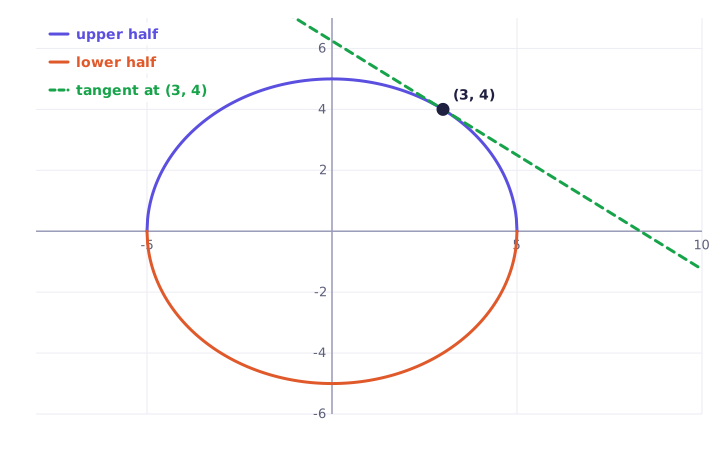
Example 2: a product term. Differentiate x^3 + y^3 = 6xy, using the product rule on 6xy:
Collect and factor:
The point (3, 3) is on the curve, since 27 + 27 = 54 = 6 \cdot 9. There the slope is \frac{6 - 9}{9 - 6} = -1.
Example 3: recovering the derivative of \ln x. If y = \ln x then e^y = x. Differentiate:
This is the idea behind the inverse function rule.
Example 4: a trig equation. Differentiate \sin y = x^2:
When to use implicit differentiation
- The equation is hard or impossible to solve for y (like x^3 + y^3 = 6xy).
- The curve is not a single function, like a circle or an ellipse, and you want slopes on every part.
- You need derivatives of inverse functions such as \ln x, \arcsin x or \arctan x.
- In related rates problems, where you differentiate with respect to time t and every quantity gets its own rate.
Common mistakes
- Forgetting \frac{dy}{dx} on y terms. \frac{d}{dx}\,y^2 is 2y\,\frac{dy}{dx}, not 2y.
- Skipping the product rule. \frac{d}{dx}\,xy is y + x\,\frac{dy}{dx}, not \frac{dy}{dx} or 1 \cdot \frac{dy}{dx}.
- Differentiating only one side. Both sides change, including a constant side, whose derivative is 0.
- Plugging in a point that is not on the curve. Check the point satisfies the original equation before using it.
For a longer walkthrough with more practice problems, read the full guide to implicit differentiation.
Practice it now
Implicit differentiation
Solve real problems on this topic with instant feedback, hints and a step-by-step walkthrough for every answer. Free, no sign-up needed to start.
Practice this lesson