nth-Term Test for Divergence: Statement, Examples and Limits
The nth-term test: if the terms of a series do not approach 0, the series diverges. The statement, why it cannot prove convergence, and examples.
Series rules Updated 3 min read
At a glance
- Also called
- The divergence test, the term test
- Can prove
- Divergence only
- Cannot prove
- Convergence. If a_n \to 0, the test is inconclusive
- Classic example
- \sum \frac{1}{n} has a_n \to 0 but still diverges
- Use it
- First, before any other convergence test
On this page
The nth-term test (or divergence test) is the quickest check in the study of series. A series can only add up to a finite number if its terms shrink to zero, so if they do not, the series diverges.
The statement
For any series \sum a_n:
The equivalent form is a necessary condition for convergence:
The converse is false. Terms going to zero is necessary, not sufficient.
Why it works
Let S_n be the nth partial sum. Then a_n = S_n - S_{n-1}. If the series converges to S, both S_n and S_{n-1} approach S, so
Reading the result
| Value of \lim a_n | Conclusion |
|---|---|
| A nonzero number | Diverges |
| \pm\infty | Diverges |
| Does not exist | Diverges |
| 0 | Inconclusive: use another test |
Worked examples
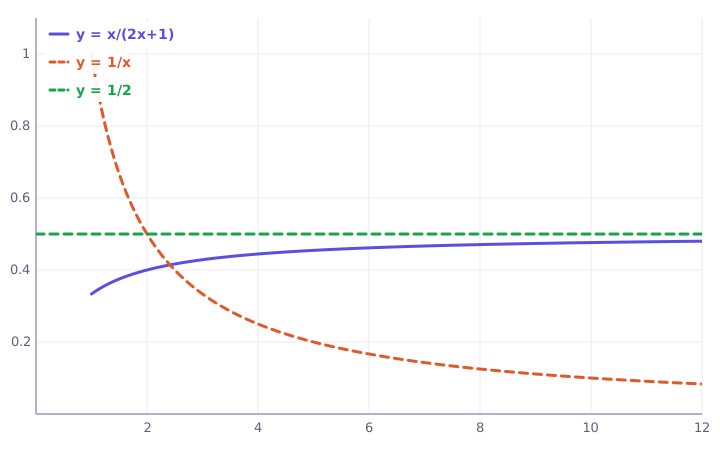
Example 1: a rational expression. For \sum \frac{n}{2n+1}:
The series diverges. You are adding numbers close to \frac{1}{2} forever.
Example 2: oscillating terms. For \sum (-1)^n, the terms alternate between 1 and -1, so \lim a_n does not exist. The series diverges.
Example 3: a trig term. For \sum \cos\left(\frac{1}{n}\right), \frac{1}{n} \to 0 and \cos 0 = 1, so a_n \to 1. The series diverges.
Example 4: a famous limit. For \sum \left(1 + \frac{1}{n}\right)^n, the terms approach e \ne 0. The series diverges.
Example 5: inconclusive. For \sum \frac{1}{n^2} and \sum \frac{1}{n}, the terms go to 0 in both cases. The test says nothing. In fact \sum \frac{1}{n^2} converges and \sum \frac{1}{n} diverges, which other tests (the integral test or the p-series rule) reveal.
Divergence vs convergence at a glance
Think of the test as a gate. Every convergent series passes through it, because its terms must shrink to zero. Many divergent series fail at the gate, but some, like the harmonic series, slip through and only reveal their divergence under a stronger test. So a failed check is a final answer, while a passed check only means the real work is still ahead. This one-way logic is the single most important thing to remember about the test.
Common mistakes
- Concluding convergence from a_n \to 0. This is the most common series mistake. The harmonic series is the counterexample.
- Taking the limit of the partial sums instead of the terms. The test uses a_n, the individual terms.
- Forgetting the "does not exist" case. Oscillating terms like (-1)^n or \sin n also fail to approach 0.
- Skipping it. Running the ratio test on \sum \frac{n}{2n+1} gives a limit of 1 and no answer, while the nth-term test settles it at once.
Where it fits
Use the nth-term test as the first step for every series. If the terms do go to zero, move on: try the geometric series formula for constant ratios, the alternating series test for alternating signs, and the ratio test for factorials and exponentials. The full guide to convergence tests shows how to choose between them.
Practice it now
The nth-term test
Solve real problems on this topic with instant feedback, hints and a step-by-step walkthrough for every answer. Free, no sign-up needed to start.
Practice this lesson