Extreme Value Theorem: Statement, Counterexamples, Examples
The extreme value theorem: a continuous function on a closed interval [a, b] has an absolute max and min. Statement, graph, counterexamples and examples.
Limits and continuity theorems Updated 4 min read
At a glance
- Hypotheses
- f is continuous on a closed, bounded interval [a, b]
- Conclusion
- f has an absolute minimum f(c) and an absolute maximum f(d) for some c, d in [a, b]
- Type
- Existence theorem: it guarantees extreme values, not their location
- Where to look
- Critical points inside (a, b) and the endpoints a and b
- Used for
- The closed interval method, optimization
- Course
- Calculus 1
On this page
The extreme value theorem (EVT) guarantees that a continuous function on a closed interval has a highest point and a lowest point. It is the reason optimization problems on a closed interval always have an answer, and it tells you exactly where to look for it.
Statement of the extreme value theorem
If f is continuous on the closed, bounded interval [a, b], then there exist numbers c and d in [a, b] such that
So f(c) is the absolute minimum of f on [a, b] and f(d) is the absolute maximum. The points c and d may be endpoints or interior points, and there may be more than one of each.
What the EVT means
A continuous graph over a closed interval is an unbroken piece of curve with both ends included. Such a piece cannot run off to infinity, and it cannot creep toward a height without reaching it, so it has a top and a bottom.
Why each hypothesis matters
The interval must be closed. f(x) = x on the open interval (0, 1) is continuous, but it has no maximum: for any value you pick, a slightly larger x gives a larger output. The would-be maximum 1 lives at the excluded endpoint.
The interval must be bounded. f(x) = x on [0, \infty) has a minimum at 0 but no maximum, because it grows forever.
The function must be continuous. Define f(x) = x for 0 \le x < 1 and f(1) = 0. On [0, 1] the values get closer and closer to 1 but never reach it, so there is no maximum. The jump at x = 1 is to blame. A vertical asymptote, as in \frac{1}{x} on [-1, 1] with f(0) defined as 0, also destroys the maximum and the minimum.
These conditions are sufficient, not necessary. Some discontinuous functions still have extreme values. The EVT just guarantees them when the hypotheses hold.
The closed interval method
The EVT says the extremes exist. Fermat's theorem says an interior extreme must be at a critical point. Together they give a complete recipe:
- Check that f is continuous on [a, b].
- Find the critical points of f in (a, b): where f'(x) = 0 or f'(x) does not exist.
- Evaluate f at each critical point and at a and b.
- The largest value is the absolute maximum, the smallest the absolute minimum.
Worked examples
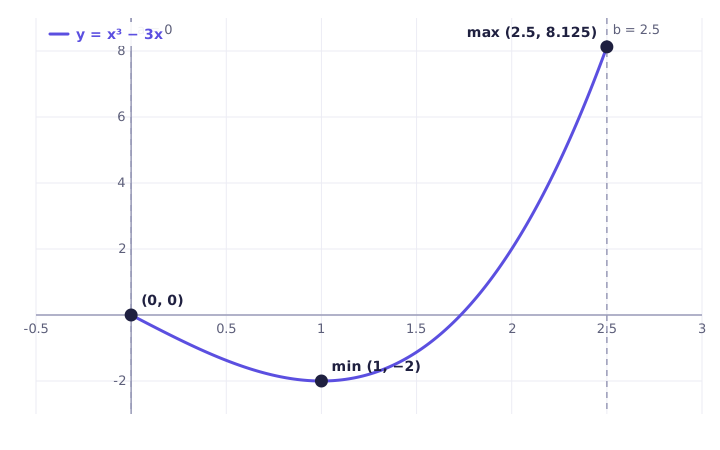
Example 1: f(x) = x^3 - 3x on [0, 2.5].
Step 1. f is a polynomial, so it is continuous and the EVT applies.
Step 2. f'(x) = 3x^2 - 3 = 3(x - 1)(x + 1), which is zero at x = \pm 1. Only x = 1 lies in (0, 2.5).
Step 3. Evaluate: f(0) = 0, f(1) = 1 - 3 = -2 and f(2.5) = 15.625 - 7.5 = 8.125.
Step 4. The absolute minimum is -2 at x = 1 and the absolute maximum is 8.125 at x = 2.5. Notice the maximum is at an endpoint, where f' is not zero. That is why you must always check the endpoints.
Example 2: f(x) = x - 2\sin x on [0, \pi].
f'(x) = 1 - 2\cos x = 0 gives \cos x = \frac{1}{2}, so x = \frac{\pi}{3} in (0, \pi). Then
The absolute minimum is \frac{\pi}{3} - \sqrt{3} at x = \frac{\pi}{3} and the absolute maximum is \pi at x = \pi.
Example 3: when the EVT does not apply. Does f(x) = \frac{1}{x} have a maximum on (0, 2]? The interval is not closed, so the EVT makes no promise. Indeed, f(x) \to \infty as x \to 0^+, so there is no maximum. There is a minimum, f(2) = \frac{1}{2}, which shows the EVT's conclusion can still partly hold.
Common mistakes
- Forgetting the endpoints. Setting f'(x) = 0 only finds interior candidates. The answer is often at a or b.
- Using critical points outside the interval. In Example 1, x = -1 is a critical point but not in [0, 2.5], so it is ignored.
- Applying the EVT on open or infinite intervals. There, look at limits at the edges instead, as in optimization problems.
Related theorems
The EVT is used to prove Rolle's theorem and therefore the mean value theorem. It shares its continuity hypothesis with the intermediate value theorem. For sketching and classifying extrema, see curve sketching with derivatives.
Practice it now
Absolute extrema on an interval
Solve real problems on this topic with instant feedback, hints and a step-by-step walkthrough for every answer. Free, no sign-up needed to start.
Practice this lesson