Rolle's Theorem: Statement, Conditions and Worked Examples
Rolle's theorem: if f is continuous on [a, b], differentiable on (a, b) and f(a) = f(b), then f'(c) = 0 for some c. Graph, counterexamples, examples.
Differential calculus theorems Updated 4 min read
At a glance
- Hypotheses
- f continuous on [a, b], differentiable on (a, b), and f(a) = f(b)
- Conclusion
- There is a c in (a, b) with f'(c) = 0
- Geometric meaning
- Somewhere between two equal heights the tangent line is horizontal
- Generalization
- The mean value theorem
- Used for
- Proving an equation has at most one root, proving the MVT
- Course
- Calculus 1
On this page
Rolle's theorem says that if a smooth function starts and ends at the same height, then somewhere in between its graph has a horizontal tangent line. It is the simplest of the mean value theorems and the step used to prove the others.
Statement of Rolle's theorem
Let f be a function that satisfies all three hypotheses:
- f is continuous on the closed interval [a, b];
- f is differentiable on the open interval (a, b);
- f(a) = f(b).
Then there is at least one number c in (a, b) such that
What Rolle's theorem means
Throw a ball up and catch it at the same height. At some moment between the throw and the catch, its vertical velocity was exactly zero: the top of the arc. Rolle's theorem is that observation for any smooth function. If the graph goes up, it has to turn around to come back down, and at the turning point the slope is zero. If the function is constant, the slope is zero everywhere.
Why each hypothesis matters
Differentiability. f(x) = |x| on [-1, 1] is continuous and f(-1) = f(1) = 1, but the graph is a sharp V. Its derivative is -1 on the left and 1 on the right and is never 0. The corner at x = 0, where f is not differentiable, is what breaks the theorem.
Continuity at the endpoints. Let f(x) = x for 0 \le x < 1 and f(1) = 0. Then f(0) = f(1) = 0 and f is differentiable on (0, 1), but f'(x) = 1 everywhere inside. The jump at x = 1 breaks continuity on [a, b].
Equal endpoint values. f(x) = x on [0, 1] is perfectly smooth, but f(0) \ne f(1) and f'(x) = 1 is never zero. For unequal endpoints you need the mean value theorem instead.
Worked examples
Example 1: find the c for f(x) = x^2 - 4x + 3 on [1, 3].
Step 1. Check the hypotheses. f is a polynomial, so it is continuous and differentiable everywhere. f(1) = 1 - 4 + 3 = 0 and f(3) = 9 - 12 + 3 = 0, so f(1) = f(3).
Step 2. Solve f'(c) = 2c - 4 = 0, giving c = 2, which is in (1, 3). The vertex of the parabola is the guaranteed point.
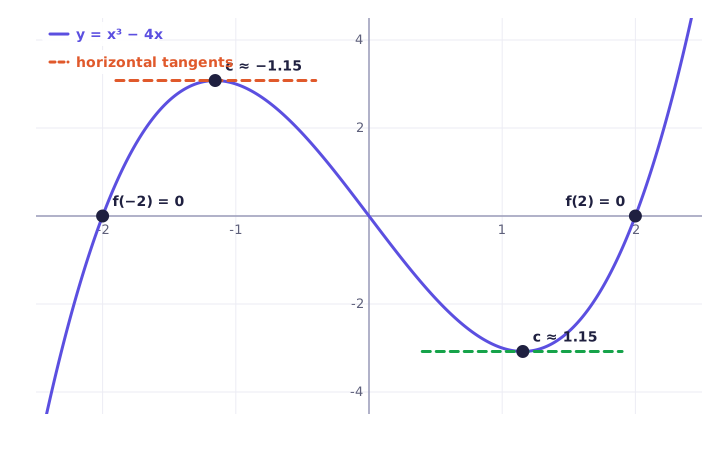
Example 2: f(x) = x^3 - 4x on [-2, 2].
f(-2) = -8 + 8 = 0 and f(2) = 8 - 8 = 0, and f is a polynomial. Solve
Both values lie in (-2, 2), so this function has two points where Rolle's conclusion holds. The theorem promised at least one.
Example 3: prove x^3 + x - 1 = 0 has exactly one real solution.
Step 1 (at least one). f(x) = x^3 + x - 1 is continuous, f(0) = -1 < 0 and f(1) = 1 > 0. By the intermediate value theorem there is a root in (0, 1).
Step 2 (at most one). Suppose there were two roots r_1 < r_2. Then f(r_1) = f(r_2) = 0, and Rolle's theorem would give a c between them with f'(c) = 0. But f'(x) = 3x^2 + 1 \ge 1 for every x, so f' is never zero. That contradiction means there cannot be two roots.
So the equation has exactly one real solution. This IVT plus Rolle argument is the most common exam use of the theorem.
How Rolle's theorem is proved
By the extreme value theorem, f has a maximum and a minimum on [a, b]. If both occur at the endpoints, then since f(a) = f(b) the function is constant and f' = 0 everywhere. Otherwise one of them occurs at an interior point c, and Fermat's theorem gives f'(c) = 0.
Common mistakes
- Not checking the hypotheses. Exams often ask whether Rolle's theorem applies. Check continuity, differentiability and f(a) = f(b) explicitly.
- Giving a c outside (a, b). A solution of f'(c) = 0 outside the open interval does not count.
- Thinking the theorem finds every critical point. It only guarantees at least one between a and b.
Related theorems
Tilt the picture so the endpoints are at different heights and you get the mean value theorem. For a full treatment with applications, read the mean value theorem guide, and see curve sketching with derivatives for where horizontal tangents matter.
Practice it now
Tangent lines at work
Solve real problems on this topic with instant feedback, hints and a step-by-step walkthrough for every answer. Free, no sign-up needed to start.
Practice this lesson