Green's Theorem: Statement, Orientation and Worked Examples
Green's theorem turns a line integral around a closed curve into a double integral over the region inside. Statement, hypotheses, area formula, examples.
Series and multivariable theorems Updated 3 min read
At a glance
- Hypotheses
- C is a positively oriented, piecewise smooth, simple closed curve bounding a region D, and P, Q have continuous partial derivatives on an open region containing D
- Positive orientation
- Counterclockwise, so the region stays on your left
- Integrand
- Q_x - P_y, the scalar curl of \langle P, Q \rangle
- Area formula
- A = \frac{1}{2}\oint_C x\,dy - y\,dx
- Generalizes to
- Stokes' theorem in three dimensions
- Course
- Calculus 3
On this page
Green's theorem relates a line integral around a closed curve in the plane to a double integral over the region it encloses. It says the total circulation around the boundary equals the sum of all the small circulations inside.
Statement of Green's theorem
Let
- C be a positively oriented (counterclockwise), piecewise smooth, simple closed curve in the plane, and
- D be the region bounded by C, and
- P(x, y) and Q(x, y) have continuous partial derivatives on an open region that contains D.
Then
In vector form, with \mathbf{F} = \langle P, Q \rangle, the left side is the circulation \oint_C \mathbf{F}\cdot d\mathbf{r} and the integrand on the right is the scalar curl Q_x - P_y.
What Green's theorem means
Chop D into tiny squares and add up the circulation of \mathbf{F} around each one. Along every interior edge, two neighboring squares traverse it in opposite directions, so those contributions cancel. Only the outer boundary survives. Meanwhile, the circulation around a tiny square is approximately (Q_x - P_y) times its area. Adding up both ways gives Green's theorem.
Why each hypothesis matters
Orientation. Traversing C clockwise reverses the sign of the line integral, while the double integral does not change. Always check the direction.
Continuity everywhere inside. The vortex field
has Q_x - P_y = 0 at every point except the origin, where it is undefined. Around the unit circle x = \cos t, y = \sin t, the line integral is \int_0^{2\pi} (\sin^2 t + \cos^2 t)\,dt = 2\pi, not 0. Green's theorem does not apply because the origin, inside D, is a point where P and Q are not even defined.
Closed curve. For a curve that does not close up, there is no enclosed region, so the theorem says nothing.
Worked examples
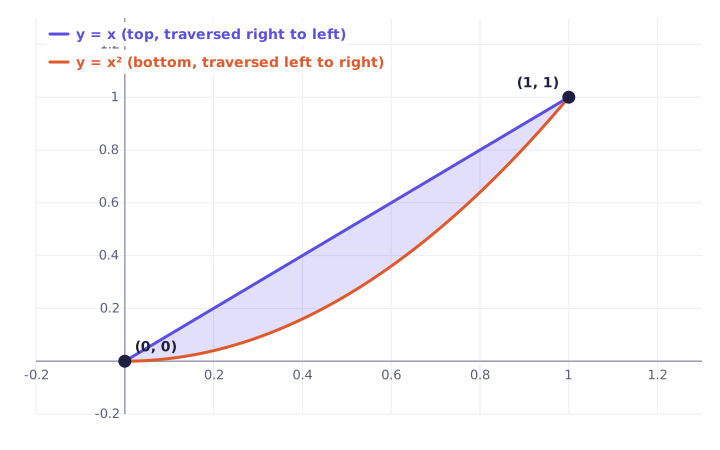
Example 1: compute \oint_C xy\,dx + x^2\,dy around the region in the graph.
Step 1. P = xy and Q = x^2, so Q_x - P_y = 2x - x = x.
Step 2. The region is x^2 \le y \le x for 0 \le x \le 1:
Check directly. Along y = x^2 (x = t, 0 \to 1) the integrand is t^3\,dt + t^2(2t\,dt) = 3t^3\,dt, contributing \frac{3}{4}. Along y = x back from (1, 1) to (0, 0) it is 2t^2\,dt with t from 1 to 0, contributing -\frac{2}{3}. The total is \frac{3}{4} - \frac{2}{3} = \frac{1}{12}. Same answer, more work.
Example 2: area of an ellipse. Choose P = -\frac{y}{2} and Q = \frac{x}{2}, so Q_x - P_y = 1 and the double integral is the area:
For the ellipse x = a\cos t, y = b\sin t, 0 \le t \le 2\pi: x\,dy - y\,dx = (ab\cos^2 t + ab\sin^2 t)\,dt = ab\,dt. So A = \frac{1}{2}\cdot 2\pi ab = \pi ab.
Example 3: a messy field, an easy answer. Evaluate \oint_C (x^2 - y)\,dx + (x + y^3)\,dy around the unit circle, counterclockwise. Here Q_x - P_y = 1 - (-1) = 2, so the integral is 2 \cdot \text{area} = 2\pi.
Common mistakes
- Swapping the order in the integrand. It is Q_x - P_y, not P_y - Q_x or P_x - Q_y.
- Ignoring orientation. A clockwise curve gives the negative of the double integral.
- Using it across a singularity. Check that P and Q are smooth on all of D, not just on C.
Related theorems and guides
Green's theorem is the flat case of Stokes' theorem, and its flux form is the two-dimensional divergence theorem. Since Q_x - P_y = 0 for gradient fields by Clairaut's theorem, conservative fields have zero circulation. For the double integrals on the right side, see double integrals.
Practice it now
Green's theorem
Solve real problems on this topic with instant feedback, hints and a step-by-step walkthrough for every answer. Free, no sign-up needed to start.
Practice this lesson