AP Calc Unit 4 Review: Derivatives in Context (AB and BC)
AP Calculus Unit 4 review for AB and BC: derivatives in context, straight-line motion, related rates, linearization and L'Hospital's rule, with practice.
AP Calculus units Updated 4 min read
At a glance
- AB exam weight
- 10–15%
- BC exam weight
- 5–10%
- Big ideas
- Rates in context, motion, related rates, local linearity, L'Hospital's rule
- BC only
- None, AB and BC cover the same Unit 4 topics
- Comes before
- Unit 5, analytical applications of differentiation
- Practice here
- Calculus 1: Applications of derivatives
AP Calculus Unit 4, Contextual Applications of Differentiation, is where derivatives start answering real questions. How fast is a particle moving? How fast is the water level rising? What is a good estimate of \sqrt{4.1} without a calculator? The math is the same as Units 2 and 3. The new skill is reading the situation and explaining your answer with units.
| AP Calculus AB | AP Calculus BC | |
|---|---|---|
| Exam weight | 10–15% | 5–10% |
| Extra topics | none | none |
What Unit 4 covers
College Board splits the unit into these topics. Each row links to a lesson where you can practice it with new numbers every time.
| Topic | What you learn | Practice |
|---|---|---|
| Derivatives in context | What f'(a) means, with units | Derivative notation and meaning |
| Straight-line motion | Position, velocity, acceleration and speed | Instantaneous rate of change |
| Rates in other contexts | Population, temperature, cost and volume rates | Derivative notation and meaning |
| Introduction to related rates | Linking rates through an equation | Related rates |
| Solving related rates | Ladders, cones, balloons and shadows | Related rates |
| Local linearity | Tangent line approximations and over or under estimates | Linear approximation |
| L'Hospital's rule | Limits of the forms \frac{0}{0} and \frac{\infty}{\infty} | L'Hospital's rule |
The key ideas
A derivative is a rate with units. If W(t) is the gallons of water in a tank after t hours, then W'(3) = -12 means "at t = 3 hours, the amount of water is decreasing at 12 gallons per hour." Always give the time, the rate, the direction and the units.
Motion has its own vocabulary. Velocity is v(t) = x'(t) and acceleration is a(t) = v'(t). Speed is |v(t)|. The particle moves right when v > 0 and left when v < 0. It speeds up when v and a share a sign.
Related rates link two changing quantities. Draw a picture, write an equation that holds at every moment, differentiate both sides with respect to t, and only then plug in numbers. Plugging in too early turns a changing quantity into a constant.
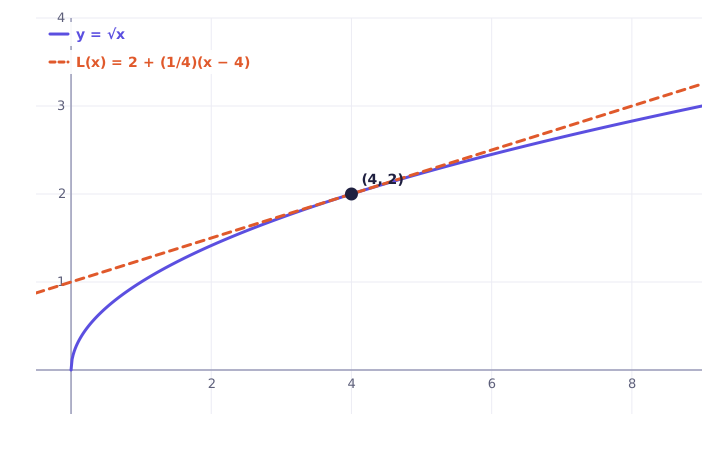
A tangent line is a good local estimate. Near x = a:
L'Hospital's rule handles indeterminate limits. Read the full L'Hospital's rule page, and the guides on related rates and linear approximation.
Sample questions
1. Motion. A particle moves along a line with x(t) = t^3 - 6t^2 + 9t. Then v(t) = 3t^2 - 12t + 9 = 3(t - 1)(t - 3) and a(t) = 6t - 12. At t = 1.5, v = -2.25 and a = -3. Both are negative, so the particle is moving left and speeding up.
2. Related rates. A 10 ft ladder leans against a wall. The bottom slides away at 1 ft/s. How fast is the top sliding down when the bottom is 6 ft from the wall? From x^2 + y^2 = 100:
When x = 6, y = 8, so 12(1) + 16\frac{dy}{dt} = 0 and \frac{dy}{dt} = -\frac{3}{4} ft/s. The top slides down at \frac{3}{4} ft/s.
3. Linearization. With f(x) = \sqrt{x} at a = 4, f(4) = 2 and f'(4) = \frac{1}{4}, so \sqrt{4.1} \approx 2 + \frac{1}{4}(0.1) = 2.025. The true value is about 2.02485, so the estimate is slightly high, as the concavity predicts.
4. L'Hospital's rule, used twice. The limit gives \frac{0}{0} each time:
How to study Unit 4
- Write context sentences every time. Practice turning f'(a) = k into a full sentence with time, rate, direction and units. This is a free-response point you can count on.
- Compare signs for speeding up. Make a quick sign chart for v and a instead of guessing from the position graph.
- Differentiate before substituting. In related rates, only fixed quantities can be plugged in before you differentiate.
- Check the form before L'Hospital. Write "this is \frac{0}{0}" before you use the rule, or the work does not earn credit.
- Work through problem sets. Try the related rates practice problems, linear approximation problems and L'Hospital's rule problems, each with full solutions.
For the full course map, see the AP Calculus AB guide or the AP Calculus BC guide.
AP and Advanced Placement are registered trademarks of College Board, which is not affiliated with PracticeCalculus and does not endorse this guide. Unit names and weights come from College Board's course framework; check it for any changes.
Practice it now
Related rates
Solve real problems on this topic with instant feedback, hints and a step-by-step walkthrough for every answer. Free, no sign-up needed to start.
Practice this lesson