Concavity and Inflection Points: How to Find Them, With Examples
Learn what concave up and concave down mean, how to use the second derivative to find intervals of concavity, and how to locate inflection points.
By the PracticeCalculus team Published 10 min read
Try it yourself
On this page
- What does concave up and concave down mean?
- The concavity test
- What is an inflection point?
- How to find inflection points: a 4-step method
- Worked example 1: a cubic
- Worked example 2: when f''(x) = 0 is not an inflection point
- Worked example 3: a product with an exponential
- Worked example 4: an inflection point where f'' is undefined
- Why concavity matters
- Reading concavity from the graph of f'
- Common mistakes with concavity and inflection points
- Quick reference
- Practice until the sign chart is automatic
You can find where a function is increasing and decreasing, but two graphs can both be increasing and still look completely different: one curls upward like the start of a rocket launch, the other flattens out like a car braking. Concavity describes that bending, and inflection points mark exactly where the bending switches direction. Both come straight from the second derivative, and they show up on nearly every Calculus 1 exam.
This guide explains what concave up and concave down mean, how to find intervals of concavity, how to locate inflection points without falling into the classic traps, and walks through four fully worked examples.
What does concave up and concave down mean?
A function is concave up on an interval if its graph bends upward there, like a cup that could hold water. A function is concave down on an interval if its graph bends downward, like an upside-down cup or a frown.
There are three equivalent ways to say this precisely:
| Description | Concave up | Concave down |
|---|---|---|
| Shape | Cup, holds water | Cap, spills water |
| Slope f'(x) | Increasing | Decreasing |
| Tangent lines | Graph sits above them | Graph sits below them |
| Second derivative | f''(x) > 0 | f''(x) < 0 |
The key idea is the second row. Concavity is about how the slope changes. On a concave up curve the slopes keep getting bigger as you move right: they might go from -3 to -1 to 2 to 5. On a concave down curve the slopes keep getting smaller.
Since the slope is f'(x), and the rate of change of f' is f'', the sign of the second derivative tells you the concavity. If you need a refresher on computing f'', see higher-order derivatives.
Tip: concavity is independent of whether a function is increasing or decreasing. A curve can be decreasing and concave up (like e^{-x}) or increasing and concave down (like \ln x). Do not mix up the two questions.
The concavity test
The concavity test turns the picture into a rule you can apply:
So finding intervals of concavity is a sign chart problem, just like finding where f increases and decreases, except you use f'' instead of f'.
What is an inflection point?
An inflection point is a point on the graph where the function is continuous and the concavity changes, either from up to down or from down to up.
Two conditions matter:
- The concavity actually changes. It is not enough for f'' to be zero. The sign of f'' must switch.
- The function is defined and continuous there. A point that is not on the graph cannot be an inflection point.
Because f'' can only change sign where it is zero or undefined (for the functions you meet in Calculus 1), those are your candidates:
Think of candidates like suspects in a lineup. Each one still has to be checked.
How to find inflection points: a 4-step method
- Find f''(x). Differentiate twice and simplify, factoring if you can.
- Find the candidates. Solve f''(x) = 0 and note where f'' is undefined (but f is defined).
- Build a sign chart for f''. Pick a test value in each interval between candidates and check the sign of f''.
- Decide and report. Where the sign changes and f is continuous, you have an inflection point. Give it as a point (c, f(c)) by plugging c into the original function.
Worked example 1: a cubic
Find the intervals of concavity and the inflection points of f(x) = x^3 - 6x^2 + 9x + 1.
Step 1. Second derivative.
Step 2. Candidates. Set 6x - 12 = 0, so x = 2. The second derivative is a polynomial, so it is never undefined.
Step 3. Sign chart.
| Interval | Test value | f'' at test value | Concavity |
|---|---|---|---|
| (-\infty, 2) | x = 0 | 6(0) - 12 = -12 < 0 | Concave down |
| (2, \infty) | x = 3 | 6(3) - 12 = 6 > 0 | Concave up |
Step 4. Report. The sign changes at x = 2, so there is an inflection point there. Its y-coordinate comes from the original function:
So f is concave down on (-\infty, 2), concave up on (2, \infty), and has an inflection point at (2, 3).
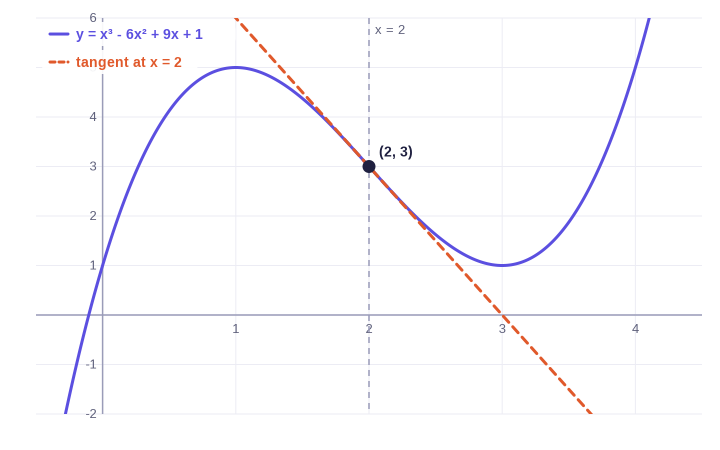
Notice something special in the graph: the tangent line at an inflection point usually crosses the curve. On the concave down side the curve is below the tangent, and on the concave up side it is above. Every cubic has exactly one inflection point, and it always sits exactly halfway between the two critical points when there are two (here x = 1 and x = 3).
Worked example 2: when f''(x) = 0 is not an inflection point
Find the inflection points of f(x) = x^4.
Step 1. f'(x) = 4x^3 and f''(x) = 12x^2.
Step 2. 12x^2 = 0 gives x = 0, so x = 0 is a candidate.
Step 3. Test both sides:
- At x = -1: f''(-1) = 12 > 0, concave up.
- At x = 1: f''(1) = 12 > 0, concave up.
Step 4. The sign does not change. The graph is concave up on both sides of 0 (in fact everywhere), so f(x) = x^4 has no inflection point.
This is the single most important example in the topic. The flat bottom of x^4 makes f''(0) = 0, but the curve never switches from a cup to a cap. A zero of f'' is a suspect, not a conviction.
Worked example 3: a product with an exponential
Find the intervals of concavity and the inflection point of f(x) = xe^{-x}.
Step 1. Second derivative. Use the product rule and the fact that the derivative of e^{-x} is -e^{-x}:
Differentiate again, treating e^{-x} and (1 - x) as the two factors:
Step 2. Candidates. Since e^{-x} > 0 for every x, the second derivative is zero only when x - 2 = 0, so x = 2.
Step 3. Sign chart. The sign of f'' matches the sign of x - 2:
| Interval | Sign of x - 2 | Concavity |
|---|---|---|
| (-\infty, 2) | Negative | Concave down |
| (2, \infty) | Positive | Concave up |
Step 4. Report. The sign changes at x = 2, and
So the inflection point is \left(2, \frac{2}{e^2}\right).
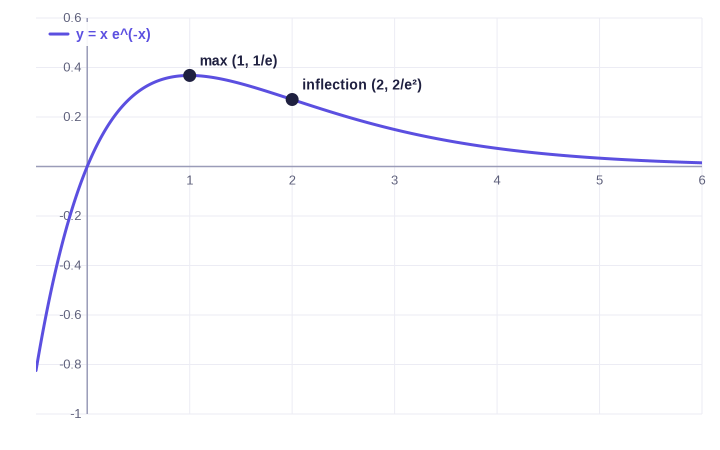
The graph shows a nice connection: the inflection point is where the curve is falling fastest. Just after the peak the slope gets more and more negative; after x = 2 the slope starts climbing back toward 0. In general, inflection points are where f' has a local max or min.
Worked example 4: an inflection point where f'' is undefined
Find the inflection points of f(x) = x^{1/3}.
Step 1. Use the power rule twice:
Step 2. Candidates. The numerator is -2, so f'' is never zero. But f'' is undefined at x = 0, while f(0) = 0 is defined. So x = 0 is a candidate.
Step 3. Sign chart. The cube root of a negative number is negative, so x^{5/3} < 0 when x < 0.
- For x < 0: f''(x) = -\frac{2}{9 \cdot (\text{negative})} > 0, concave up.
- For x > 0: f''(x) = -\frac{2}{9 \cdot (\text{positive})} < 0, concave down.
Step 4. The concavity changes and f is continuous at 0, so (0, 0) is an inflection point. Here the tangent line is vertical, which is exactly why f' and f'' fail to exist. If you only solved f''(x) = 0, you would have missed it completely.
Why concavity matters
Concavity is not just a graphing detail. It shows up across calculus:
- Curve sketching. Knowing where a graph cups up or down, plus where it increases and decreases, pins down its shape. The full process is in curve sketching with derivatives.
- The second derivative test. At a critical point where f'(c) = 0, concave up means a local minimum and concave down means a local maximum.
- Tangent line estimates. Since a concave up graph sits above its tangent lines, a linear approximation underestimates the true value there. On a concave down graph it overestimates.
- Motion and rates. If s(t) is position, then s''(t) is acceleration. A concave up position graph means the object is speeding up in the positive direction or slowing its descent. In economics, an inflection point on a sales curve marks the moment growth stops accelerating, often called the point of diminishing returns.
Reading concavity from the graph of f'
Exams love giving you the graph of f' instead of f. Since concavity of f depends on whether f' is increasing or decreasing:
- Where the graph of f' is rising, f is concave up.
- Where the graph of f' is falling, f is concave down.
- Where f' has a peak or valley, f has an inflection point.
Do not look at the sign of f' for concavity. Whether f' is above or below the axis tells you if f is increasing or decreasing, which is a different question.
Common mistakes with concavity and inflection points
- Assuming f''(c) = 0 means an inflection point. As x^4 shows, you must confirm that f'' changes sign. Always build the sign chart.
- Ignoring points where f'' is undefined. Functions like x^{1/3} and x^{5/3} have inflection points exactly where f'' does not exist.
- Claiming an inflection point where f is undefined. For f(x) = \frac{1}{x}, f''(x) = \frac{2}{x^3} changes sign at x = 0, but 0 is not in the domain. The concavity changes across the asymptote, yet there is no inflection point.
- Using f' instead of f''. Critical points (f' = 0) are candidates for maximums and minimums, not inflection points. Mixing the two up is very common under time pressure.
- Plugging into the wrong function for the y-value. The inflection point is (c, f(c)), using the original function, not f''(c), which is usually 0.
- Flipping the signs. Positive second derivative means concave up. A memory aid: a smile (+) is concave up, a frown (-) is concave down.
Quick reference
| Question | What to check | Result |
|---|---|---|
| Concave up? | f''(x) > 0 | Cup shape, slopes increasing |
| Concave down? | f''(x) < 0 | Cap shape, slopes decreasing |
| Inflection candidates | f''(c) = 0 or undefined, f(c) defined | Suspects only |
| Confirm inflection | Sign of f'' changes at c | Point (c, f(c)) |
| From the graph of f' | f' rising or falling | Up or down, peaks of f' are inflections |
| Common examples | x^3, xe^{-x}, x^{1/3} | Inflections at 0, 2, 0 |
| Classic non-example | x^4 at x = 0 | f'' = 0 but no sign change |
Practice until the sign chart is automatic
Concavity problems follow the same four steps every time: differentiate twice, find the candidates, test the signs, report the points. The hard part is not the idea, it is staying accurate with the algebra and remembering to check for a sign change. A few dozen problems with instant feedback will make that check a reflex. Try the interactive lesson below, where each question tells you right away whether your interval or point is correct and shows you where a sign went wrong.
Practice it now
Concavity and the second derivative
Solve real problems on this topic with instant feedback, hints and a step-by-step walkthrough for every answer. Free, no sign-up needed to start.
Practice this lesson