Higher-Order Derivatives: Second, Third and nth Derivatives Explained
Learn what higher-order derivatives mean, from concavity to acceleration and jerk, with notation, nth derivative patterns and fully worked examples.
By the PracticeCalculus team Published 9 min read
Try it yourself
On this page
- What is a higher-order derivative?
- Notation for second, third and nth derivatives
- What does the second derivative mean?
- Position, velocity, acceleration and jerk
- Worked example 1: differentiate a polynomial until it vanishes
- Worked example 2: motion along a line
- Worked example 3: the 99th derivative of sin x
- Worked example 4: finding the nth derivative of 1/x
- Worked example 5: a second derivative with implicit differentiation
- Why higher-order derivatives matter
- Common mistakes with higher-order derivatives
- Quick reference: nth derivative patterns
- Practice until it feels routine
You have learned to take a derivative. Then a homework problem asks for f''(x), or a physics question asks for acceleration when you are only given position, and you wonder what it even means to differentiate twice. Higher-order derivatives are simply derivatives of derivatives, and each one answers a real question about how a function behaves.
This guide covers the notation, what the second and third derivatives actually measure, how to spot nth derivative patterns, and five worked examples with every step shown.
What is a higher-order derivative?
The derivative f'(x) is itself a function. Since it is a function, you can differentiate it too. The result is the second derivative, f''(x). Differentiate that and you get the third derivative, f'''(x), and you can keep going as long as the derivatives exist.
In plain language:
- f(x) gives the value.
- f'(x) tells you how fast the value is changing (the slope).
- f''(x) tells you how fast the slope is changing.
- f'''(x) tells you how fast that rate is changing.
The key formula is just repeated differentiation:
No new rules are needed. Every higher-order derivative uses the same power rule, product rule, quotient rule and chain rule you already know, applied again.
Notation for second, third and nth derivatives
There are several ways to write the same thing. You will see all of them in textbooks and on exams.
| Derivative | Prime notation | Leibniz notation | Other |
|---|---|---|---|
| First | f'(x) or y' | \frac{dy}{dx} | Df |
| Second | f''(x) or y'' | \frac{d^2y}{dx^2} | D^2 f |
| Third | f'''(x) or y''' | \frac{d^3y}{dx^3} | D^3 f |
| Fourth | f^{(4)}(x) | \frac{d^4y}{dx^4} | D^4 f |
| nth | f^{(n)}(x) | \frac{d^ny}{dx^n} | D^n f |
Two details trip people up. In Leibniz notation the 2 goes on top of the d but on the x at the bottom: \frac{d^2y}{dx^2}, not \frac{d^2y}{d^2x}. And after three primes, switch to a number in parentheses, f^{(4)}, because f^4 would look like a power. If Leibniz notation still feels strange, our page on dy/dx notation explains where it comes from.
What does the second derivative mean?
The first derivative says whether a graph is rising or falling. The second derivative says how it bends.
- If f''(x) > 0, the slope is increasing. The graph is concave up, shaped like a cup.
- If f''(x) < 0, the slope is decreasing. The graph is concave down, shaped like a cap.
- Where f'' changes sign, the graph has an inflection point.
Take f(x) = x^3 - 3x. Then f'(x) = 3x^2 - 3 and f''(x) = 6x. For x < 0, f''(x) < 0, so the curve bends downward. For x > 0, f''(x) > 0, so it bends upward. At x = 0 the concavity flips, giving an inflection point at (0, 0).
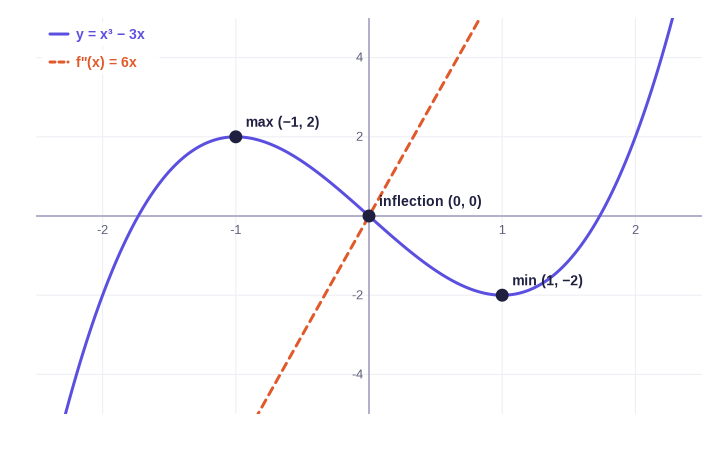
The second derivative also gives the second derivative test: at a critical point where f'(c) = 0, if f''(c) < 0 the point is a local max, and if f''(c) > 0 it is a local min. Here f''(-1) = -6 confirms the max at x = -1 and f''(1) = 6 confirms the min at x = 1. The full method is in our guide to curve sketching with derivatives.
Position, velocity, acceleration and jerk
The most physical way to understand higher-order derivatives is motion along a line. If s(t) is position at time t:
| Quantity | Formula | Meaning |
|---|---|---|
| Position | s(t) | Where the object is |
| Velocity | v(t) = s'(t) | How fast position changes |
| Acceleration | a(t) = s''(t) | How fast velocity changes |
| Jerk | j(t) = s'''(t) | How fast acceleration changes |
When a car pulls away smoothly, acceleration builds gradually and jerk is small. When a driver stomps on the brake, acceleration changes suddenly and jerk is large, which is why you lurch forward. Engineers design elevators and roller coasters to keep jerk under control.
Worked example 1: differentiate a polynomial until it vanishes
Find all derivatives of f(x) = x^4 - 3x^3 + 2x^2 - 5x + 7.
First derivative. Apply the power rule term by term:
Second derivative. Differentiate f':
Third derivative.
Fourth derivative.
Fifth derivative. The derivative of a constant is zero:
Each differentiation lowers the degree by one, so a degree 4 polynomial reaches a constant at the fourth derivative and zero at the fifth. In general, a polynomial of degree n has f^{(n+1)}(x) = 0. Notice also that f^{(4)}(x) = 24 = 4!, which is the factorial pattern from the leading term x^4.
Worked example 2: motion along a line
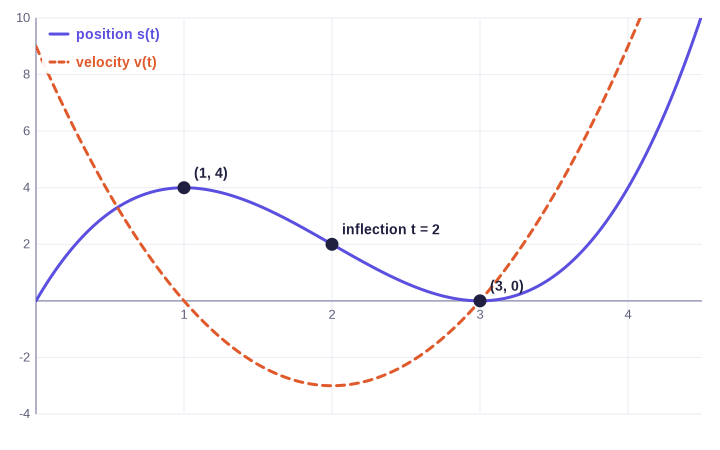
A particle moves with position s(t) = t^3 - 6t^2 + 9t meters for t \ge 0 seconds. Find its velocity, acceleration and jerk, and decide when it is speeding up.
Step 1. Velocity.
The particle stops at t = 1 and t = 3. Velocity is positive before t = 1, negative between 1 and 3, and positive after 3.
Step 2. Acceleration.
Acceleration is negative for t < 2 and positive for t > 2.
Step 3. Jerk.
The jerk is constant, so acceleration increases at a steady 6 meters per second cubed.
Step 4. Speeding up or slowing down. An object speeds up when velocity and acceleration have the same sign.
| Interval | Sign of v | Sign of a | Behavior |
|---|---|---|---|
| 0 < t < 1 | + | - | slowing down |
| 1 < t < 2 | - | - | speeding up |
| 2 < t < 3 | - | + | slowing down |
| t > 3 | + | + | speeding up |
At t = 1, a(1) = -6, so the turnaround at position s(1) = 4 is a maximum. At t = 3, a(3) = 6, so position s(3) = 0 is a minimum.
Worked example 3: the 99th derivative of sin x
Find \frac{d^{99}}{dx^{99}} \sin x.
Nobody differentiates 99 times. Instead, look for a pattern using the derivative of sin x and cos x:
The derivatives repeat every 4 steps. So only the remainder when dividing by 4 matters.
The remainder is 3, so the 99th derivative matches the third derivative:
Tip: a remainder of 0 means you are back to \sin x. Remainders 1, 2, 3 give \cos x, -\sin x, -\cos x. A compact formula is \frac{d^n}{dx^n}\sin x = \sin\left(x + \frac{n\pi}{2}\right).
Worked example 4: finding the nth derivative of 1/x
Find a formula for f^{(n)}(x) when f(x) = \frac{1}{x}.
Step 1. Rewrite as a power. f(x) = x^{-1}.
Step 2. Compute several derivatives without simplifying the numbers away.
Step 3. Spot the pattern. The signs alternate, starting negative: (-1)^n. The coefficients are 1, 2, 6, 24, which are 1!, 2!, 3!, 4!. The exponent is always -(n+1).
Step 4. Check. For n = 3: \frac{(-1)^3 \cdot 6}{x^4} = -\frac{6}{x^4}, which matches. Always test a pattern against a case you computed by hand.
Worked example 5: a second derivative with implicit differentiation
Find \frac{d^2y}{dx^2} for the circle x^2 + y^2 = 25.
Step 1. First derivative. Differentiate both sides with respect to x, remembering y is a function of x (see implicit differentiation):
Step 2. Differentiate again with the quotient rule.
Step 3. Substitute y' = -\frac{x}{y}.
Step 4. Use the original equation. Since x^2 + y^2 = 25:
This makes geometric sense. On the top half of the circle y > 0, so y'' < 0 and the arc is concave down. On the bottom half y < 0, so y'' > 0 and the arc is concave up.
Why higher-order derivatives matter
Beyond concavity and motion, higher-order derivatives are the building blocks of Taylor polynomials. Near x = a, a function can be approximated by
The first derivative gives the tangent line, the linear approximation. The second derivative adds curvature, the third corrects for how curvature changes, and so on. This is why finding nth derivative patterns, as in examples 3 and 4, is such a useful skill. The full story is in our guide to Taylor series.
Higher derivatives also show up in differential equations, such as y'' = -y for a spring, whose solutions are exactly the sine and cosine functions with their four-step cycle.
Common mistakes with higher-order derivatives
- Not simplifying the first derivative. Differentiating a messy f'(x) doubles the mess. Expand, combine terms or factor before taking f''.
- Losing the chain rule factor on the second pass. For e^{3x}, the first derivative is 3e^{3x} and the second is 9e^{3x}, not 3e^{3x}. Every pass brings out another factor of 3.
- Treating y' as a constant in implicit problems. When you differentiate -\frac{x}{y}, the y is still a function of x, so its derivative is y', not 0.
- Confusing f^{(n)} with f^n. f^{(2)}(x) is the second derivative. f^2(x) usually means \big(f(x)\big)^2.
- Assuming f''(c) = 0 means an inflection point. For f(x) = x^4, f''(0) = 0 but the graph is concave up on both sides. Concavity must actually change.
- Mixing up speeding up with positive acceleration. An object with negative velocity and positive acceleration is slowing down. Compare the signs of v and a.
Quick reference: nth derivative patterns
| Function | nth derivative | Note |
|---|---|---|
| x^m (degree m polynomial) | 0 for n > m | \frac{d^m}{dx^m} x^m = m! |
| e^{x} | e^{x} | never changes |
| e^{kx} | k^n e^{kx} | one factor of k per pass |
| \sin x | \sin\left(x + \frac{n\pi}{2}\right) | repeats every 4 |
| \cos x | \cos\left(x + \frac{n\pi}{2}\right) | repeats every 4 |
| \frac{1}{x} | \frac{(-1)^n\, n!}{x^{n+1}} | alternating signs |
| \ln x | \frac{(-1)^{n-1}(n-1)!}{x^n} | for n \ge 1 |
| x e^x | (x + n)e^x | from the product rule |
Practice until it feels routine
Higher-order derivatives are mostly careful bookkeeping: simplify, differentiate again, and watch the signs and constant factors. The meaning comes from reading the sign of f'' as concavity or acceleration, and that interpretation is what exams test most. Work through the interactive lesson below, where each problem gives instant feedback and shows exactly where a sign or factor went wrong, so the patterns become second nature.
Practice it now
Concavity and the second derivative
Solve real problems on this topic with instant feedback, hints and a step-by-step walkthrough for every answer. Free, no sign-up needed to start.
Practice this lesson