Net Change Theorem: The Definite Integral as Net Change
Learn how a definite integral measures net change: the net change theorem, displacement vs total distance, units, and worked examples with rates.
By the PracticeCalculus team Published 9 min read
Try it yourself
On this page
- What does it mean for a definite integral to measure net change?
- The net change theorem formula
- Net change in different settings
- Worked example 1: displacement and total distance
- Worked example 2: water in a tank
- Worked example 3: marginal cost
- Worked example 4: population growth with an exponential rate
- Why the definite integral is signed
- How to solve net change problems: a 4-step method
- Common mistakes with net change
- Quick reference
- Practice turning rates into answers
You know how to evaluate \int_0^4 (t^2 - 4t + 3)\,dt, but what does the number actually mean? Word problems hand you a velocity, a flow rate or a marginal cost and ask "how much changed?" or "how far did it go?", and it is easy to compute the right integral and still give the wrong answer. The idea that ties it all together is simple: the definite integral of a rate is the net change in the quantity.
This guide explains the net change theorem, why it works, how displacement differs from total distance, and walks through worked examples you can follow line by line.
What does it mean for a definite integral to measure net change?
Suppose a quantity F changes over time, and you know its rate of change F'(t). Over a tiny time interval \Delta t, the quantity changes by about
Chop the whole interval [a, b] into many small pieces and add up these small changes. That sum is a Riemann sum, and as the pieces shrink it becomes the definite integral \int_a^b F'(t)\,dt. The sum of all the small changes is the total change, F(b) - F(a).
In plain language: if you integrate how fast something is changing, you get how much it changed.
The net change theorem formula
The net change theorem states that if F' is continuous on [a, b], then
This is exactly the Fundamental Theorem of Calculus, Part 2, just read from an applied point of view. The left side is the accumulated rate; the right side is the change in the quantity.
Rearranging gives the version you will use most in word problems:
In words: final amount = starting amount + net change.
Tip: the word "net" matters. Increases count as positive and decreases count as negative, so they can cancel. If water flows in and then flows out, the net change might be small even though a lot of water moved.
Net change in different settings
The same theorem shows up under many names. Here is a quick-reference table.
| Rate of change | Integral | Net change it gives | Example units |
|---|---|---|---|
| Velocity v(t) | \int_a^b v(t)\,dt | Displacement s(b) - s(a) | m/s times s = m |
| Speed \lvert v(t) \rvert | \int_a^b \lvert v(t) \rvert\,dt | Total distance traveled | m/s times s = m |
| Acceleration a(t) | \int_a^b a(t)\,dt | Change in velocity | m/s² times s = m/s |
| Flow rate r(t) | \int_a^b r(t)\,dt | Change in volume | L/min times min = L |
| Growth rate P'(t) | \int_a^b P'(t)\,dt | Change in population | people/yr times yr = people |
| Marginal cost C'(x) | \int_a^b C'(x)\,dx | Change in total cost | dollars/unit times units = dollars |
Notice the units column. The units of a definite integral are always the units of the integrand times the units of the variable. That is just "rate times time" again, and it is one of the best ways to check your setup.
Worked example 1: displacement and total distance
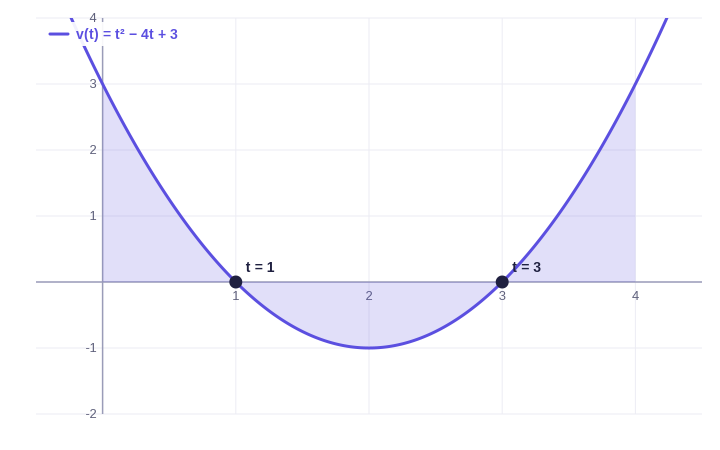
A particle moves along a line with velocity v(t) = t^2 - 4t + 3 meters per second for 0 \le t \le 4. Find (a) its displacement and (b) the total distance it travels.
(a) Displacement. Integrate velocity directly. An antiderivative, using the reverse power rule, is
Then
The particle ends \frac{4}{3} meters to the right of where it started.
(b) Total distance. Now we must account for backward motion. Factor the velocity: v(t) = (t-1)(t-3), which is zero at t = 1 and t = 3. Test a point in each piece:
- On (0, 1): v(0.5) = 1.25 > 0, moving right.
- On (1, 3): v(2) = -1 < 0, moving left.
- On (3, 4): v(3.5) = 1.25 > 0, moving right.
Compute each piece with the same antiderivative. We need F(0) = 0, F(1) = \frac{1}{3} - 2 + 3 = \frac{4}{3}, F(3) = 9 - 18 + 9 = 0 and F(4) = \frac{4}{3}.
Total distance adds the absolute values:
Check: the signed pieces add to \frac{4}{3} - \frac{4}{3} + \frac{4}{3} = \frac{4}{3}, matching part (a). The particle walked 4 meters in total but only ended up \frac{4}{3} meters from home.
Worked example 2: water in a tank
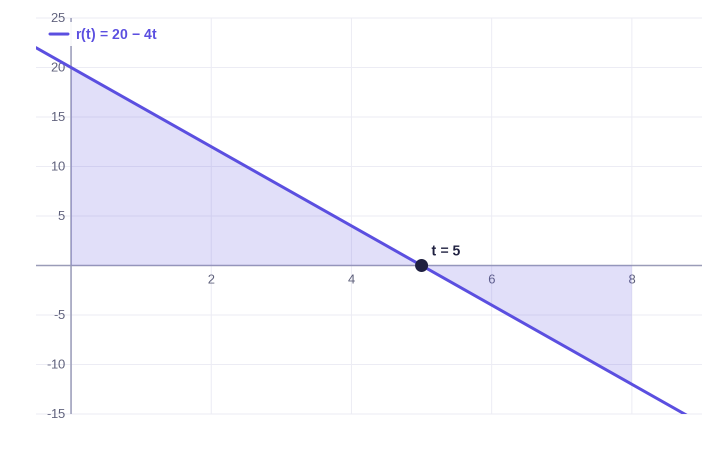
Water flows into a tank at a rate of r(t) = 20 - 4t liters per minute, where t is in minutes. At t = 0 the tank holds 100 liters. How much water is in the tank at t = 8?
Step 1. Identify the rate and the quantity. The rate r(t) is the derivative of the volume V(t). We want V(8), and we know V(0) = 100.
Step 2. Compute the net change.
Step 3. Add the starting amount.
The graph shows what happened. For t < 5 the rate is positive and water flows in; after t = 5 the rate is negative and water drains out. Splitting at t = 5: the inflow is \int_0^5 (20-4t)\,dt = 100 - 50 = 50 liters and the outflow is \int_5^8 (20-4t)\,dt = 32 - 50 = -18 liters. The net change is 50 - 18 = 32, as computed. Notice that the integral handled the draining automatically. You only split the interval when a question asks for total flow in or out, or for the maximum amount.
Tip: the tank holds the most water at t = 5, exactly when the rate switches from positive to negative. At that moment V(5) = 100 + 50 = 150 liters.
Worked example 3: marginal cost
A factory's marginal cost is C'(x) = 50 - 0.04x dollars per unit, where x is the number of units produced. How much does total cost increase when production rises from 100 to 200 units?
Step 1. Set up the integral. Marginal cost is the rate of change of cost with respect to units, so
Step 2. Find an antiderivative. \int (50 - 0.04x)\,dx = 50x - 0.02x^2 + C.
Step 3. Evaluate.
The cost rises by 4400 dollars. Units check: dollars per unit times units gives dollars. Notice that we never needed the fixed cost C(0), because net change only depends on the rate.
Worked example 4: population growth with an exponential rate
A bacteria culture grows at a rate of P'(t) = 200e^{0.1t} bacteria per hour. At t = 0 there are 5000 bacteria. How many are there after 10 hours?
Step 1. Net change. Use \int e^{kt}\,dt = \frac{1}{k}e^{kt} (a quick u-substitution):
Step 2. Add the starting value.
So there are about 8437 bacteria after 10 hours. The exact answer 5000 + 2000(e-1) is perfectly acceptable on most exams.
Why the definite integral is signed
The net change theorem explains why definite integrals count area below the axis as negative. A negative rate means the quantity is decreasing, so that part of the interval should subtract from the total. Geometrically, the integral is area above the axis minus area below the axis.
This is the key difference between net change and total amount. If you want every bit of change to count positively, like distance traveled or total water that passed through a pipe in either direction, integrate the absolute value of the rate. That is the same idea behind always using "top minus bottom" in area between curves: you arrange the integrand so it is never negative.
How to solve net change problems: a 4-step method
- Identify the rate and its units. What quantity is changing, and what is the input variable?
- Decide what is asked. Net change, a final amount, or a total (like distance)?
- Integrate. For net change, integrate the rate over the interval. For a total, find where the rate is zero, split the interval and add absolute values.
- Add the initial value if needed and check the units of your answer.
Common mistakes with net change
- Confusing displacement with distance. \int_a^b v(t)\,dt is displacement. If the question says "total distance traveled," you need \int_a^b \lvert v(t) \rvert\,dt, which means finding where v(t) = 0 and splitting.
- Forgetting the starting amount. The integral gives only the change. If the tank started with 100 liters, the answer is 100 + 32, not 32.
- Integrating the wrong function. If you are given the quantity itself, such as position s(t), you do not integrate it. Net change is just s(b) - s(a). Integrate only when you are given a rate.
- Taking absolute values too early. Writing \lvert \int_a^b v\,dt \rvert is not total distance. In Example 1 it gives \frac{4}{3}, not 4. The absolute value goes on each piece, not on the whole integral.
- Ignoring units. If a rate is in gallons per hour but time is given in minutes, convert first. Your final units should match the quantity, not the rate.
- Treating inflow minus outflow carelessly. When a problem gives separate inflow and outflow rates, the net rate is \text{in}(t) - \text{out}(t). Integrate that difference, or integrate each one and subtract.
Quick reference
| Question asks for | Compute |
|---|---|
| Change in F from a to b | \int_a^b F'(x)\,dx |
| Value of F at time b | F(a) + \int_a^b F'(x)\,dx |
| Displacement | \int_a^b v(t)\,dt |
| Total distance traveled | \int_a^b \lvert v(t) \rvert\,dt |
| Change in velocity | \int_a^b a(t)\,dt |
| Average rate over [a, b] | \frac{1}{b-a}\int_a^b F'(x)\,dx |
For more on why integrals and antiderivatives connect this way, see our guide to the Fundamental Theorem of Calculus, and brush up on antiderivatives and initial value problems, which use the same "start plus change" idea. You can also work through extra definite integral practice problems.
Practice turning rates into answers
Net change problems reward a clear routine: name the rate, check the units, decide between net and total, and remember the starting value. After a handful of velocity, tank and cost problems, that routine becomes automatic, and word problems stop feeling like puzzles. Work through the interactive lesson below, where every answer gets instant feedback and each step is explained when you slip.
Practice it now
Net change and displacement
Solve real problems on this topic with instant feedback, hints and a step-by-step walkthrough for every answer. Free, no sign-up needed to start.
Practice this lesson