Derivative of arccos x: Formula, Proof and Examples
The derivative of arccos x is −1/√(1 − x²). See the proof, why it is the negative of the arcsin derivative, chain rule examples and a graph.
Inverse trig derivatives Updated 2 min read
At a glance
- Derivative
- -\dfrac{1}{\sqrt{1 - x^2}} for -1 < x < 1
- Chain rule form
- \dfrac{d}{dx}\arccos u = -\dfrac{u'}{\sqrt{1 - u^2}}
- Domain of arccos x
- [-1, 1]
- Range of arccos x
- [0, \pi]
- Key identity
- \arcsin x + \arccos x = \frac{\pi}{2}
On this page
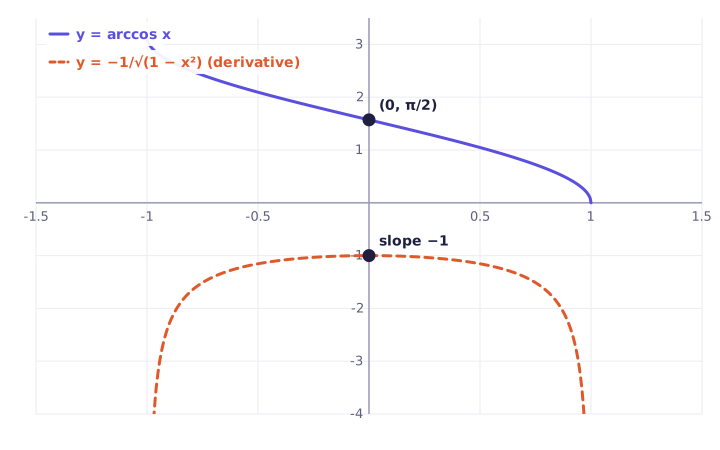
The derivative of \arccos x is -\dfrac{1}{\sqrt{1 - x^2}}. It looks just like the derivative of arcsin x with a minus sign in front, and there is a neat reason for that.
Graph of arccos x and its derivative
Proof of the derivative of arccos x
Let y = \arccos x, so \cos y = x with 0 \le y \le \pi. Use implicit differentiation:
On [0, \pi] sine is never negative, so \sin y = \sqrt{1 - \cos^2 y} = \sqrt{1 - x^2}. That gives
A faster proof using arcsin
For every x in [-1, 1],
Picture a right triangle: if one acute angle has sine x, the other has cosine x, and the two angles add to \frac{\pi}{2}. Differentiate both sides. The right side is a constant, so its derivative is 0:
So the arccos derivative is the arcsin derivative with the sign flipped. This is a good way to remember it.
Chain rule version: derivative of arccos(u)
| Function | Inside u | Derivative |
|---|---|---|
| \arccos(3x) | 3x | -\frac{3}{\sqrt{1 - 9x^2}} |
| \arccos(x^2) | x^2 | -\frac{2x}{\sqrt{1 - x^4}} |
| \arccos(\sqrt{x}) | \sqrt{x} | -\frac{1}{2\sqrt{x}\sqrt{1 - x}} |
| \arccos\!\left(\frac{x}{2}\right) | \frac{x}{2} | -\frac{1}{\sqrt{4 - x^2}} |
Worked examples
Example 1: product rule. For f(x) = x^2\arccos x, the product rule gives
Example 2: slope at a point. At x = \frac{\sqrt{3}}{2}, the slope of \arccos x is
Example 3: tangent line. At x = 0 the curve passes through \left(0, \frac{\pi}{2}\right) with slope -1, so the tangent line is y = \frac{\pi}{2} - x.
Common mistakes
- Dropping the minus sign. It is the only difference from arcsin, and the easiest thing to lose.
- Thinking \cos^{-1} x = \sec x. The reciprocal of cosine is secant. \cos^{-1} is the inverse function.
- Leaving out u'. \frac{d}{dx}\arccos(5x) = -\frac{5}{\sqrt{1 - 25x^2}}, not -\frac{1}{\sqrt{1 - 25x^2}}.
- Using it at x = \pm 1. The tangent is vertical there, so there is no derivative.
You will rarely see -\frac{1}{\sqrt{1 - x^2}} integrated as arccos, since -\arcsin x + C is the same family of answers. See the arccosine function page for the graph and range, and practise with inverse trig derivative problems.
Practice it now
Inverse trig derivatives
Solve real problems on this topic with instant feedback, hints and a step-by-step walkthrough for every answer. Free, no sign-up needed to start.
Practice this lesson