Derivative of arccot x: Formula, Proof and Examples
The derivative of arccot x is −1/(1 + x²). See the proof from cot y = x, the link to arctan, chain rule examples and a graph.
Inverse trig derivatives Updated 2 min read
At a glance
- Derivative
- -\dfrac{1}{1 + x^2} for every real x
- Chain rule form
- \dfrac{d}{dx}\operatorname{arccot} u = -\dfrac{u'}{1 + u^2}
- Domain of arccot x
- all real numbers
- Range of arccot x
- (0, \pi)
- Key identity
- \operatorname{arccot} x = \frac{\pi}{2} - \arctan x
On this page
The derivative of \operatorname{arccot} x is -\dfrac{1}{1 + x^2}. It is the derivative of arctan x with a minus sign, and it holds for every real number.
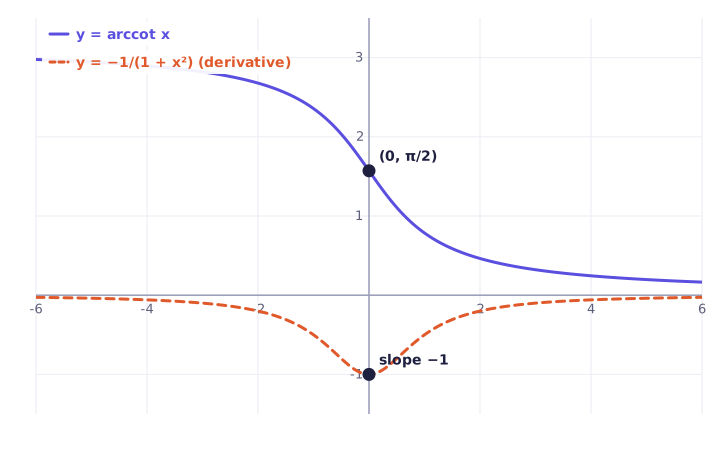
Graph of arccot x and its derivative
Proof from cot y = x
Let y = \operatorname{arccot} x, so \cot y = x with 0 < y < \pi. Differentiate with implicit differentiation, using \frac{d}{dy}\cot y = -\csc^2 y (see the derivative of cot x):
The identity \csc^2 y = 1 + \cot^2 y = 1 + x^2 finishes it:
Proof from arctan
With the range (0, \pi), arccot and arctan are related by
The derivative of the constant \frac{\pi}{2} is 0, so the derivative of arccot is just minus the derivative of arctan. This identity is also how the graph above is drawn.
A note on conventions
Some books and software define \operatorname{arccot} x = \arctan\frac{1}{x}, which has range \left(-\frac{\pi}{2}, 0\right) \cup \left(0, \frac{\pi}{2}\right] and jumps at x = 0. The derivative still comes out the same wherever the function is defined:
So the formula is safe to use either way. Only the values of the function differ.
Chain rule version and examples
| Function | Derivative |
|---|---|
| \operatorname{arccot}(3x) | -\frac{3}{1 + 9x^2} |
| \operatorname{arccot}(x^2) | -\frac{2x}{1 + x^4} |
| \operatorname{arccot}(\ln x) | -\frac{1}{x(1 + \ln^2 x)} |
| \operatorname{arccot}(e^x) | -\frac{e^x}{1 + e^{2x}} |
Worked example. Differentiate f(x) = x\operatorname{arccot} x with the product rule:
At x = 1: \operatorname{arccot} 1 = \frac{\pi}{4}, so f'(1) = \frac{\pi}{4} - \frac{1}{2} \approx 0.285.
Common mistakes
- Writing -\csc^2 x. That is the derivative of \cot x, not of the inverse.
- Losing the minus sign. Arccot decreases, so its slope must be negative.
- Forgetting u'. \operatorname{arccot}(5x) gives -\frac{5}{1 + 25x^2}.
- Assuming the integral needs arccot. Since the derivatives differ only by sign, \int \frac{dx}{1 + x^2} is usually written as \arctan x + C. The answer -\operatorname{arccot} x + C is also correct, because the two differ by a constant.
All six inverse trig derivatives come in pairs: arcsin and arccos, arctan and arccot, arcsec and arccsc. The second of each pair has a minus sign. Practise them with inverse trig derivative problems.
Practice it now
Inverse trig derivatives
Solve real problems on this topic with instant feedback, hints and a step-by-step walkthrough for every answer. Free, no sign-up needed to start.
Practice this lesson