Derivative of arctan x: Formula, Proof and Examples
The derivative of arctan x is 1/(1 + x²). See the proof from tan y = x, chain rule examples like arctan(2x) and arctan(x²), and a graph.
Inverse trig derivatives Updated 2 min read
At a glance
- Derivative
- \dfrac{1}{1 + x^2} for every real x
- Chain rule form
- \dfrac{d}{dx}\arctan u = \dfrac{u'}{1 + u^2}
- Domain of arctan x
- all real numbers
- Range of arctan x
- \left(-\frac{\pi}{2}, \frac{\pi}{2}\right)
- Integral version
- \int \frac{1}{1 + x^2}\,dx = \arctan x + C
On this page
The derivative of \arctan x is \dfrac{1}{1 + x^2}. Unlike arcsin and arccos, there is no square root and no domain restriction: the formula works for every real number.
Graph of arctan x and its derivative
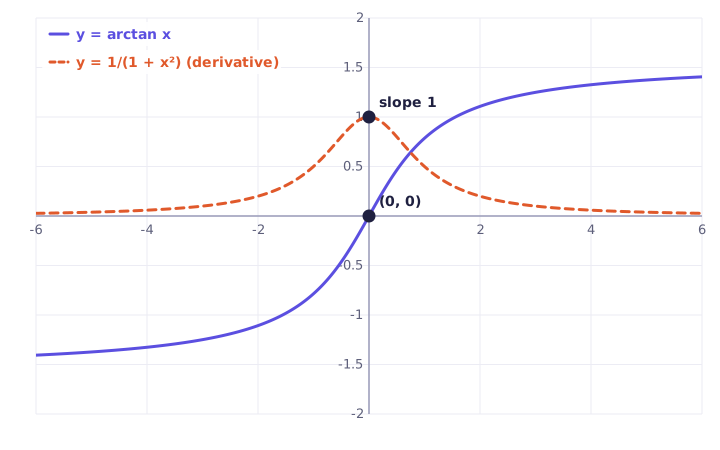
The derivative is a bell-shaped curve that is always positive, so \arctan x always increases. Because the derivative goes to 0 at both ends, the graph flattens out toward \pm\frac{\pi}{2}.
Proof of the derivative of arctan x
Let y = \arctan x, so \tan y = x with -\frac{\pi}{2} < y < \frac{\pi}{2}. Differentiate both sides with implicit differentiation, using the derivative of tan x:
The Pythagorean identity \sec^2 y = 1 + \tan^2 y turns this into x:
No sign choice is needed this time, since 1 + x^2 is always positive.
Chain rule version: derivative of arctan(u)
With the chain rule:
| Function | Inside u | Derivative |
|---|---|---|
| \arctan(2x) | 2x | \frac{2}{1 + 4x^2} |
| \arctan(x^2) | x^2 | \frac{2x}{1 + x^4} |
| \arctan(e^x) | e^x | \frac{e^x}{1 + e^{2x}} |
| \arctan(\sqrt{x}) | \sqrt{x} | \frac{1}{2\sqrt{x}(1 + x)} |
| \arctan\!\left(\frac{x}{a}\right) | \frac{x}{a} | \frac{a}{a^2 + x^2} |
The last row gives the standard integral \int \frac{dx}{a^2 + x^2} = \frac{1}{a}\arctan\frac{x}{a} + C.
Worked examples
Example 1: arctan of 1/x. For x \ne 0,
This is the negative of the arctan derivative, so \arctan x + \arctan\frac{1}{x} is constant on each side of 0. It equals \frac{\pi}{2} for x > 0 and -\frac{\pi}{2} for x < 0.
Example 2: product rule. For f(x) = x\arctan x:
Example 3: tangent line. At x = 1, \arctan 1 = \frac{\pi}{4} and the slope is \frac{1}{2}. The tangent line is y = \frac{\pi}{4} + \frac{1}{2}(x - 1).
Common mistakes
- Writing \sec^2 x. That is the derivative of \tan x, not of \arctan x.
- Writing \frac{1}{1 + x}. The x is squared. Check: at x = 1 the slope must be \frac{1}{2}.
- Forgetting to square the whole inside. \arctan(3x) gives 1 + 9x^2, not 1 + 3x^2.
- Mixing it up with \frac{1}{\tan x} = \cot x. \tan^{-1} x is the inverse function.
Read backwards, this derivative gives the integral of 1/(1 + x²). The integral of arctan x itself uses integration by parts. See also the arctangent function and inverse trig derivative problems.
Practice it now
Inverse trig derivatives
Solve real problems on this topic with instant feedback, hints and a step-by-step walkthrough for every answer. Free, no sign-up needed to start.
Practice this lesson